
Geotextile Canal Lining: Engineer's Selection Guide
Quick Summary
Geotextile systems for canal lining range from simple filter blankets to grout-filled mattresses providing full seepage control and scour resistance. This guide explains every geotextile canal lining option, the design basis for each, and how to select the right system.
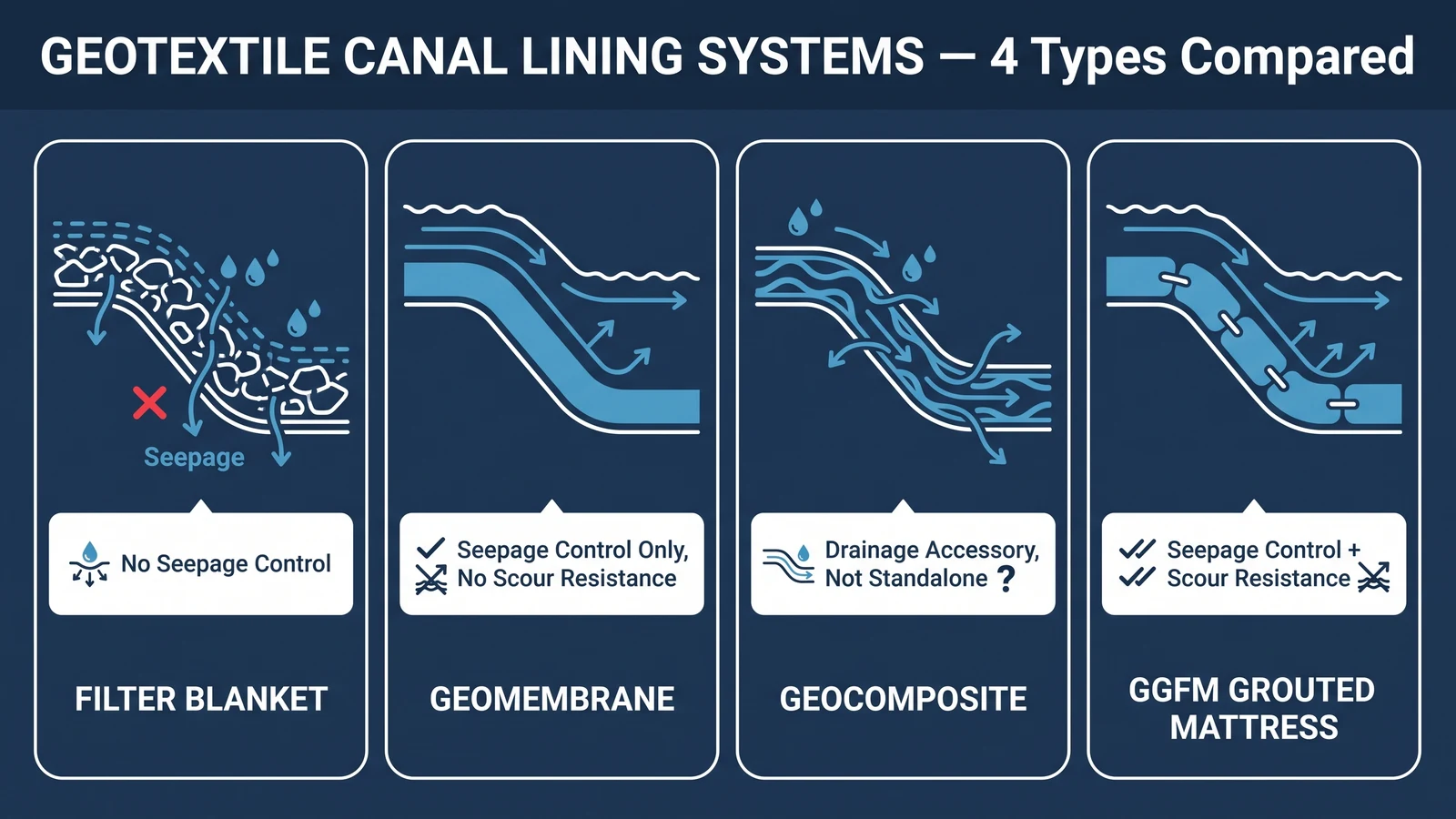
Quick Answer: "Geotextile canal lining" covers four distinct systems: (1) geotextile filter blanket beneath riprap — no seepage control, just erosion protection; (2) geomembrane — full seepage control, no scour resistance; (3) geocomposite — combined filter and drainage layer; and (4) grout-filled geotextile mattress (GGFM) — combined seepage control and scour resistance in one product. For most irrigation main canals with flow velocity above 1.5 m/s, GGFM is the only single-product system that addresses both design requirements. This guide explains when each system is appropriate.
"Geotextile" is a broad term — it describes any permeable polymer fabric used in geotechnical or civil engineering applications. In canal lining, the term is used for at least four distinct system types that perform very differently. Specifying "geotextile canal lining" without further qualification in a tender document will get you multiple products that are not interchangeable. This guide defines each type and provides the selection criteria.
For cost and performance comparison across all canal lining types including concrete, see Canal Lining Methods: Complete Comparison. For seepage control ROI analysis, see Canal Seepage Control: Methods, Costs, and ROI.
The Four Geotextile Canal Lining Systems
Type 1: Geotextile Filter Blanket (Under Riprap)
A non-woven or woven geotextile laid on the prepared subgrade before placing riprap or gabion armour. Function: prevents fine subgrade particles from migrating upward through the voids in the overlying stone (piping). Provides no seepage control — water still passes freely through the permeable riprap and geotextile into the subgrade. Provides no scour resistance on its own — the overlying riprap provides the scour resistance. This is the simplest and lowest-cost geotextile application; it is not a seepage control measure.
Type 2: Geomembrane (HDPE / LLDPE)
A continuous impermeable polymer sheet deployed over the subgrade and seam-welded into a monolithic barrier. Provides excellent seepage control (95–99% reduction) but zero scour resistance. Exposed on canal slopes, the membrane must be protected by a cover layer — riprap, concrete slab, or grouted mattress — adding $30–$60/m² to installed cost. On flat canal inverts with low flow velocity (<1.0 m/s), geomembrane without cover can be specified, ballasted by the water column alone. For a full comparison, see Grouted Mattress vs Geomembrane.
Type 3: Geocomposite (Drainage Layer + Filter)
A factory-bonded combination of a non-woven geotextile filter (one or both faces) and an internal drainage core (geonet or cuspated HDPE). Used beneath geomembrane on reservoir upstream faces and in pavement drainage applications. In canal lining, geocomposites are sometimes specified as a drainage layer beneath impermeable linings to intercept and manage seepage pressure reversal during drawdown. Not a lining system on its own — an accessory to a primary lining system.
Type 4: Grout-Filled Geotextile Mattress (GGFM)
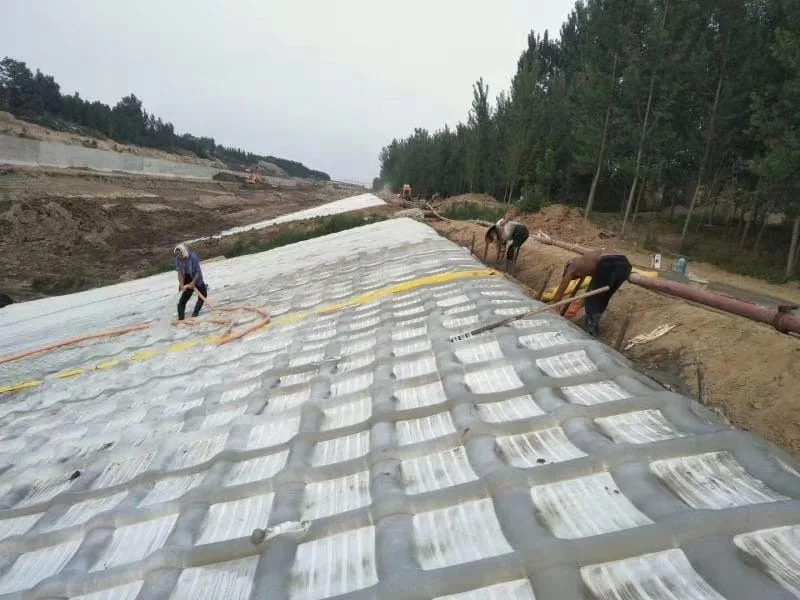
GGFM is a double-layer woven geotextile fabric pumped on-site with cement grout to form articulated concrete armour. It simultaneously provides seepage control (impermeable woven face) and scour resistance (concrete-hard surface, up to 6.0 m/s). Complies with GRI GT16. The only single-product system that addresses both design requirements for high-velocity irrigation canals. Available in standard (impermeable), filter point (drainage), and vegetated variants.
Design Requirements by Canal Type
| Canal Type | Flow Velocity | Seepage Control? | Recommended System |
|---|---|---|---|
| Large irrigation main (>10 m³/s) | > 2.0 m/s | Yes | GGFM 100–150 mm |
| Medium canal (2–10 m³/s) | 1.0–2.0 m/s | Yes | GGFM 100 mm or concrete + geomembrane |
| Small lateral (<2 m³/s) | < 1.5 m/s | Yes | Geomembrane (flat invert) + GGFM 75 mm (slopes) |
| Drainage/flood channel | 1.0–4.0 m/s | No | Geotextile filter + riprap, or GGFM for high velocity |
| Ecological canal | < 1.5 m/s | Partial | Vegetated GGFM |
Geotextile Fabric Specifications: What Matters
The geotextile fabric in a GGFM system is the primary structural component — it holds the grout in place during injection and curing, and provides the tensile skin that holds the cured concrete layer together. The fabric specification defines product quality.
| Property | GRI GT16 Minimum | Why It Matters |
|---|---|---|
| Polymer type | Polypropylene (PP) or polyester (PET) | PP preferred — alkali-resistant (concrete pH 12+); PET degrades in high-pH environments |
| Weave type | Woven (not non-woven) | Woven fabric provides the tensile strength; non-woven is too weak for grout pressures |
| Grab tensile strength | ≥ 1,200 N (ASTM D4632) | Fabric must resist installation tension and pump pressure without tearing |
| CBR puncture resistance | ≥ 4,500 N (ASTM D6241) | Fabric must resist puncture from subgrade stone during placement |
| UV stabilisation | ≥ 70% tensile retained at 500 hr (ASTM D4355) | Fabric is exposed to UV during installation; must not degrade before grouting |
Filter Criteria: Does GGFM Need a Separate Filter?
In most canal lining applications, the GGFM woven fabric itself serves as the geotextile filter layer between the subgrade and the overlying concrete — this is one of the key design advantages. A separate filter geotextile is required only where the subgrade is gap-graded or fine-grained enough that the GGFM fabric's apparent opening size (AOS) does not satisfy the filter retention criterion.
Check the filter criterion: D85 (subgrade) ÷ AOS (fabric) ≥ 1.0 for retention. If this ratio is less than 1.0, the subgrade particle D85 is smaller than the fabric opening — fine particles can migrate through, triggering piping. In this case, add a 150 g/m² non-woven geotextile filter beneath the GGFM. Your geotechnical engineer should confirm this calculation using the project soil particle size distribution data.
Further reading: The FAO Land and Water Division publishes irrigation canal seepage and lining guidance for developing-country irrigation schemes. The International Commission on Irrigation and Drainage (ICID) maintains technical papers on geosynthetic canal lining performance.
Frequently Asked Questions
Is geotextile canal lining the same as grouted mattress?
Not necessarily — "geotextile canal lining" describes any of the four systems above. Grouted mattress (GGFM) is the most capable system within the geotextile family, providing both seepage control and scour resistance. When specifying, always state the exact system type: "grout-filled geotextile mattress to GRI GT16" rather than "geotextile lining" to avoid ambiguity in tendering.
Can I use a non-woven geotextile as a canal lining?
A non-woven geotextile alone is not a canal lining — it has no scour resistance and negligible seepage control. It is used as a filter layer beneath riprap or as a separator beneath geomembrane. Do not specify non-woven geotextile as the primary canal lining on any hydraulic application.
What is the longest-lasting geotextile canal lining?
GGFM (grouted mattress) — the polypropylene fabric is protected from UV by the cured concrete immediately after installation, and the concrete core has effectively unlimited life in a submerged environment. Design life is quoted at 50+ years based on installations dating to the 1980s still in service. Geomembrane has a theoretical design life of 100 years buried but 30–50 years in exposed canal applications where UV exposure, wave loading, and maintenance traffic reduce longevity.
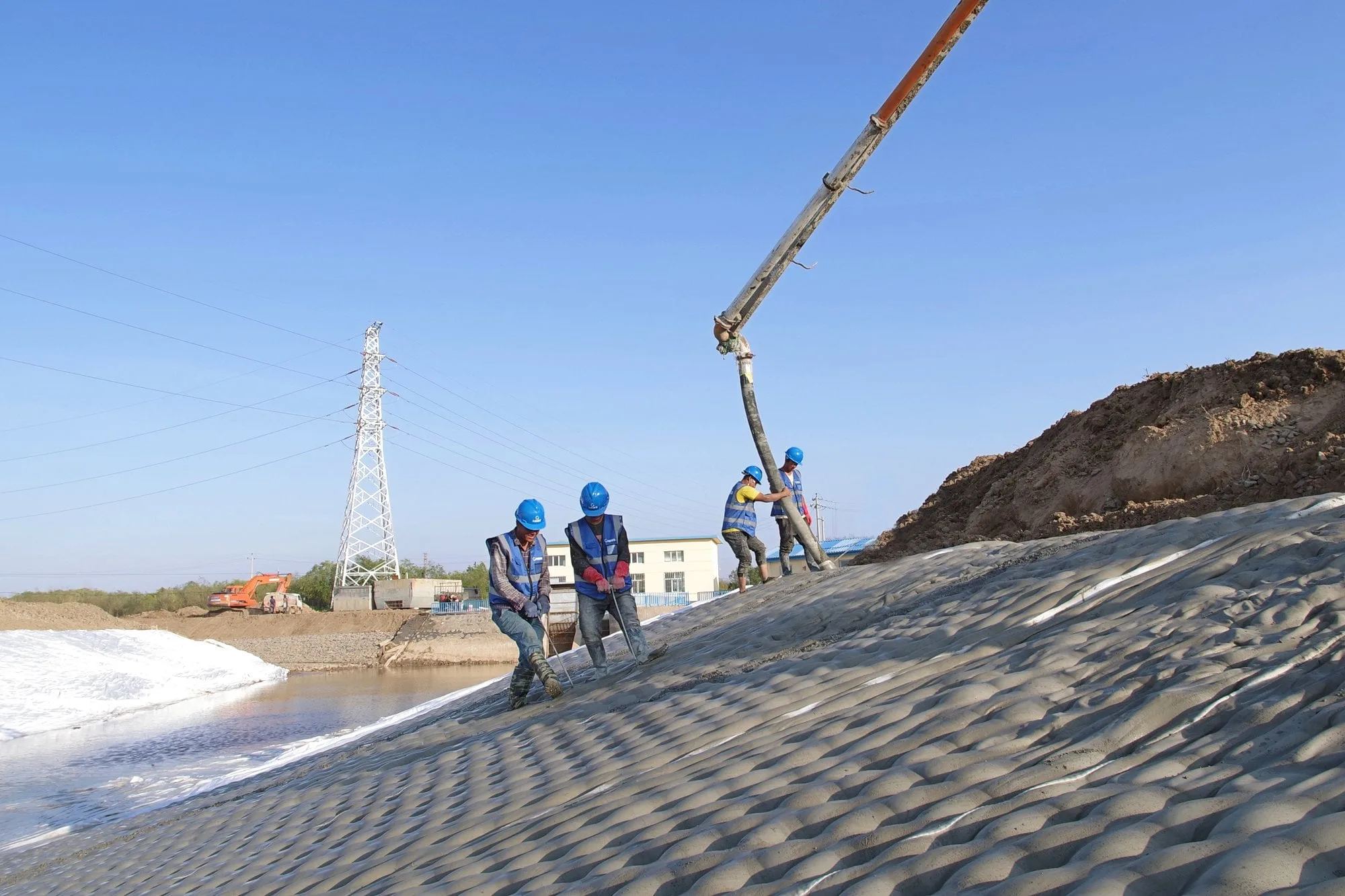
HydroBase manufactures GRI GT16 GGFM in standard, filter point, and vegetated variants for irrigation canals across 30+ countries. Send us your canal design parameters — velocity, slope gradient, subgrade type — and our engineering team will specify the correct geotextile lining system within 48 hours.
HydroBase Technical Team
HydroBase manufactures grouted mattresses (GRI GT16 compliant) in China and delivers to 30+ countries. Our engineering team provides specification support, grout mix design, and installation guidance.
About HydroBaseMore Articles
View all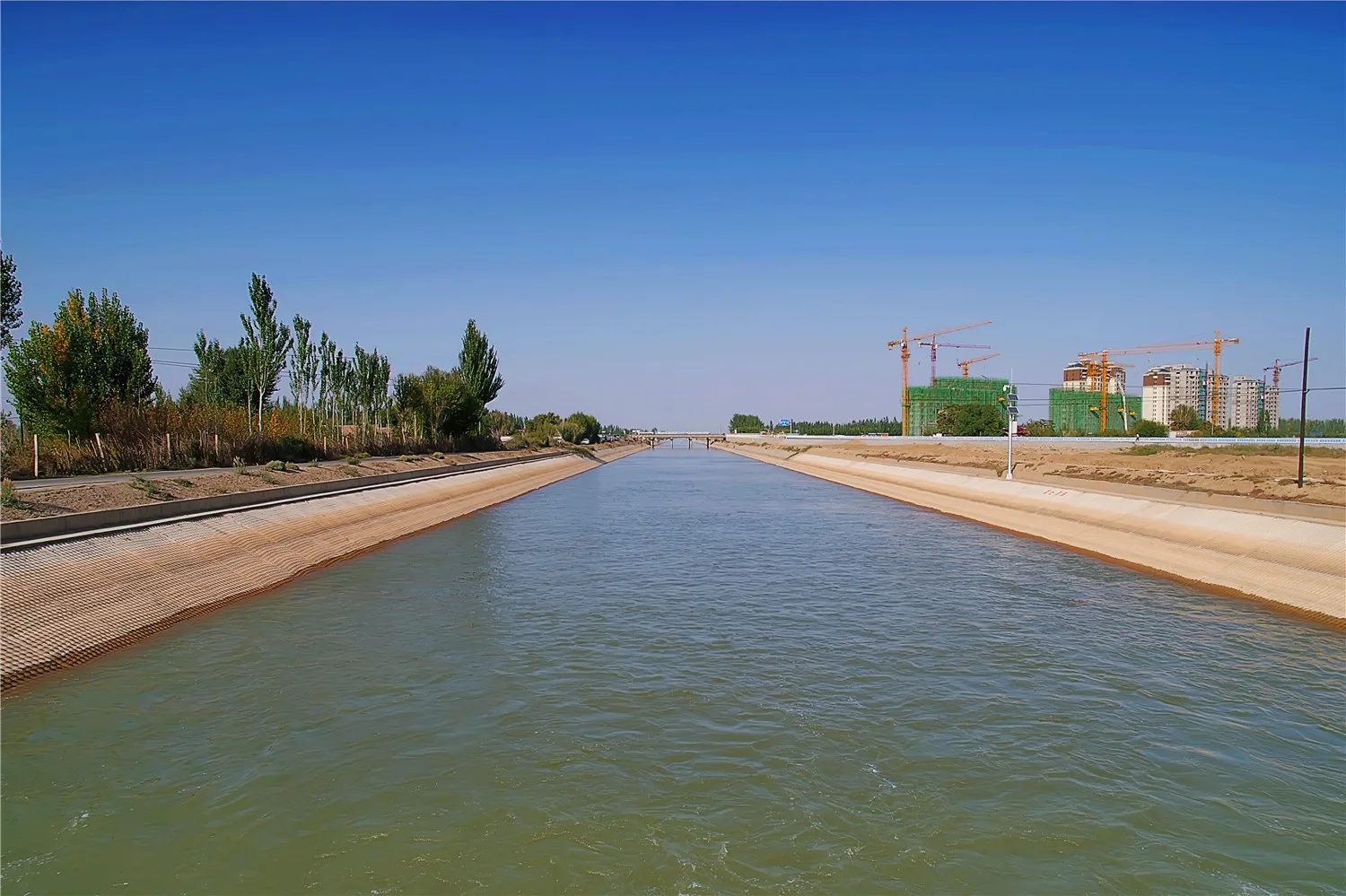
Grouted Mattress Case Studies: 5 Projects, Real Data
Five real grouted mattress installations across canal lining, river bank protection, coastal revetment, reservoir lining, and bridge pier scour — with actual project areas, design parameters, installation programmes, and post-installation performance data.
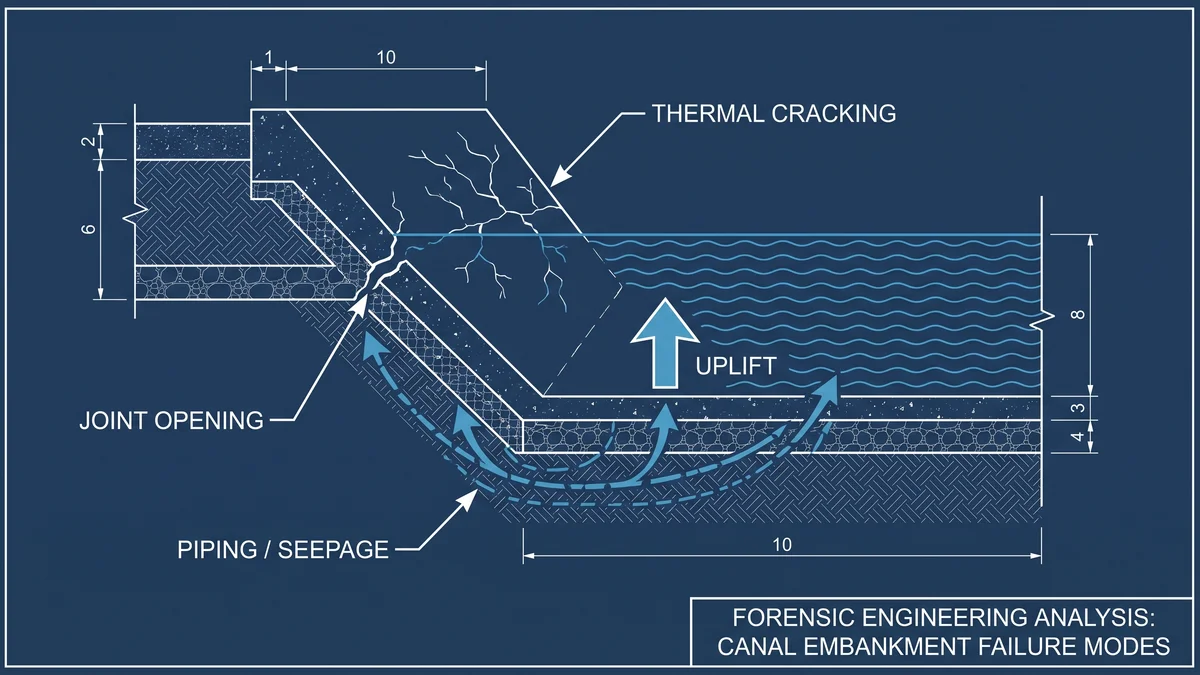
Canal Lining Failure: 7 Causes and How to Prevent Them
Canal lining failures cost irrigation authorities billions annually in emergency repairs and lost water. This forensic guide identifies the 7 most common failure causes — from joint failure to uplift — and explains how to prevent each through better specification and installation.
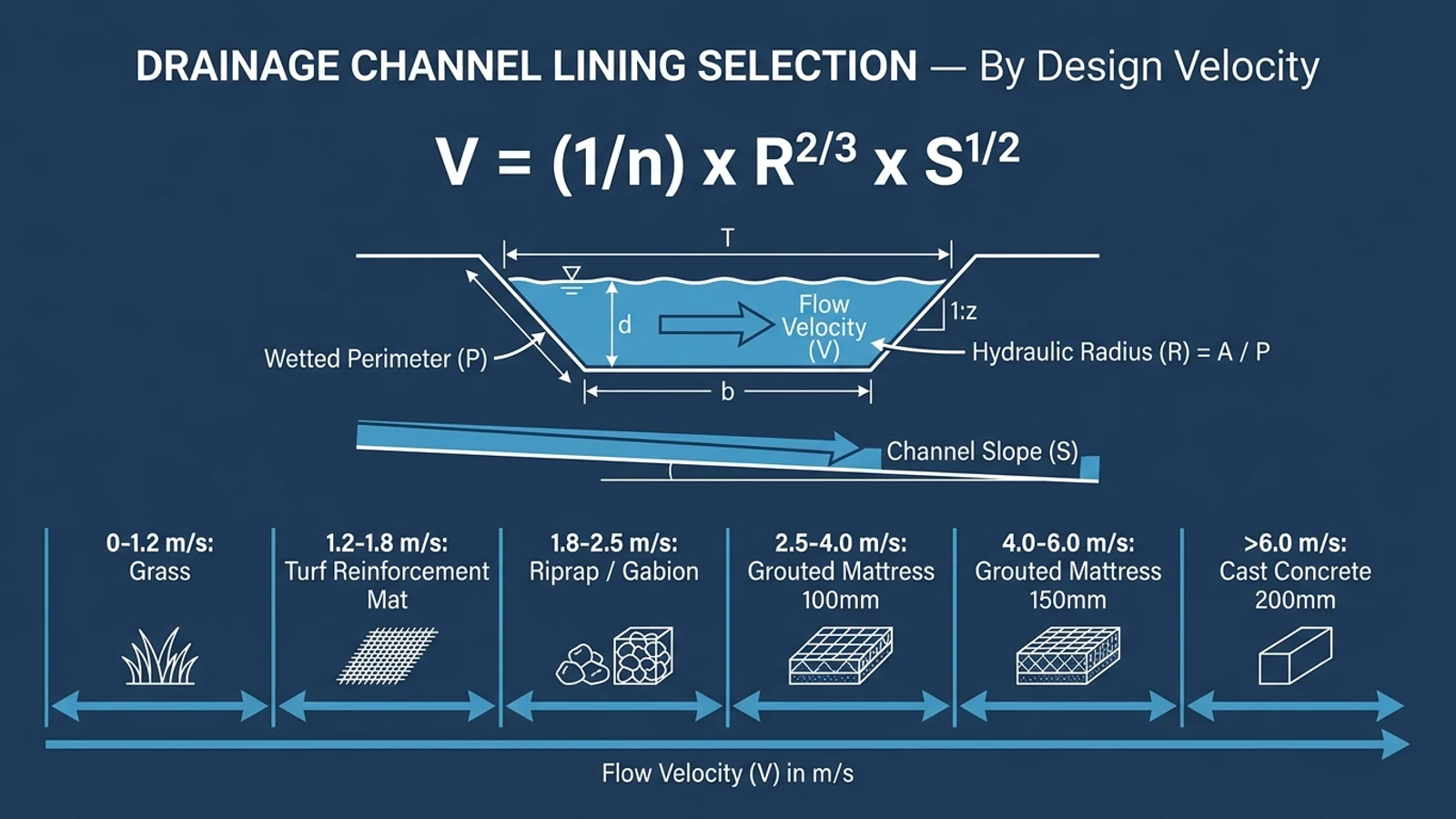
Drainage Channel Lining: Road and Infrastructure Guide
Drainage channels alongside roads, railways, and industrial sites carry high-velocity storm runoff that erodes unlined channels within seasons. This guide covers lining selection, hydraulic design, and installation for roadside drainage channels.
HydroBase - China Manufacturer
Ready to Specify Grouted Mattress?
GRI GT16 compliant products, factory test reports included. Engineering support at no cost. 48-hour response.