
DOT Articulated Concrete Block Specification: How Approval and Alternates Work
Quick Summary
State DOT specifications for articulating concrete block usually work through standard drawings and approved product lists. This guide explains the general process and how an alternate product is proposed.
State departments of transportation commonly specify articulating concrete block (ACB) through standard index drawings and an approved or qualified product list, rather than an open performance specification. A different product, such as a grouted mattress, can only be proposed where the contract allows an equal or approved alternate, and the reviewing engineer decides. This guide is general. Always read the specific state's current documents.
ACB is articulating concrete block, a system of precast units connected by cable or geotextile. An index drawing is a standard drawing that a DOT references by number in project documents. An APL (approved product list) is a register of products a DOT has pre-approved for an index category. Names vary by state, and this guide does not state any one state's requirements.
State DOT erosion control specifications are more procedurally rigid than a typical private civil engineering specification, because they support a competitive bid across many contractors and products. Understanding how the approval process works, rather than the performance requirement alone, is often the difference between a smooth substitution and a rejected alternate.
How DOT Index Drawings Work
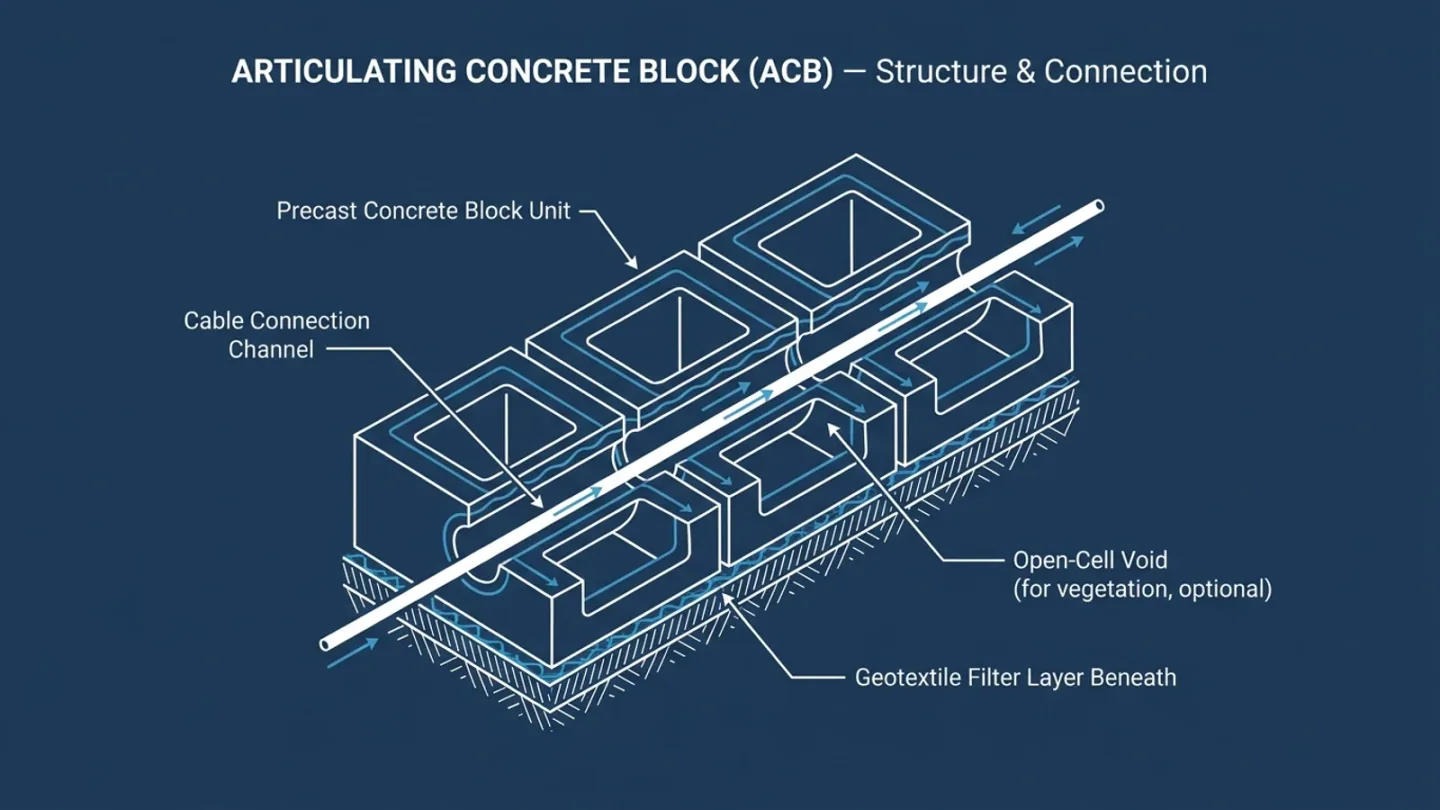
Many state DOTs maintain standard drawings for erosion control systems, referenced by number in project drawings and specifications. These typically show a generic cross-section and state minimum performance criteria, such as a hydraulic rating, block thickness and connection method, that any qualifying product must meet, rather than naming a specific manufacturer. The exact criteria and values are in each state's current documents. See Articulating Concrete Block: Types, Specifications for the underlying product comparison.
Approved / Qualified Product Lists
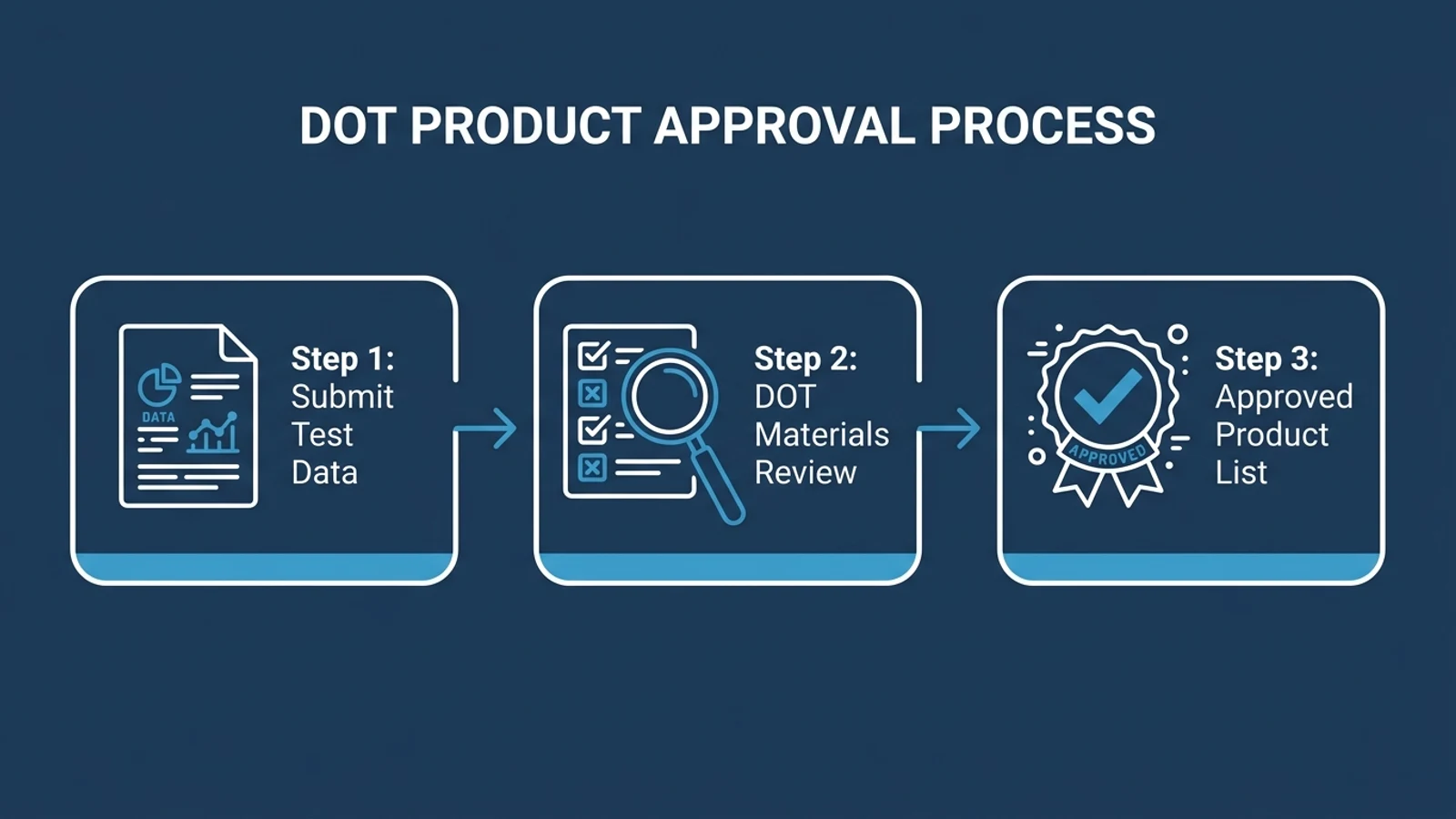
Alongside index drawings, many DOTs maintain an approved product list (APL) or qualified products list (QPL): a register of specific products that have already passed the required review for that category. Being listed speeds project approval, since the engineer can specify "any listed product meeting the index" rather than reviewing each submittal from scratch.
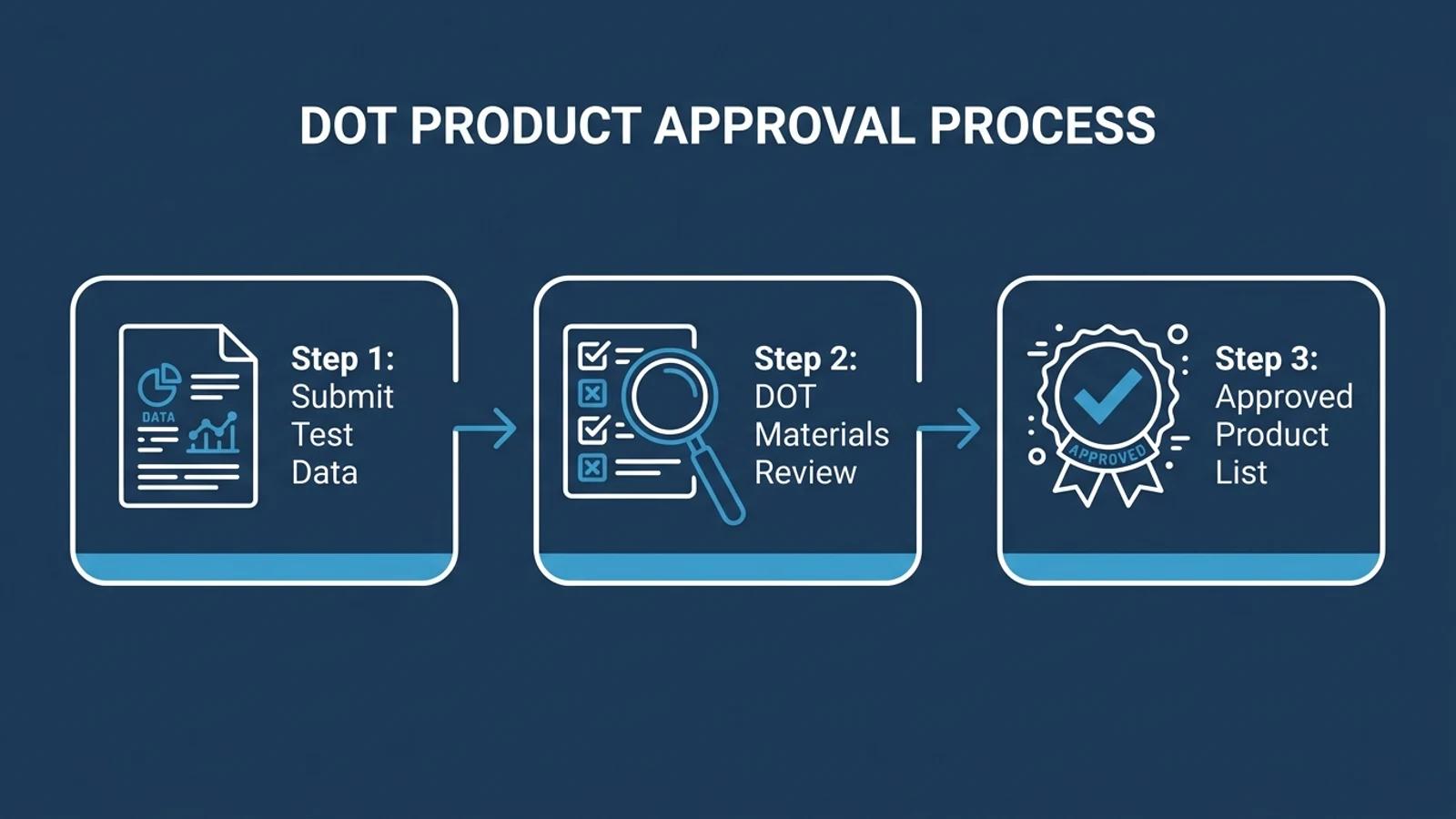
Getting a new product, or a different product category, onto or accepted alongside a list usually involves:
- Test data against the DOT's stated performance criteria, produced as that DOT requires
- A formal submittal to the DOT's materials or geotechnical office, following its submission process
- In some cases, a period of monitored field trial installation before full listing
Specifying Grouted Mattress as a DOT Project Alternative
Where a project specification permits an "equal or approved alternate", grouted mattress can be proposed against an ACB index drawing. The proposal has to show, with the DOT's own criteria and test methods, that the product meets the hydraulic and structural requirements of the index. This is a project-by-project submittal, not a blanket listing, and it needs early engagement with the reviewing engineer rather than a late substitution request.
It helps to be clear about what GRI GT16 contributes. It is a manufacturing quality control specification for the geotextile fabric. It says nothing about hydraulic performance such as velocity resistance, so it cannot be offered as evidence that a mattress matches an ACB index rating. Hydraulic performance has to be shown through the design method and test data the DOT accepts.
| Requirement | Typical DOT ACB Index | Grouted Mattress Submittal |
|---|---|---|
| Hydraulic rating | Stated by the index class, with the DOT's own test basis | Design basis for the selected thickness, shown against the index criteria |
| Filter layer | Usually a separate geotextile beneath the units | Explain how the fabric and any separator meet the filter design |
| Test documentation | Per DOT-specified test methods | Test reports for the methods the DOT names, plus fabric documents the supplier can provide for your order |
What Goes Into a Substitution Submittal?
- The index drawing number and the criteria it states: hydraulic class, thickness, connection method.
- A comparison of the proposed product against each criterion, with the supporting test reports.
- Installation method statement, including how the system is placed, grouted and cured.
- Product data and, where requested, references to comparable installations.
- A statement of how the fabric filter or separator replaces the separate layer the ACB index calls for.
Why Are Alternates Rejected?
Most rejections come from process, not performance: the request arrives after bids close, the submittal omits a criterion in the index, or the test documentation is out of date or does not use the methods the DOT names. A submittal that maps each index requirement to a specific piece of evidence is easy to review, and one that makes the reviewer search is not.
How Should a Manufacturer Plan the Timeline?
Allow generous time for a new-product submittal and start before any specific bid date. Where a field trial is required, plan for monitored installation as part of the process. Project-specific alternates are usually quicker than full list approval, so successful alternates can serve as evidence for later listing.
What Should a Substitution Letter Cover?
- Identify the contract, the index drawing and the item being substituted.
- State the proposed product and why it is equal or better against each index criterion.
- Attach the test reports and laboratory documentation.
- Describe installation, curing and quality control, including grout cylinder testing and how test records match the delivered material.
- Offer a meeting with the reviewing engineer before the bid date.
Which Questions Should You Ask the Reviewer Early?
- Does the project specification permit equal or approved alternates, and by what deadline?
- Which test methods and report formats does the department require?
- Is a field trial or a monitored installation expected for a new product category?
- Are there warranty or installer qualification requirements beyond the material standard?
What to Confirm Before You Submit an Alternate
A substitution package is easier to approve when the groundwork is done early. Before you draft the letter, confirm the following with the project documents and the reviewing office:
- The contract allows an equal or approved alternate, and the closing date for requests.
- The exact index drawing and the class or rating the project calls for.
- The test methods and report formats the department names, so your data matches them.
- Whether the project engineer wants a design calculation, a test report or both for hydraulic performance.
- Whether a field trial, installer qualification or warranty term applies beyond the material standard.
- Who at the department decides, and whether that person wants a meeting first.
Keep the answers in a short file with dates and names. If the reviewer later asks why a choice was made, that file saves time.
How to Run the Early Meeting With the Reviewer
An early meeting works best when it is short and prepared. Bring the index drawing, a one-page comparison of each index criterion against the proposed product, a draft method statement and a list of open questions. Ask the reviewer which criteria they treat as fixed and which they treat as flexible, and which evidence they expect for each.
Take notes, then send a written summary within a day or two so that the reviewer can correct any misunderstanding while it is fresh. Treat anything said in the meeting as informal until it appears in writing from the department. If the reviewer signals that the product category is outside the index, ask what route, if any, the department offers, and do not argue the point in the room. The aim is to leave knowing what the submittal must contain and by when.
Limits of This Guide
This guide does not reproduce any state's index values, list contents or deadlines, because those change and differ by state. It does not claim that any state accepts grouted mattress. Use the DOT's current standard plans and specifications, and confirm requirements with its reviewing engineer.
What This Means When You Order Grouted Mattress for a DOT Project
If a reviewer allows a grouted mattress alternate, the supplier side starts from your project documents. Prepare the index drawing number, the hydraulic class or design velocity the index calls for, the area, the project location and the drawings, plus the reviewer's list of required test methods. These let the engineering team work out which thickness corresponds to the design velocity, within the range of 75 to 200 mm and ratings of 2.5 m/s to 6.0 m/s.
Approval rests with the department, so nothing here promises it. For planning, stock sizes dispatch in 3 to 5 days, and custom-size panels take 5 to 7 working days to produce at the factory in Inner Mongolia, China. Pricing is by project. Send your documents through the contact page; the engineering team replies within 48 hours.
Sources and Further Reading
Open each document to confirm its current edition and scope before you rely on it.
- GRI GT16: The manufacturing quality control specification for the geotextile fabric used in grout-filled mattress. Checked 2026-10-24 (link and title).
- Geosynthetic Institute specifications index: Index of GRI test and specification documents. Checked 2026-10-24 (link and title).
- ASTM geotechnical engineering standards: Catalogue page for ASTM geotechnical standards. Checked 2026-10-24 (link and title).
- CEN EN 13254, geotextiles for reservoirs and dams: European standard for geotextile characteristics in reservoirs and dams. Checked 2026-10-24 (link and title).
- Caltrans, Local Assistance Erosion Control Design: Caltrans erosion control design resources. Checked 2026-10-24 (link and title).
Frequently Asked Questions
Does GRI GT16 satisfy a state DOT requirement for erosion control?
No, not on its own. GRI GT16 is a manufacturing quality control specification for the geotextile fabric. A DOT index drawing may require hydraulic performance, installation method, warranty terms and specific test methods, and these have to be shown separately in the submittal package.
How long does DOT product approval take?
It varies by state and by whether a field trial is required. Plan for a long lead time on a new-product submittal and start well ahead of any specific bid date, rather than trying to complete approval within one project's timeline. Ask the DOT's materials office for its current process.
Is a project-specific alternate easier than full list approval?
Generally yes in terms of process. A project-specific "equal or approved alternate" submittal only has to satisfy the reviewing engineer for that one contract, whereas list approval is a standing approval that applies to future projects. Manufacturers pursuing repeat work in a state sometimes seek listing after several project approvals.
Send the index drawing, design velocity and project location to our engineering team, and we will reply within 48 hours. Contact the engineering team.
HydroBase Technical Team
HydroBase manufactures grouted mattresses (GRI GT16 compliant) in China and delivers to 30+ countries. Our engineering team provides specification support, grout mix design, and installation guidance.
About HydroBaseMore Articles
View all
Streambank Erosion Control: Methods and Selection Guide
Streambank erosion control spans bioengineering to full structural armor. This guide compares the methods by stream power, site tolerance, permitting and maintenance.
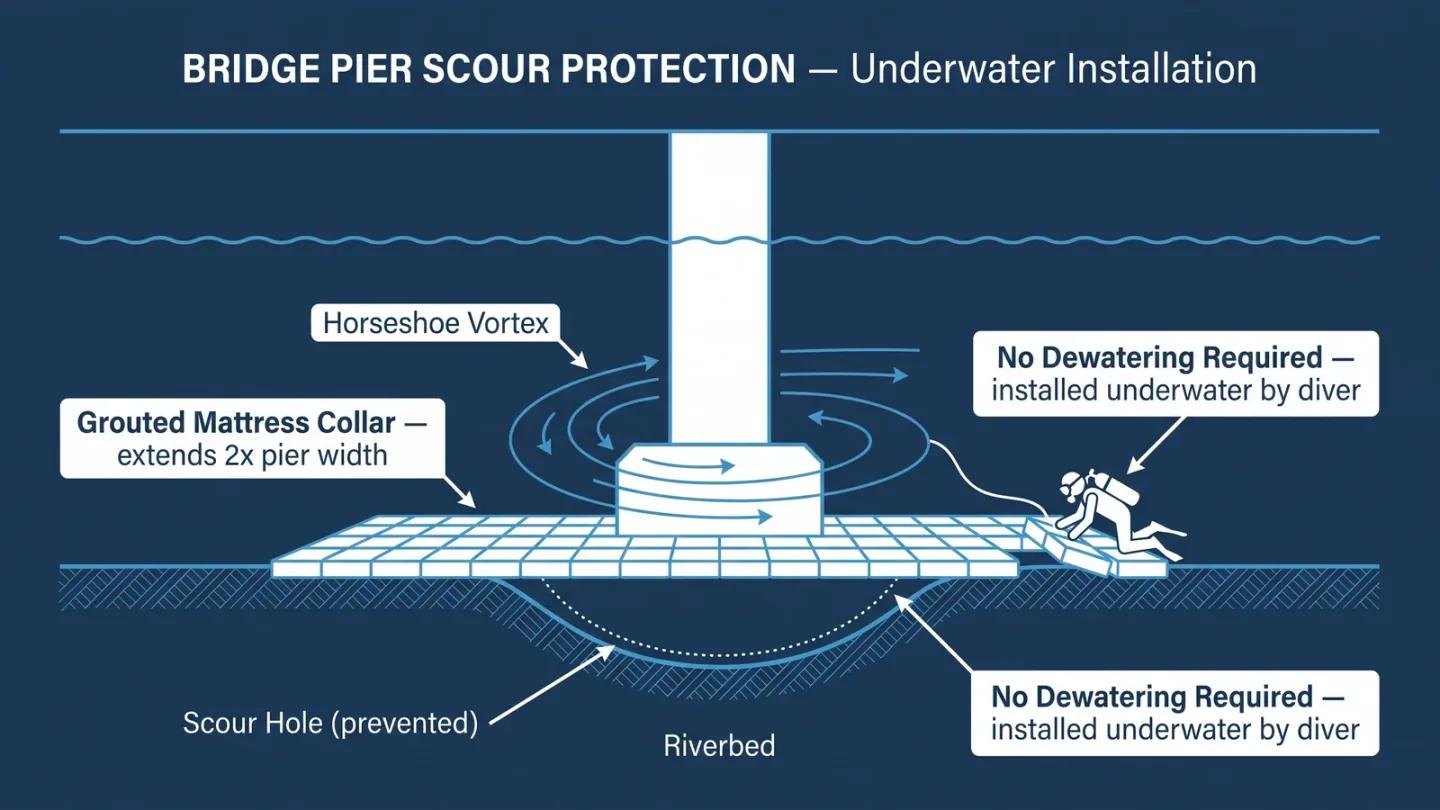
Scour Countermeasures: A Design Guide Beyond Riprap
Riprap is a common default scour countermeasure, but not always the right one. This guide compares the main scour countermeasures using the HEC-23 categories.
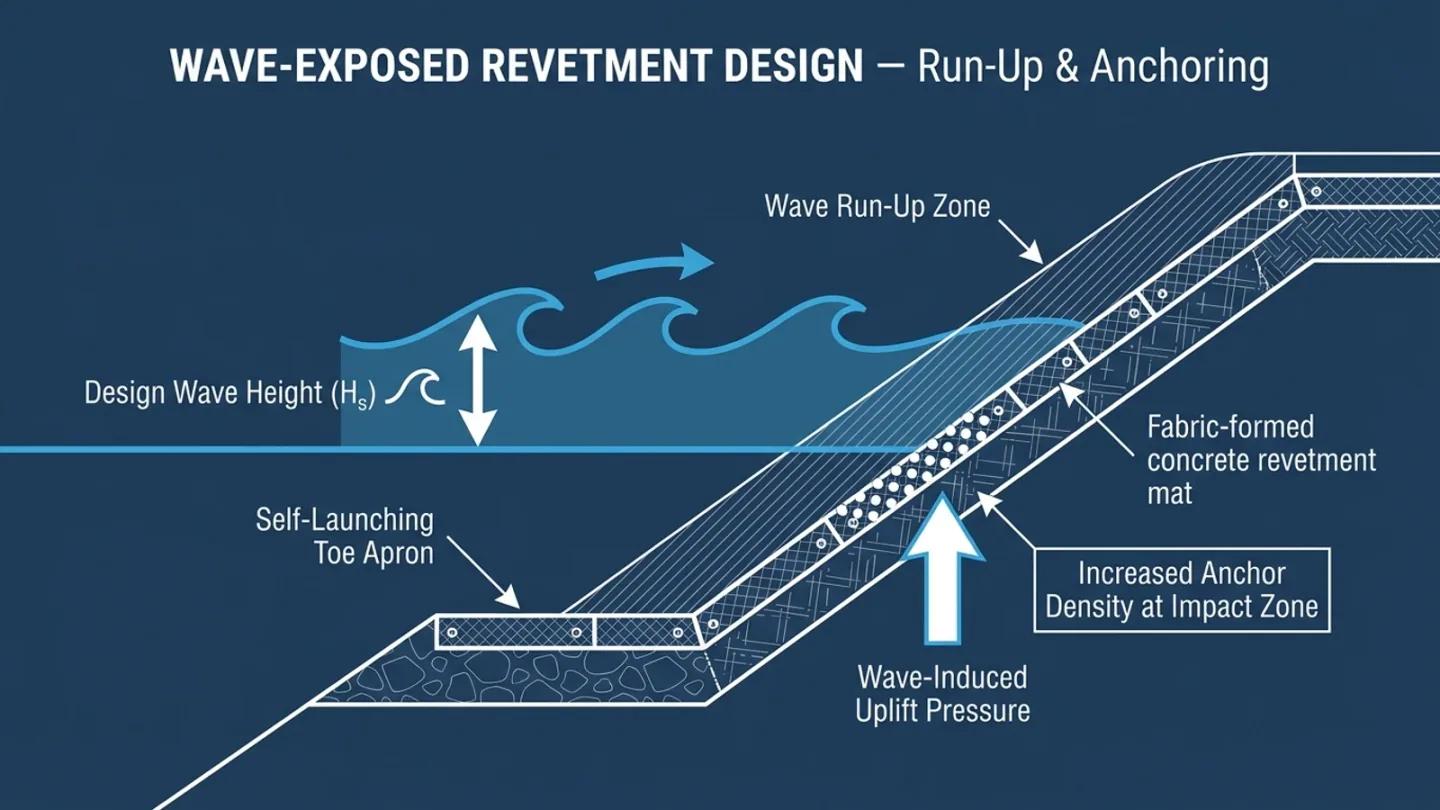
Fabric-Formed Concrete Revetment Mat: Design and Specification Guide
Fabric-formed concrete revetment mat is designed differently for wave-exposed faces than for river current. This guide covers thickness selection by rated velocity, wave design differences and toe detail.
HydroBase - China Manufacturer
Ready to Specify Grouted Mattress?
GRI GT16 compliant products, factory test reports included. Engineering support at no cost. 48-hour response.