
Scour Countermeasures: A Design Guide Beyond Riprap
Quick Summary
Riprap is a common default scour countermeasure, but not always the right one. This guide compares the main scour countermeasures using the HEC-23 categories.
HEC-23 (Bridge Scour and Stream Instability Countermeasures) groups scour countermeasures into categories: riprap and rock variants, articulated concrete block or grouted mattress systems, gabion mattresses, and structural countermeasures such as sheet pile cutoff walls and grade control. Riprap is a common default because it is familiar, but it is not the best fit at every pier geometry, flow condition and debris risk level.
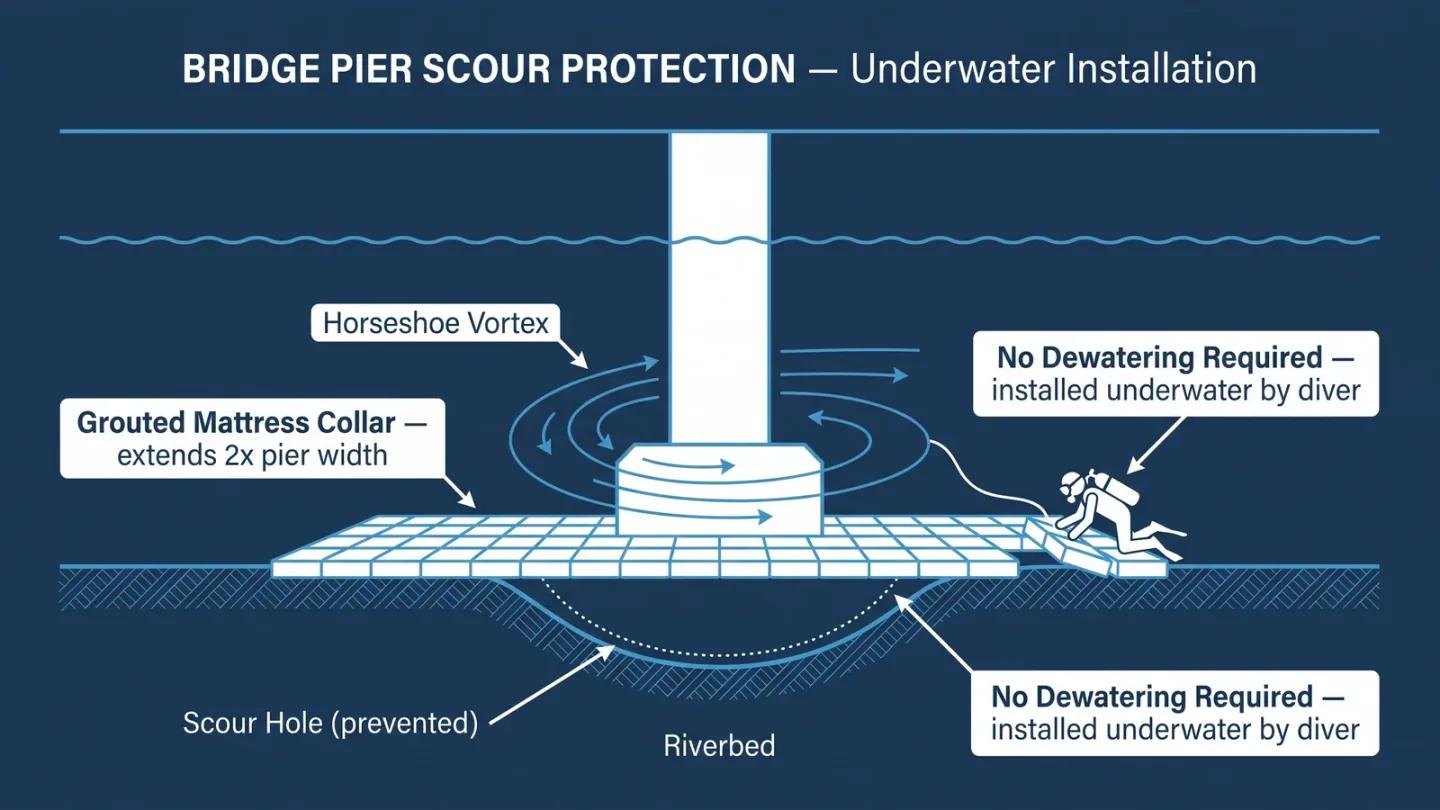
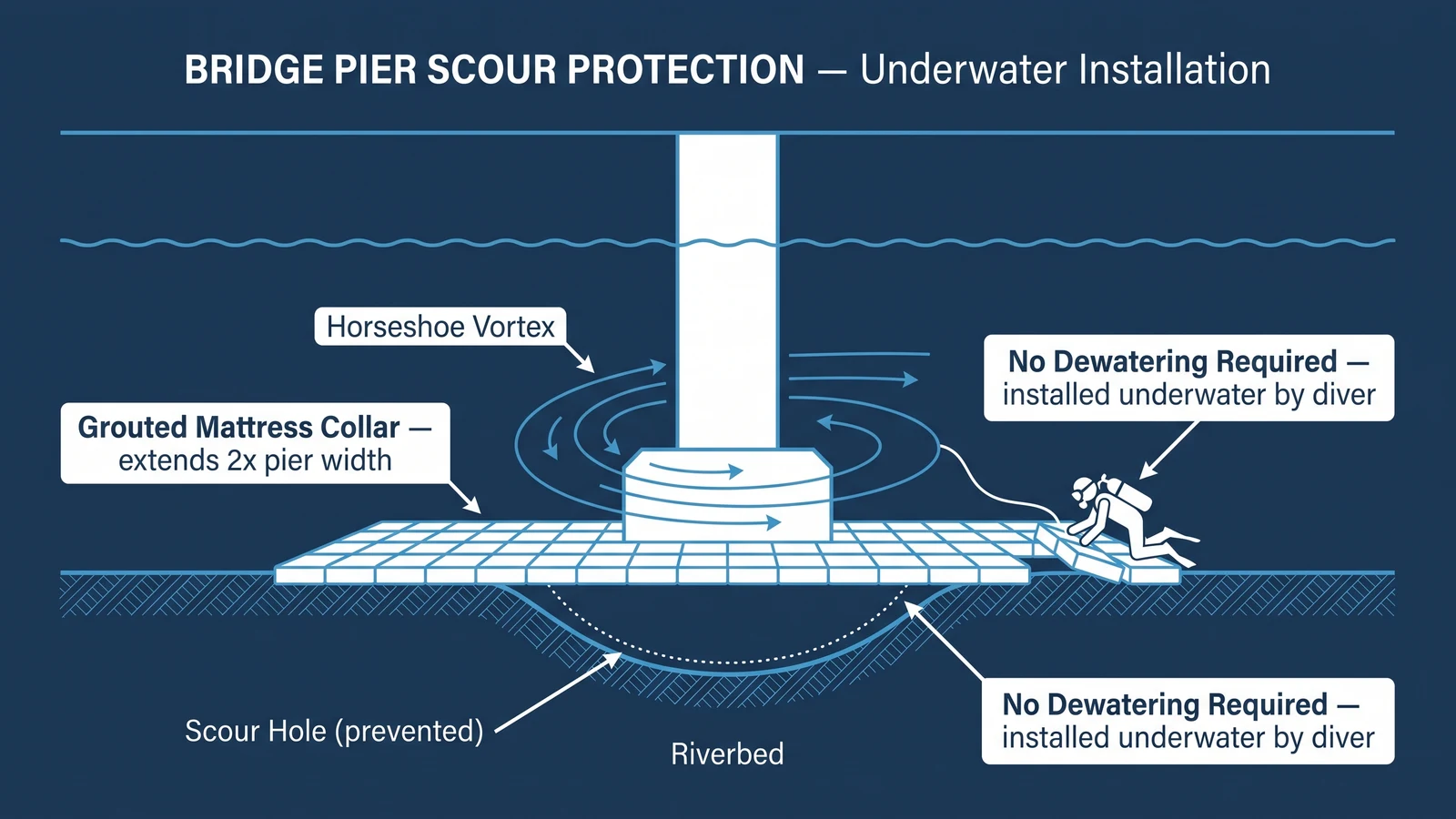
A scour countermeasure is a measure that prevents or limits scour at a structure. The horseshoe vortex is the flow structure that wraps around a pier base and drives local scour. HEC-23 is the FHWA circular on bridge scour and stream instability countermeasures.
Scour is a major cause of damage to bridges during floods, and HEC-23 exists because riprap, while a reasonable default, has documented failure modes at certain pier geometries and flow conditions that other countermeasures can address. The FHWA countermeasure selection matrix is a companion tool for this design process. Scour depth itself is evaluated with HEC-18, and the countermeasure is then designed from that depth under HEC-23.
HEC-23 Countermeasure Categories
| Countermeasure | Best Suited To | Key Limitation |
|---|---|---|
| Riprap apron | Standard pier geometry, local rock available, moderate velocity | Needs larger stone as velocity rises; loose material can migrate and may need periodic replenishment |
| Articulated concrete block (ACB) | Dry or shallow-water installation, regular subgrade | Individual units are jointed by cables or backing and can lose contact with the bed on irregular scour-hole topography |
| Grouted mattress (GGFM) | Underwater installation without dewatering, irregular scour topography, sites with debris risk | Needs grout pumping plant and diver or pontoon-based placement in deep water, within a method statement |
| Gabion mattress | Lower-velocity sites where some flexibility and permeability are acceptable | Wire basket corrosion in saline or aggressive water; velocity capacity lower than a thick grouted mattress |
| Sheet pile cutoff wall | Severe scour risk, new pier design, sites where a permanent structural barrier is justified | A major structural element, generally considered only for the highest-consequence structures |
When Grouted Mattress Suits a Retrofit
For scour protection retrofitted around an existing bridge pier, as opposed to a countermeasure designed in at new construction, a grouted mattress has a practical advantage: it can be positioned and pumped around an existing pier foundation by diver in flowing water, within the limits of the method statement, without dewatering the channel. See Bridge Pier Scour Protection for the mechanism and installation method. This matters for retrofit projects, where dewatering an active river channel around an in-service bridge is often impractical.
Sizing the Countermeasure Extent
Whichever countermeasure is selected, the protected area must cover the zone the horseshoe vortex can scour, not just the scour hole visible today. The required extent and thickness come from the scour analysis for your pier, using HEC-23 and HEC-18 and the designer's judgment on pier shape, skew and flow angle. There is no single multiple of pier width that fits every case, so take the extent from the design rather than from a rule of thumb.
Undersized extent, protecting only the area currently showing scour, is a common specification mistake in scour retrofit projects. State the required extent from the pier face on the drawings, and require a survey to confirm it was built.
How Does the Choice Differ for Retrofit and New Piers?
| Situation | Approach to consider | Reason |
|---|---|---|
| Existing pier, flowing river, no dewatering possible | Grouted mattress apron placed by diver or pontoon | No cofferdam or channel diversion needed |
| New pier with severe scour risk | Sheet pile cutoff or designed-in apron | Permanent structural barrier justified by consequence |
| Standard geometry, rock nearby, moderate velocity | Riprap apron | Local stone is easy to source |
| Debris risk | Continuous grout-filled section | No loose units for debris impact to displace |
What Should Be Inspected After a Flood?
Check that the apron edge has not been exposed or lifted, that the transition between countermeasure types has not opened, and that no new scour hole has formed beyond the protected extent. Compare against the as-built survey.
What Does a Countermeasure Specification Clause Contain?
State the pier geometry, the calculated scour depth and its source, the required extent from the pier face, and the countermeasure type and thickness. For a grouted mattress, list the fabric acceptance basis, the grout strength and testing that the project specification requires, and the installation method where underwater placement is needed. Ask the supplier which test documents apply to your order. Add a clause for transition details if two countermeasure types are used, so the junction is not left to the contractor.
How Do Debris and Ice Change the Choice?
| Condition | Desired behavior | Implication |
|---|---|---|
| Floating logs or vegetation mats | High impact resistance, no loose units | A continuous grout-filled section suits better than loose rock |
| Ice | Resistance to lateral and uplift loads, secure edges | Anchor edges and check against local cold-region guidance |
| Sediment-laden flow | Abrasion-tolerant surface | Dense, fully cured grout skin |
| Low debris, local rock | Simple, available material | Riprap can suit the outer zone |
What to Confirm Before You Specify a Scour Countermeasure
Work through these points with the bridge designer before the countermeasure is drawn. Each one changes the choice or the detail.
- The source and date of the scour estimate, and the flood event it assumes.
- Whether general and contraction scour were assessed, or only local pier scour.
- The condition of the foundation, including how much of it is already exposed.
- Bed material, and whether the countermeasure needs its own filter against it.
- How the work will reach the pier: boat, pontoon, diver or dry access, and who proves that method.
- Debris and ice history for the reach, taken from inspection reports and local knowledge.
- The transition detail where two countermeasure types meet, and who owns it.
- The survey that will record the as-built extent for later comparison.
If an answer is unknown, write it into the specification as an item to be established, and do not let it default to the contractor. Collect the answers in one design basis note so that the tender, the drawings and the inspection plan all refer to the same facts. A countermeasure chosen with these answers open is a guess about the site, however well the product is described.
Common Mistakes in Scour Countermeasure Specifications
Choosing from the table. The comparison table above shows where each option tends to fit, but it is not a design. Picking a type from it without a scour estimate for the pier is a route to a mismatch.
Treating the pier as isolated. A countermeasure at the pier does not stop channel-wide change. If the reach is unstable, the apron can end up perched above a lowering bed, so the stream stability assessment must be read together with the pier design.
Leaving placement to the contractor. Underwater work is where a clean drawing meets a difficult site. Require a method statement for placement, and a survey that checks the result against the drawing.
No plan after the flood. A countermeasure is not a one-time fix. Name who inspects it, after which events, and what findings trigger repair or redesign.
Naming a product instead of a requirement. State the performance the apron must deliver, so an alternative can be judged on engineering grounds.
Limits and Sources
This guide is general. Countermeasure selection, sizing and the owner's approval are the responsibility of the bridge designer. A grouted mattress does not stop general or contraction scour of the channel, which is addressed in the overall scour assessment. The documents to read are FHWA HEC-23 (countermeasures), HEC-18 (evaluating scour at bridges) and, for rock sizing, CIRIA C683 The Rock Manual; CIRIA C742 is the manual on scour at bridges.
What This Means When You Plan a Scour Countermeasure with HydroBase
If a grouted mattress is on your shortlist, bring the scour analysis with you. HydroBase makes the mattress at its factory in Inner Mongolia, China, in thicknesses from 75 to 200 mm. The rated velocities are 2.5 m/s at 75 mm, 3.5 m/s at 100 mm, 4.5 m/s at 150 mm and 6.0 m/s at 200 mm, but the bridge designer sets the thickness from the flow conditions at the pier, not from the ratings alone.
Pricing is by project. Send the pier geometry, design velocity, scour depth and its source, the site location and drawings through the contact page, and say whether placement will be by diver, pontoon or dry access. Stock sizes dispatch in 3 to 5 days, and custom-size panels take 5 to 7 working days to produce, both before shipping. The engineering team replies within 48 hours.
Sources and Further Reading
Open each document to confirm its current edition and scope before you rely on it.
- FHWA HEC-18, Evaluating Scour at Bridges: Federal manual for evaluating scour at bridges. Checked 2026-10-24 (link and title).
- FHWA HEC-23, Bridge Scour and Stream Instability Countermeasures: Guidance on selecting and designing scour countermeasures. Checked 2026-10-24 (link and title).
- FHWA scour countermeasures matrix: An overview of scour countermeasure types. Checked 2026-10-24 (link and title).
- FHWA HEC-20, Stream Stability at Highway Structures: River mechanics and stream stability at highway structures. Checked 2026-10-24 (link and title).
Frequently Asked Questions
How is scour depth calculated for countermeasure sizing?
HEC-18 (Evaluating Scour at Bridges) provides the standard equations for local pier scour depth, based on pier geometry, approach flow depth and velocity, and bed material. Countermeasure thickness and extent are then sized from the calculated depth using HEC-23 guidance for the selected countermeasure type. Your bridge designer or hydraulic engineer should carry out and document this calculation.
Can multiple countermeasure types be combined at one pier?
Yes. A common arrangement uses a grouted mattress apron at the pier base, transitioning to riprap at the outer edge where flow velocity has reduced and local rock makes riprap suitable for the lower-demand zone. The transition needs its own detail so the junction does not become the weak point.
Does debris loading change the countermeasure choice?
Yes. Sites with floating debris risk, such as logs, ice or vegetation mats during floods, favor countermeasures with high impact resistance and no loose units that debris can displace. A continuous grout-filled section generally performs better than loose riprap or individually jointed blocks under debris impact, though the designer should confirm this against the site. See Articulating Concrete Block vs Grouted Mattress.
Send the HydroBase engineering team your pier geometry, design velocity and location; the team replies within 48 hours. Project pricing is individual.
HydroBase Technical Team
HydroBase manufactures grouted mattresses (GRI GT16 compliant) in China and delivers to 30+ countries. Our engineering team provides specification support, grout mix design, and installation guidance.
About HydroBaseMore Articles
View all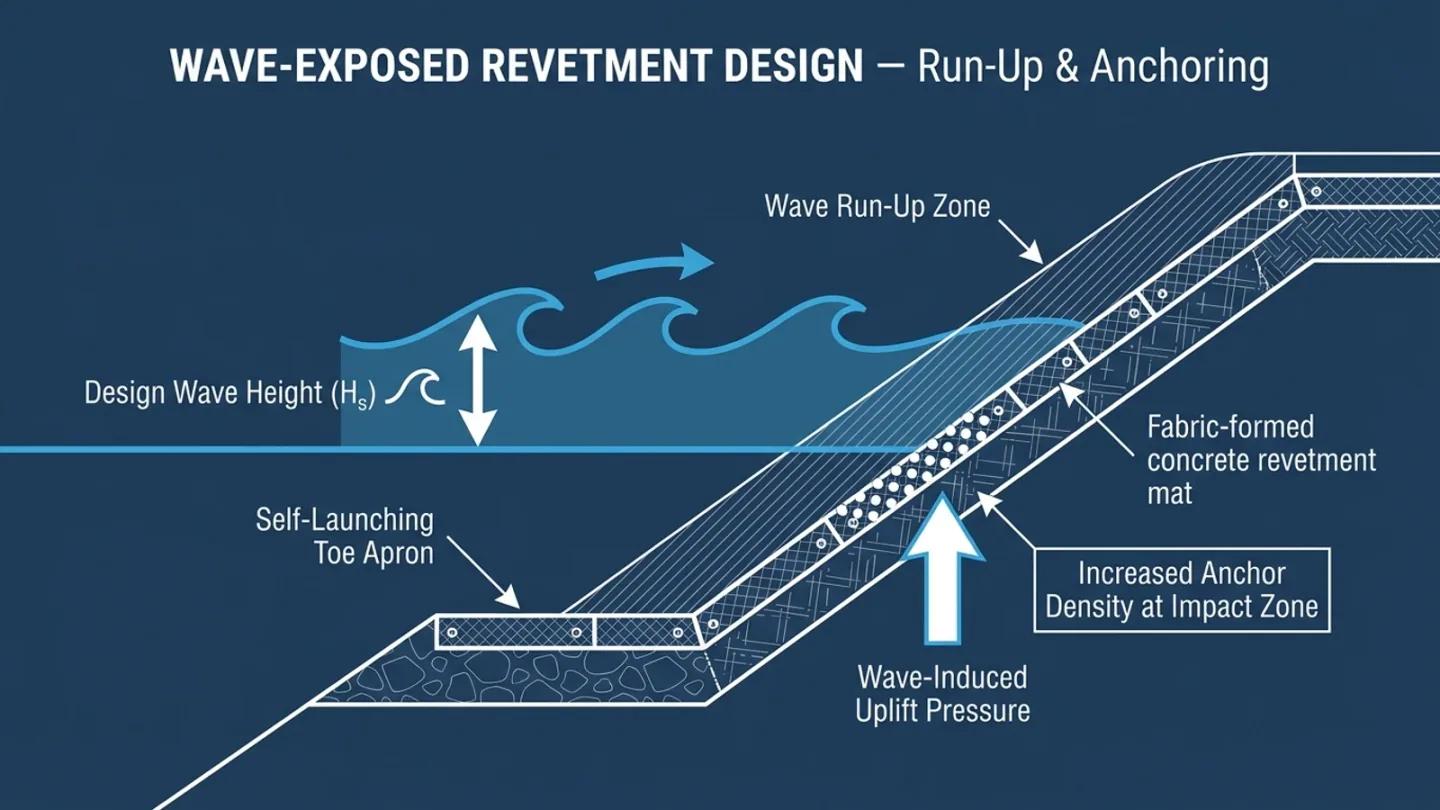
Fabric-Formed Concrete Revetment Mat: Design and Specification Guide
Fabric-formed concrete revetment mat is designed differently for wave-exposed faces than for river current. This guide covers thickness selection by rated velocity, wave design differences and toe detail.
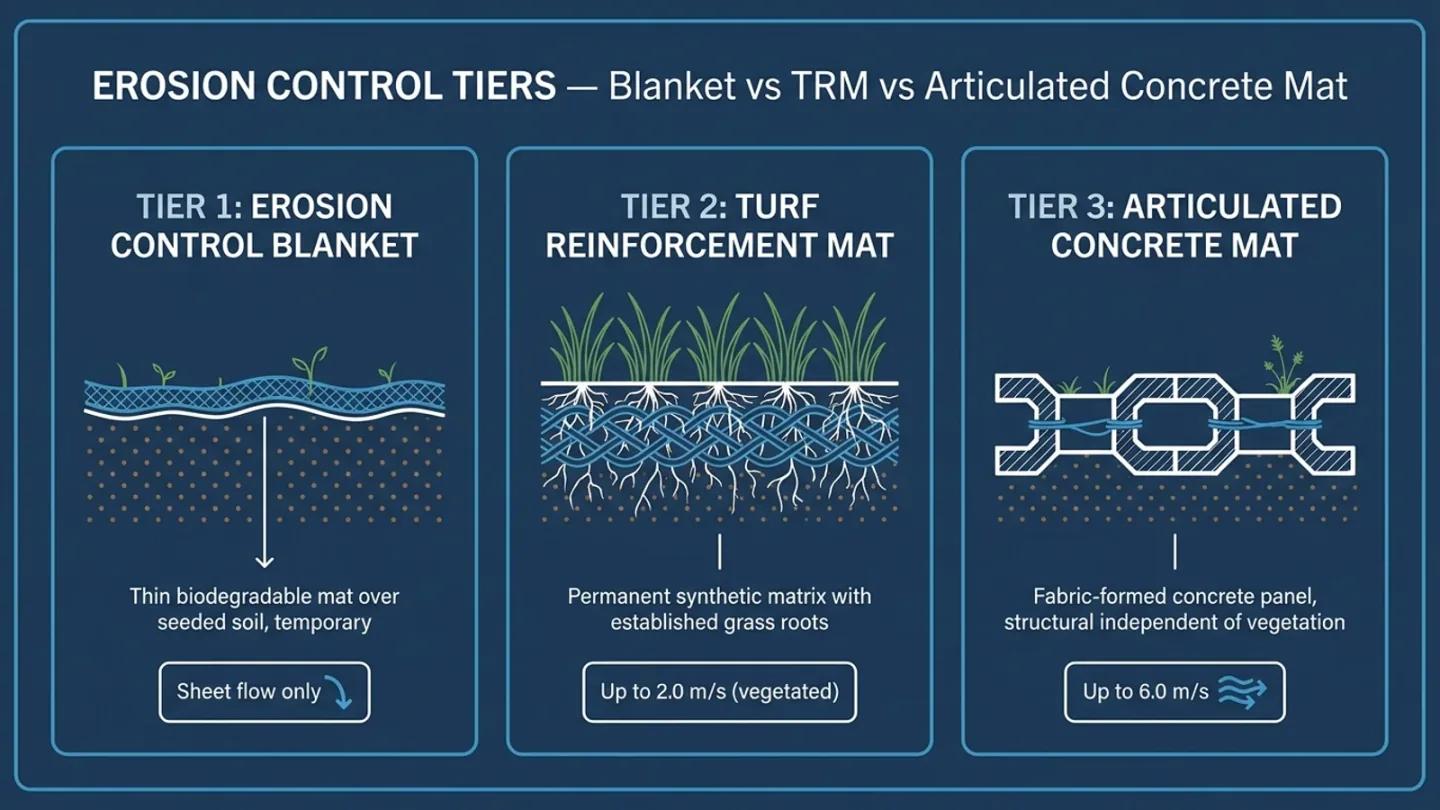
Erosion Control Blanket vs TRM vs Articulated Concrete Mat: Selection by Design Velocity
Three tiers of vegetated and structural erosion control: erosion control blanket, TRM, and articulated concrete mat. This guide sets out where each tier stops working and how to combine them.
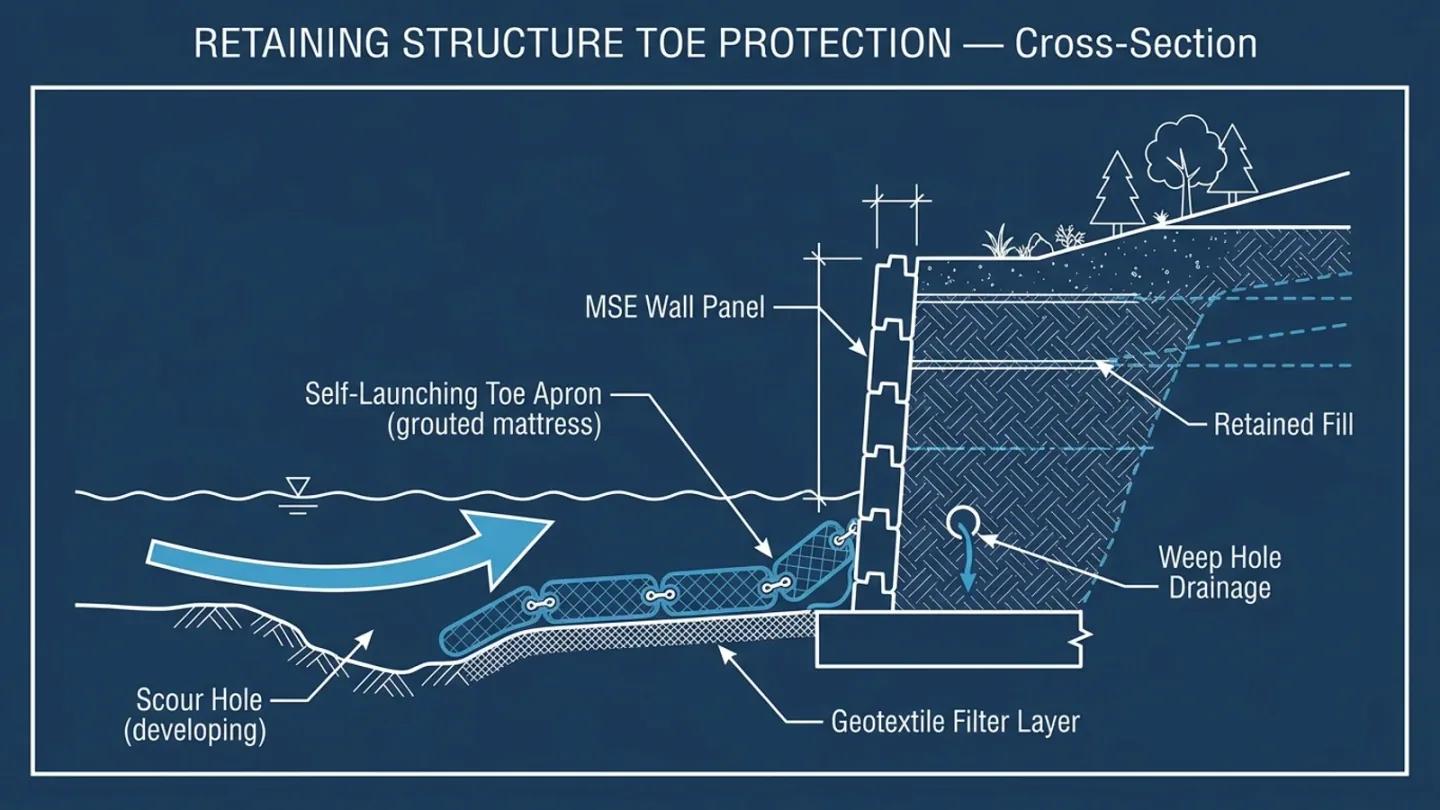
Erosion Control for Engineered Retaining Structures: MSE Walls, Canal Retaining, and Dam Toe Protection
Toe erosion and drainage problems are major risks for retaining structures, separate from the wall's structural design. This guide covers erosion control design at MSE walls, canal retaining structures and dam toes.
HydroBase - China Manufacturer
Ready to Specify Grouted Mattress?
GRI GT16 compliant products, factory test reports included. Engineering support at no cost. 48-hour response.