
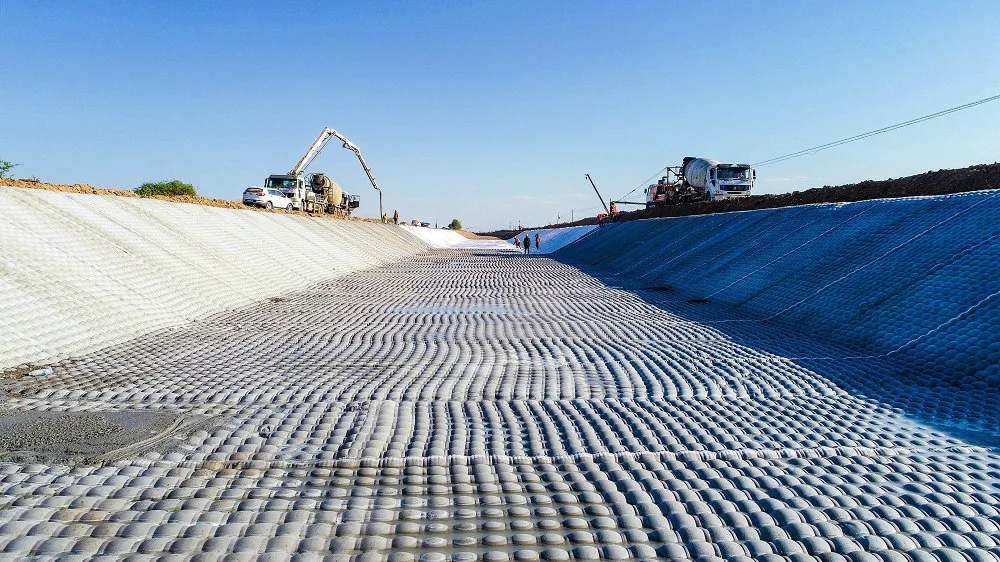
Installing Grouted Mattress for Canal Lining
Quick Summary
A practical installation guide for grouted mattress canal lining, covering site preparation, panel deployment, grout mix design, pumping sequence, and curing.
Quick Answer: Grouted mattress canal lining requires no dewatering and installs at 800–1,200 m²/shift using a standard concrete pump truck. Critical parameters: subgrade to ±30 mm tolerance, grout w/c ratio ≈ 0.49, slump 150–200 mm, 7-day moist curing. Minimum 28-day cube strength ≥17 MPa per GRI GT16.
Poor subgrade preparation, a too-dry grout mix, and inadequate curing are the three most common causes of underperformance in grouted mattress installations. This guide walks through every stage with specific parameters for a 100 mm standard canal lining.
Before reading this guide, ensure you have selected the correct product and thickness. See What Is a Grouted Mattress and the grouted mattress vs rip-rap comparison for context.
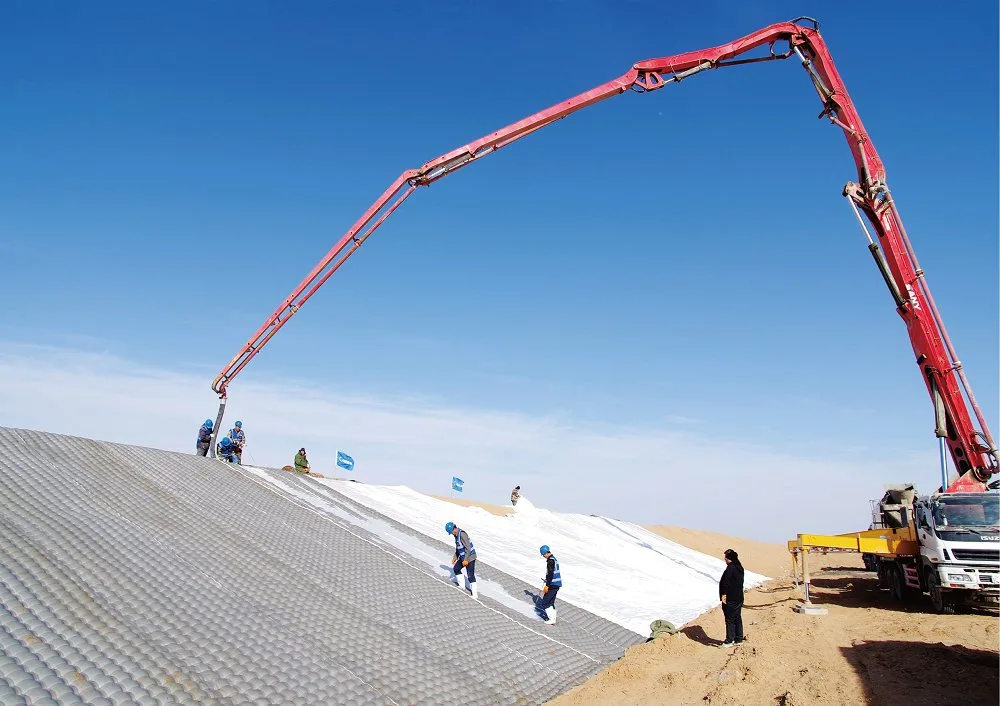
What Equipment Does Grouted Mattress Installation Require?
| Equipment | Specification | Quantity |
|---|---|---|
| Concrete pump truck | Standard 42 m or 47 m boom | 1 per working face |
| Concrete mixer truck | 6–8 m³ capacity | 2–3 per pump unit |
| Water supply | Sprinkler hose or water tanker for curing | 1 per working face |
| Steel anchor stakes | 400 mm × 8 mm rebar at 2 m spacing | Per panel layout |
| Grout cube moulds | 100 × 100 mm for quality sampling | Sets of 3 per 50 m³ |
No dewatering equipment is required unless the channel has standing water deeper than 1.5 m. For deeper water, a submersible pump to reduce the level to <1.5 m is sufficient — full dewatering is not necessary.
Step 1: How Do You Prepare the Canal Subgrade?
Subgrade preparation is the most underestimated step. The mattress conforms to the subgrade during pumping — but cannot bridge significant voids or correct a slope that is substantially out of profile.
Tolerances: Grade the canal bed and slopes to within ±30 mm of design profile. Check with a template or digital level at 3 m centres across the slope and 5 m intervals along the channel.
Material removal: Remove all vegetation roots, stones larger than 50 mm, and loose material that could puncture the geotextile during deployment or under the grout weight.
Soft subgrade (CBR <3%): Install a non-woven geotextile separator layer (150–200 g/m², 4,500 N CBR puncture resistance minimum) before the mattress panels to prevent differential settlement that could cause the mattress to crack after curing. The International Geosynthetics Society provides guidance on subgrade assessment for geosynthetic installations.
Water management: Pump down standing water to below 150 mm. Flowing water up to 0.5 m/s can remain — the fabric anchors adequately against this velocity before pumping begins.
Step 2: How Are Panels Laid and Secured?
For side slopes, unroll panels from the top downward. For the channel invert, unroll from one end of the working section toward the other. Adjacent panels must overlap by a minimum of 300 mm along the long edges and 500 mm at butt ends — under-lapping is a common cause of leakage and piping failure at panel joints.
Drive steel stakes through anchor holes at the top edge of each panel at 2 m centres before pumping. On slopes steeper than 1:2, anchor all four edges before pumping. For trapezoidal canals, start with the invert panels and work up both slopes simultaneously — this ensures slope panels overlap onto invert panels, preventing piping at the toe-of-slope joint.
Step 3: What Grout Mix Is Used?
The grout must be fluid enough to pump through the 75 mm injection nozzle and fill every cell without blockage, and must achieve ≥17 MPa at 28 days per GRI GT16.
| Material | Quantity per m³ | Notes |
|---|---|---|
| OPC cement (42.5N) | 380 kg | Minimum 42.5N grade only |
| Fine aggregate (0–5 mm) | 1,450 kg | Clean, well-graded; max 20% retained on 5 mm sieve |
| Water | 185 L | w/c ratio = 0.49; adjust for aggregate moisture |
| Plasticiser (optional) | 1.5–3.0 L | Improves flowability without increasing w/c ratio |
Target slump: 150–200 mm. Test with a standard slump cone before each truck load. Reject any load below 130 mm — do not add extra water to correct slump; use plasticiser instead.
Step 4: How Is the Grout Pumped?
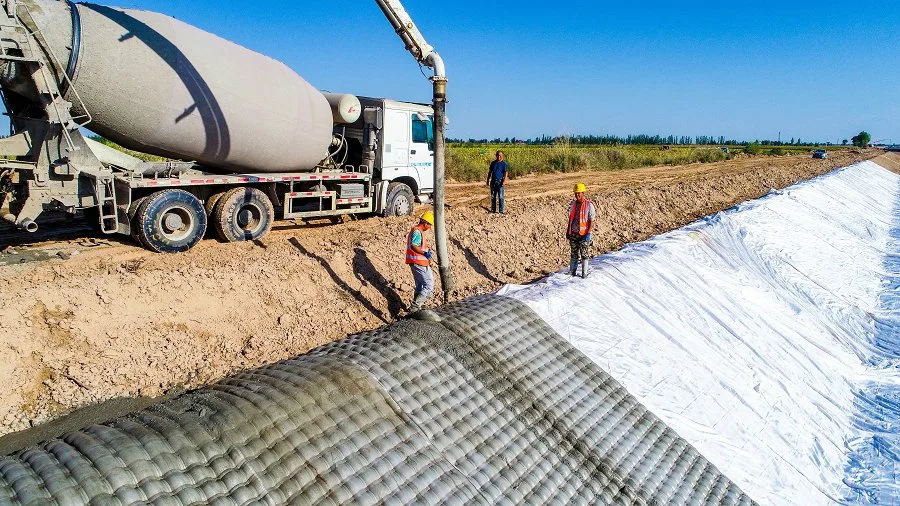
Connect the pump hose to the injection nozzle at the downslope end of the panel. Pumping from the bottom upward ensures grout displaces water and air upward, minimising voids. Pump at 15–25 m³/hour and move the nozzle along the panel at approximately 1 m intervals. Do not attempt to fill more than 6 m of panel from a single injection point.
Monitor panel fill visually: a correctly pumped panel expands uniformly from the injection point outward. Flat areas after adjacent cells have expanded indicate a blocked internal seam — add a second injection point near the void.
Step 5: How Long Does Curing Take?
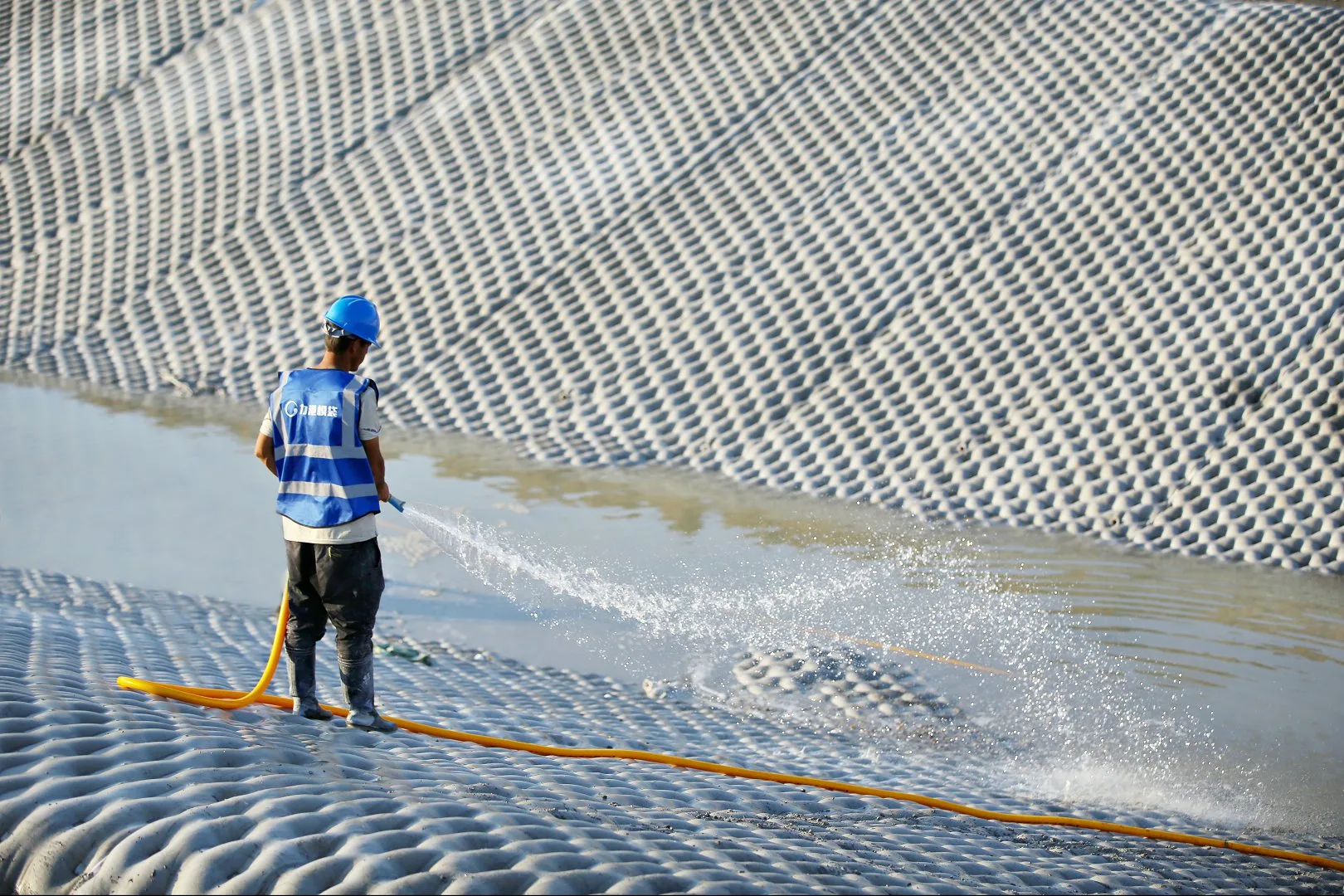
Curing is the most commonly neglected step — and the main cause of grout strength deficiencies. A grout that dries out within 24 hours of pumping will achieve only 60–70% of its potential 28-day strength.
Begin water misting within 30 minutes of completing pumping on each panel. Maintain a damp surface for a minimum of 7 days. At air temperatures above 30°C or wind speeds above 15 m/s, supplement misting with wet hessian or geotextile cover kept continuously damp. Shade netting reduces surface temperature by 8–12°C and significantly reduces evaporative loss.
What Output Rate Can You Expect, and How Is Quality Checked?
With one pump unit and two mixer trucks: 800–1,200 m² of 100 mm mattress per 8-hour shift — approximately 180–260 linear metres of trapezoidal canal (4 m base, 1:1.5 slopes) per shift.
For grout quality control, take one set of three 100 × 100 mm cubes per 50 m³ placed. Test at 7 days (target ≥12 MPa indicative) and 28 days (minimum 17 MPa for GRI GT16 compliance).
Frequently Asked Questions
Can installation continue in rain?
Yes — light to moderate rainfall does not affect installation. Heavy rain can dilute freshly pumped grout if pooling occurs; cover pumped sections with polythene sheeting until the grout has stiffened (approximately 4–6 hours). Curing spray can be reduced but should not be stopped during prolonged rain.
What is the minimum temperature for installation?
Do not pump in air temperatures below 5°C without anti-freeze precautions. Below 0°C, consult the HydroBase engineering team for a cold-weather grout mix design incorporating rapid-hardening cement and heated mix water. The Geosynthetic Research Institute provides additional guidance on cold-weather installation for GRI GT16 compliant systems.
How do you prevent grout blockage when pumping through long hose runs?
Keep hose runs under 60 m where possible. For longer runs (60–120 m), increase pump pressure to maintain flow velocity above 1.2 m/s in the delivery hose — below this the grout will segregate. A plasticiser at 1.5–3.0 L/m³ dramatically reduces viscosity without raising the w/c ratio, which is the preferred fix. Purge hoses with water between trucks to prevent cold joints forming in the hose when a truck change takes more than 10 minutes.
HydroBase provides free site-specific installation guidance — grout mix design for local aggregates, thickness specification for your hydraulic conditions, and troubleshooting during installation. Contact us with your site details.
HydroBase Technical Team
HydroBase manufactures grouted mattresses (GRI GT16 compliant) in China and delivers to 30+ countries. Our engineering team provides specification support, grout mix design, and installation guidance.
About HydroBaseMore Articles
View all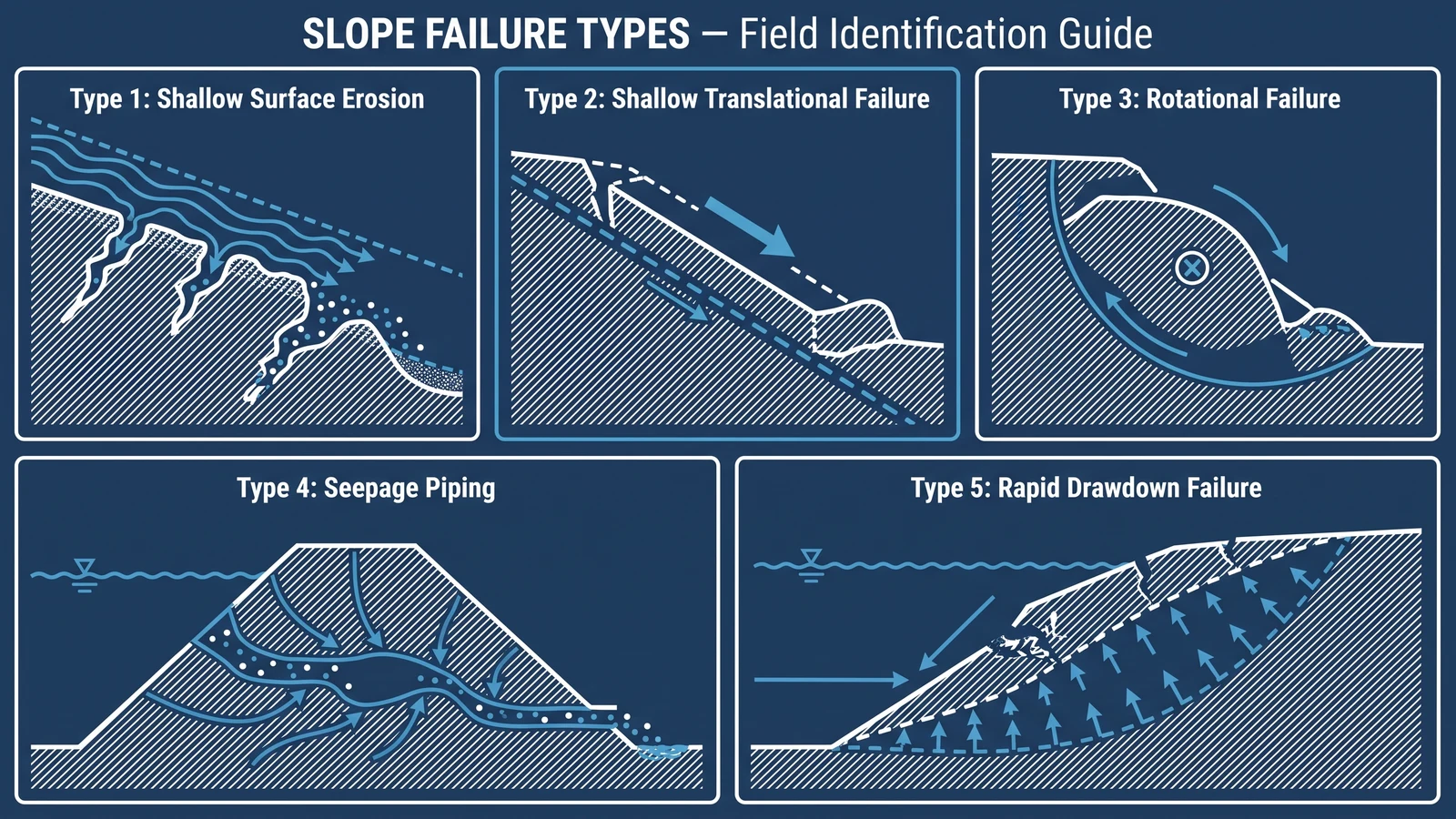
Slope Failure Causes and Prevention: Field Guide
Slope failures on canal embankments, reservoir faces, and road cuttings follow recognisable patterns. This field guide covers the five main slope failure types — shallow surface erosion, shallow translational, rotational, piping, and rapid drawdown — with prevention measures for each.
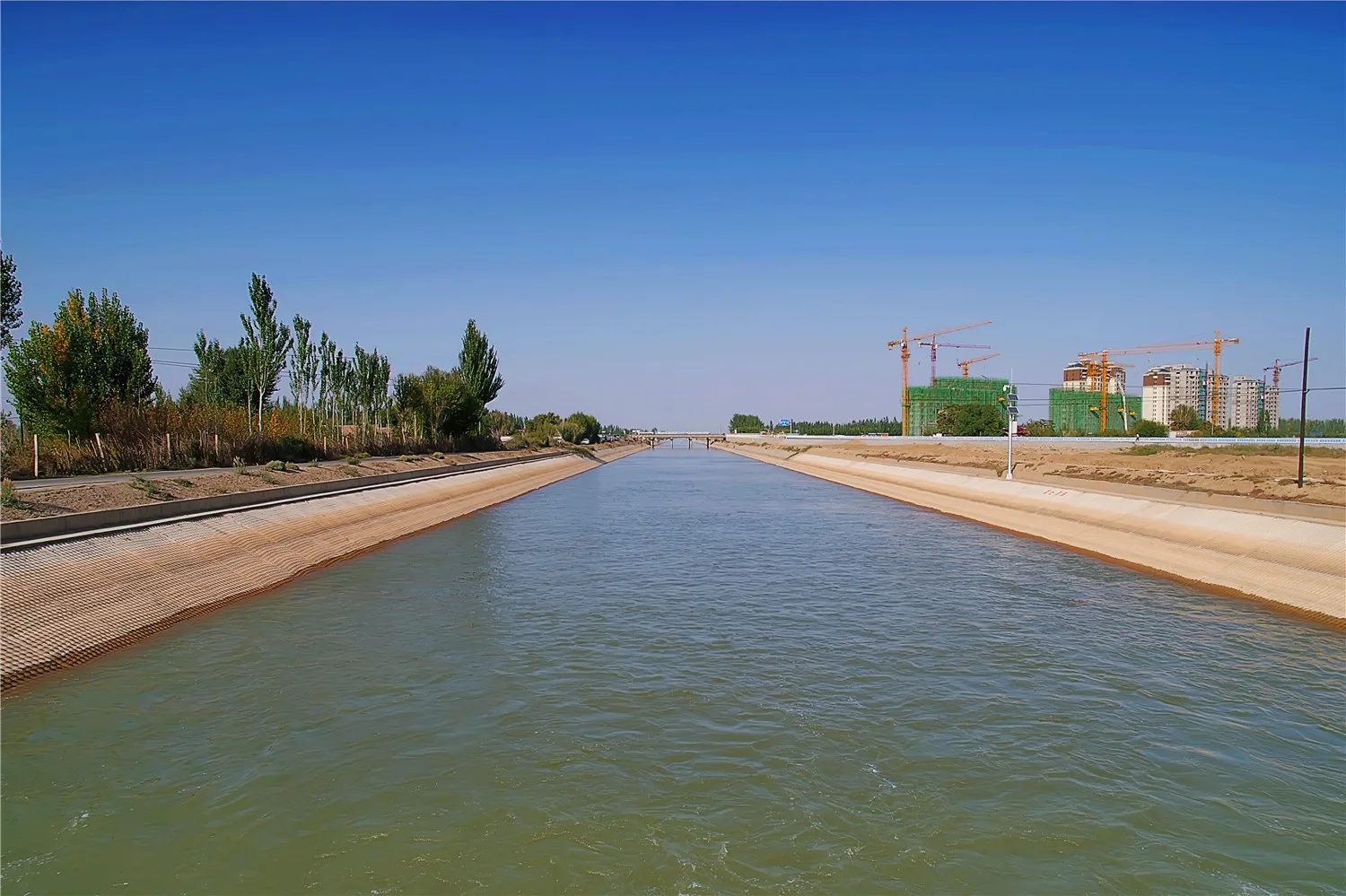
Grouted Mattress Case Studies: 5 Projects, Real Data
Five real grouted mattress installations across canal lining, river bank protection, coastal revetment, reservoir lining, and bridge pier scour — with actual project areas, design parameters, installation programmes, and post-installation performance data.
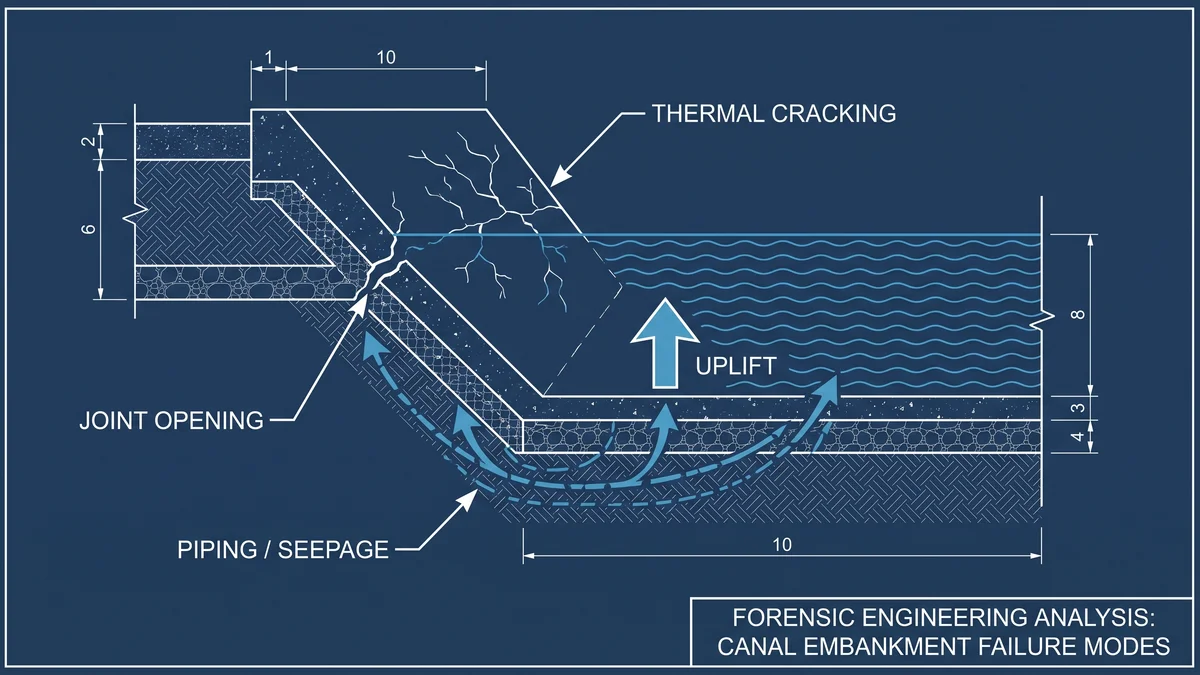
Canal Lining Failure: 7 Causes and How to Prevent Them
Canal lining failures cost irrigation authorities billions annually in emergency repairs and lost water. This forensic guide identifies the 7 most common failure causes — from joint failure to uplift — and explains how to prevent each through better specification and installation.
HydroBase - China Manufacturer
Ready to Specify Grouted Mattress?
GRI GT16 compliant products, factory test reports included. Engineering support at no cost. 48-hour response.