
Canal Lining Failure: 7 Causes and How to Prevent Them
Quick Summary
Canal lining failures cost irrigation authorities billions annually in emergency repairs and lost water. This forensic guide identifies the 7 most common failure causes — from joint failure to uplift — and explains how to prevent each through better specification and installation.
Quick Answer: The seven most common canal lining failure causes are: (1) concrete joint opening from subgrade settlement; (2) uplift from hydrostatic pressure during rapid drawdown; (3) subgrade erosion (piping) through permeable lining joints; (4) inadequate design velocity — lining is undersized for actual flow conditions; (5) poor grout compressive strength — grout mix too wet; (6) tree root intrusion at lining edges; and (7) thermal cracking from daily temperature cycling. Grouted mattress eliminates the first three causes by design; the remaining four require correct specification and installation. This guide explains each cause and the prevention.
Canal lining failures are expensive, disruptive, and frequently avoidable. The International Commission on Irrigation and Drainage (ICID) estimates that poor lining performance — from both premature failure and inadequate seepage control — costs global irrigation authorities over $2 billion annually in emergency repairs, rehabilitation, and water loss. Most of these failures share the same root causes, which are well understood and preventable through correct design and specification.
This guide is written for irrigation engineers, project managers, and procurement teams who want to understand what goes wrong with canal linings and how to prevent it. For the correct design process, see Canal Lining Methods: Complete Comparison. For rehabilitation after failure, see Canal Rehabilitation Guide.
The Seven Failure Causes at a Glance
| # | Failure Cause | Lining Type Affected | Severity | Prevention Summary |
|---|---|---|---|---|
| 1 | Joint opening from settlement | Concrete panels | High — allows uncontrolled seepage | 12-month settlement wait; flexible sealant; or use GGFM |
| 2 | Uplift during rapid drawdown | Concrete, geomembrane | Critical — can lift entire slope facing | Weepholes; filter-point GGFM; limit drawdown rate |
| 3 | Subgrade piping through joints | Concrete, geomembrane | High — progressive void formation | Non-woven geotextile filter beneath; annual inspection |
| 4 | Inadequate design velocity | All lining types | High — first-flood failure | Calculate slope face velocity; select thickness from GRI GT16 |
| 5 | Poor grout compressive strength | Grouted mattress | Medium — surface spalling and erosion | Specify 1:2 mix, w/c ≤ 0.50; cube test every 500 m³ |
| 6 | Tree root intrusion at lining edges | All types at edges | Low-medium — 5–15 yr onset | 2 m vegetation exclusion zone; physical root barrier |
| 7 | Thermal cracking (arid climates) | Unreinforced concrete | Medium — cumulative fatigue cracking | Tighter joint spacing; BRC mesh reinforcement; or GGFM |
Failure Cause 1: Concrete Joint Opening from Settlement
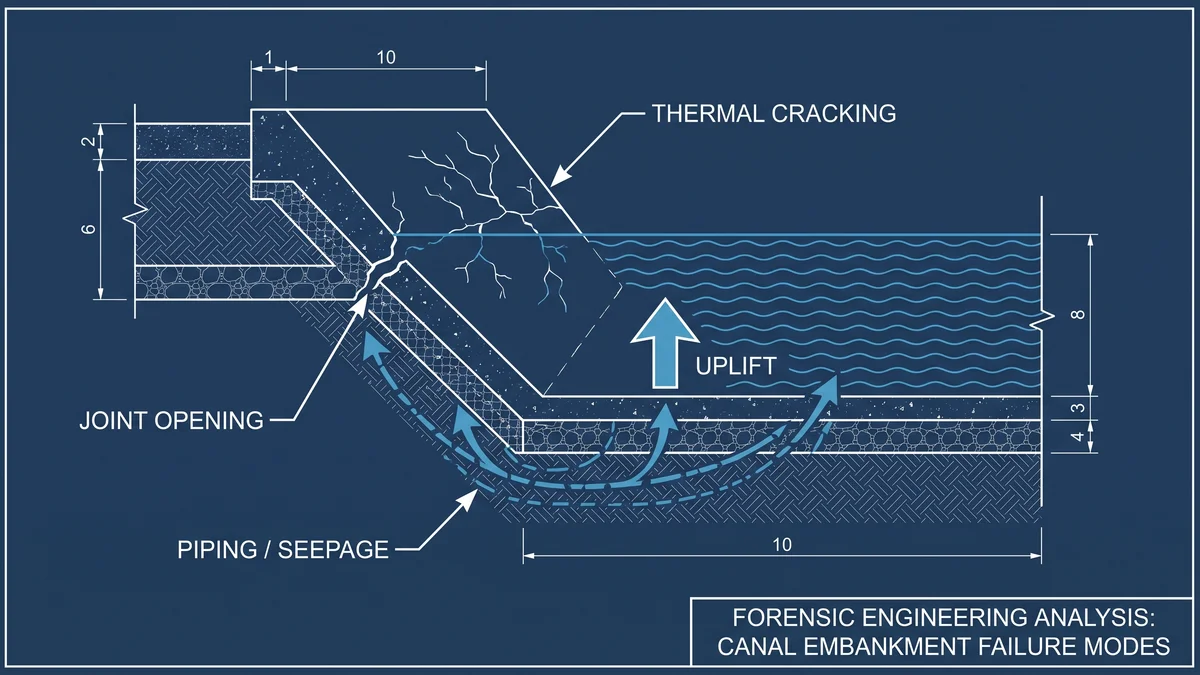
What happens: Concrete canal linings are constructed in panels — typically 3–5 m long by 1–3 m wide — separated by construction joints. As the canal embankment settles under its own weight and the weight of the water (typically 2–5% settlement over the first 3 years of operation), differential settlement between adjacent panels opens the joints. Open joints allow seepage to flow directly through the lining, bypassing its seepage control function. Seepage at joints also undermines the panels — the flowing water carries fine particles from behind the lining (sub-panel erosion), creating voids that cause panel settlement and cracking.
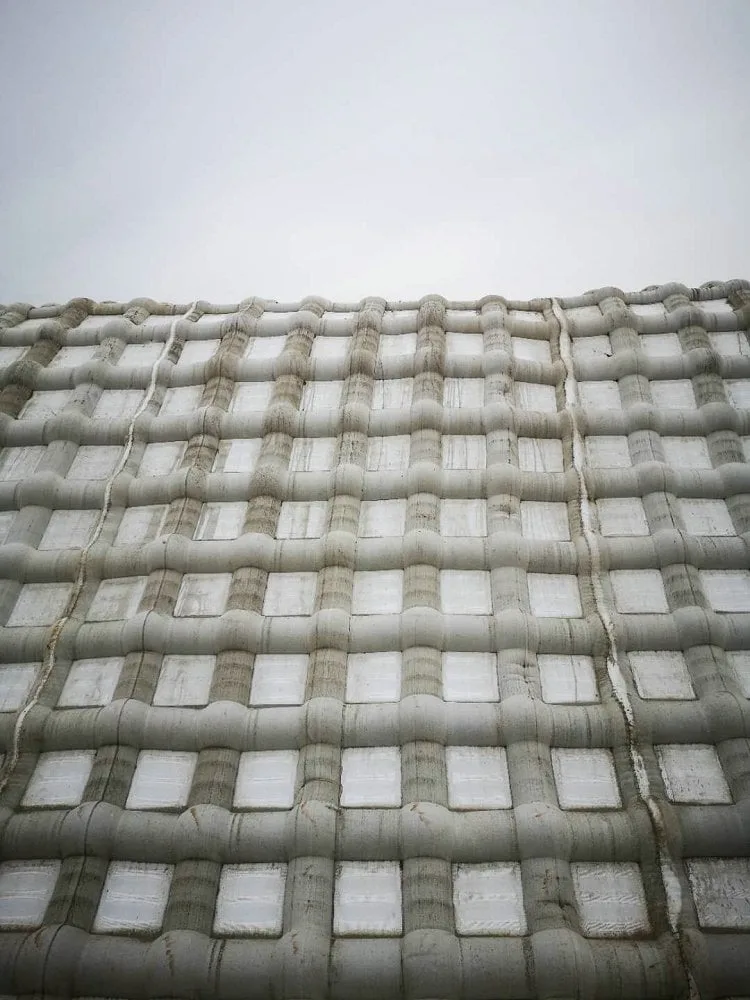
Prevention: (a) Allow a minimum 12-month embankment settlement period before lining; (b) use flexible joint sealant (polyurethane or polysulfide) in all construction joints — and specify resealing every 5–7 years; (c) specify grouted mattress instead of concrete — GGFM is an articulated system with no discrete joints and tolerates differential settlement without opening seepage paths.
Failure Cause 2: Uplift During Rapid Canal Drawdown
What happens: When a canal is drained rapidly for maintenance or emergency, the pore pressure in the embankment behind the lining remains elevated while the water pressure on the lining face drops. The net force reverses — instead of water pressure holding the lining in place, pore pressure pushes the lining off the slope. Concrete panels and geomembrane are most susceptible — they are impermeable, so pore pressure cannot equalise. Typical failure pattern: panels lift, slide, or buckle progressively from the toe upward.
Prevention: (a) For concrete linings — install weepholes at 1.5 m centres to allow pore pressure equalisation during drawdown; (b) specify filter point grouted mattress (filter point GGFM) for canals with rapid drawdown design scenario — the filter openings allow pore pressure to equalise without displacing the lining; (c) control the drawdown rate — limit drawdown to no more than 0.3–0.5 m/day for concrete linings without adequate weepholes.
Failure Cause 3: Subgrade Piping Through Lining Joints
What happens: Water flowing through open joints in a concrete lining, or through the joints between geomembrane panels, carries fine particles from the subgrade (piping). Progressive particle removal creates voids behind the lining — visible on the surface as irregular subsidence or panel cracking following a straight line. Left unaddressed, piping voids grow to the point where panels lose support and fail.
Prevention: (a) Install a non-woven geotextile filter layer beneath all concrete or geomembrane linings — this prevents particle migration even if the overlying lining joints open; (b) for grouted mattress, the fabric itself is the filter layer if the filter criterion is satisfied; (c) inspect linings annually for signs of subsidence along straight lines indicating joint location — these are early-warning signs of sub-panel piping and should be addressed by pressure grouting before full failure develops.
Failure Cause 4: Inadequate Design Velocity
What happens: A lining specified for the wrong design velocity fails within the first major flow event. This commonly occurs when: (a) the canal is subsequently operated at higher flow rates than the original design; (b) the design was based on mean channel velocity without correcting for the higher velocity at the slope face; or (c) the designer used a table value for maximum permissible velocity from an old reference that does not match the current condition. Failure pattern: surface erosion of the lining material, beginning at the points of highest velocity (invert, transitions, bends).
Prevention: Calculate design velocity at the slope surface (not just mean channel velocity) using Manning's equation with the correct roughness for the proposed lining material. Apply the slope correction factor (velocity at slope = 0.7–0.85× mean channel velocity). Select lining thickness from the correct design standard (GRI GT16 for GGFM, USACE EM 1110-2-1601 for riprap). For existing canals — measure actual operating flow velocity before specifying rehabilitation lining.
Failure Cause 5: Poor Grout Compressive Strength
What happens: In grouted mattress systems, the most common quality failure is grout compressive strength below the GRI GT16 minimum of 17 MPa at 28 days. This typically occurs because the water/cement ratio in the grout mix was too high — either deliberately (to improve workability) or due to inadequate batch control. Weak grout appears normal visually but has low surface hardness and may spall or crack under hydraulic impact loading during the first high-flow event.
Prevention: (a) Specify the grout mix design (1:2 cement:sand, w/c = 0.45–0.50) in the contract documents; (b) require cube samples (minimum 3 per 500 m³) tested at 28 days by a GAI-LAP accredited laboratory; (c) use a plasticiser if workability is a problem — do not add water; (d) include a liquidated damages clause for cube failures. See How to Install Grouted Mattress for full mix design guidance.
Failure Cause 6: Tree Root Intrusion
What happens: Tree roots growing adjacent to the canal lining — from riparian vegetation or from farm trees near the canal bank — penetrate lining edges and joints, lifting and cracking panels. Root intrusion is a slow process — typically 5–15 years before structural damage is visible — but the resulting cracks and lifting create seepage pathways and compromise the lining integrity. Root damage is particularly common at the junction between the canal slope and the top of the bank, where the lining edge is accessible to near-surface roots.
Prevention: (a) Maintain a minimum 2 m vegetation exclusion zone on each side of the canal; (b) where existing trees cannot be removed, install a physical root barrier (HDPE sheet, 500 mm depth) between the tree base and the canal edge; (c) inspect lining edges annually and remove any vegetation encroaching within 1 m of the lining.
Failure Cause 7: Thermal Cracking from Daily Temperature Cycling
What happens: In arid climates with large daily temperature swings (30–40°C diurnal range), unreinforced concrete linings experience daily thermal expansion and contraction cycles. Over 10–15 years, the accumulated fatigue damage from thousands of expansion/contraction cycles causes transverse cracking in concrete panels — even in panels that have not experienced any differential settlement.
Prevention: (a) Specify joint spacing appropriate to the thermal climate — reduce from 3 m to 2 m spacing in high diurnal range climates; (b) add light reinforcing mesh (BRC mesh) in arid climate concrete linings to control crack width; (c) use grouted mattress — the articulated structure accommodates thermal movement through the flexible joints between cells without generating crack-inducing stresses.
Frequently Asked Questions
How can I tell if my concrete canal lining is failing due to piping or settlement?
Piping typically produces subsidence lines that follow the joint pattern — straight lines that correspond to the panel joint locations beneath the surface. Settlement produces random or irregular subsidence not aligned with joints. Both can produce panel cracking, but the crack orientation differs: joint-aligned cracks indicate piping; diagonal or random cracks indicate settlement. If in doubt, drill a 50 mm inspection hole through the panel and probe for voids — a rebar probe can confirm whether a void exists beneath the panel.
Can a failed concrete lining be rehabilitated without demolition?
Yes — in most cases. See Canal Rehabilitation Guide for the full methodology. The key step is void filling beneath failed panels before overlining — unfilled voids will cause the new lining to bridge the same voids, repeating the failure. For piping failures, the sub-panel voids must be pressure-grouted through drilled holes before overlining with GGFM.
How often should canal linings be inspected?
Minimum annual visual inspection — preferably during the dry season when the canal can be dewatered for the inspection. Post-major-flood inspection is also critical — high flood flows can accelerate failure modes that were stable under normal operating conditions. Any turbidity in the discharge from a canal reach is a warning sign of active piping and should trigger immediate inspection of that reach.
HydroBase's engineering team can review your canal condition assessment data and identify which failure modes are active — recommending the most cost-effective rehabilitation strategy. Request a free canal lining failure analysis with your inspection records and site photos.
HydroBase Technical Team
HydroBase manufactures grouted mattresses (GRI GT16 compliant) in China and delivers to 30+ countries. Our engineering team provides specification support, grout mix design, and installation guidance.
About HydroBaseMore Articles
View all
Grouted Mattress Case Studies: 5 Projects, Real Data
Five real grouted mattress installations across canal lining, river bank protection, coastal revetment, reservoir lining, and bridge pier scour — with actual project areas, design parameters, installation programmes, and post-installation performance data.
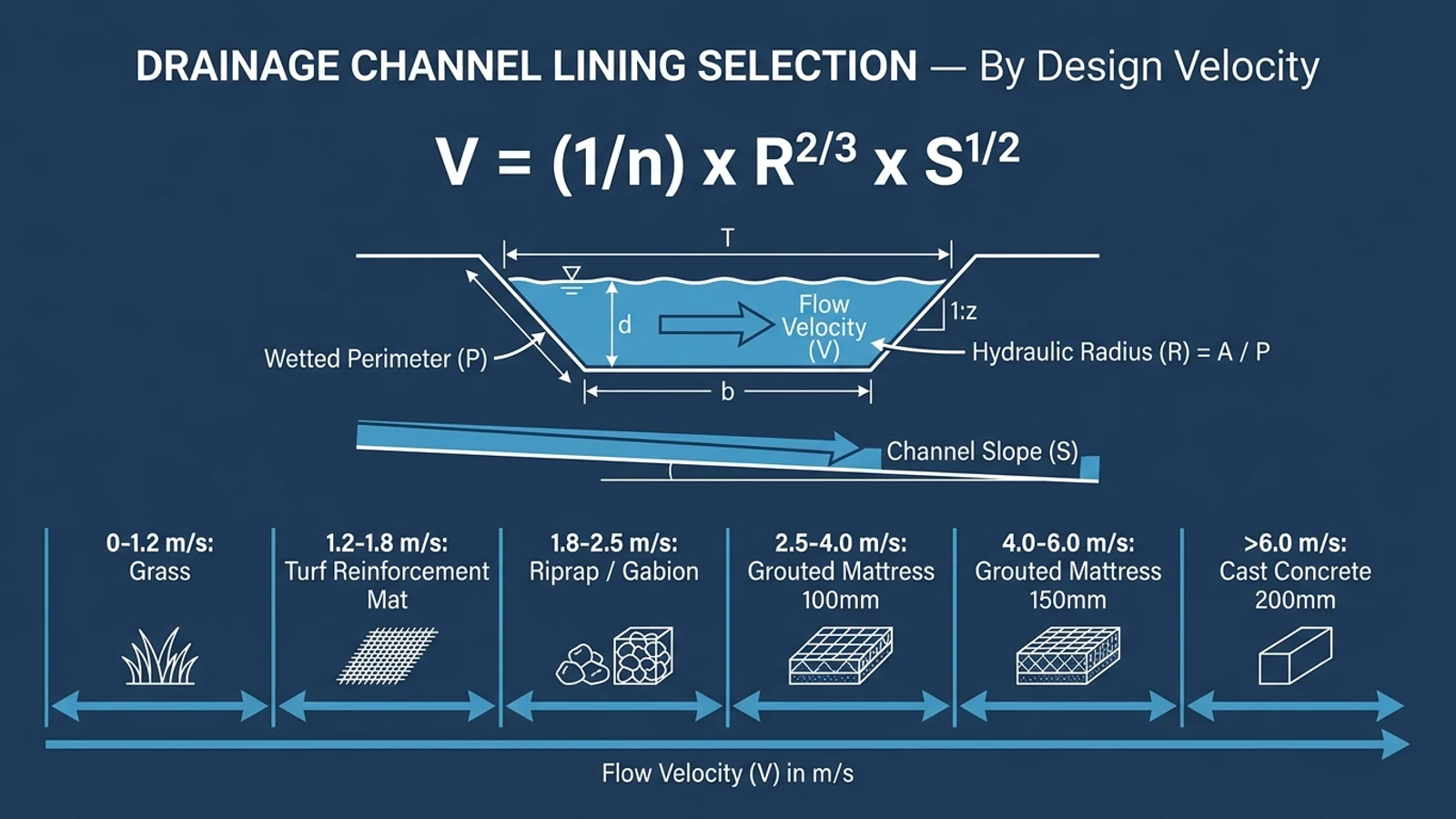
Drainage Channel Lining: Road and Infrastructure Guide
Drainage channels alongside roads, railways, and industrial sites carry high-velocity storm runoff that erodes unlined channels within seasons. This guide covers lining selection, hydraulic design, and installation for roadside drainage channels.
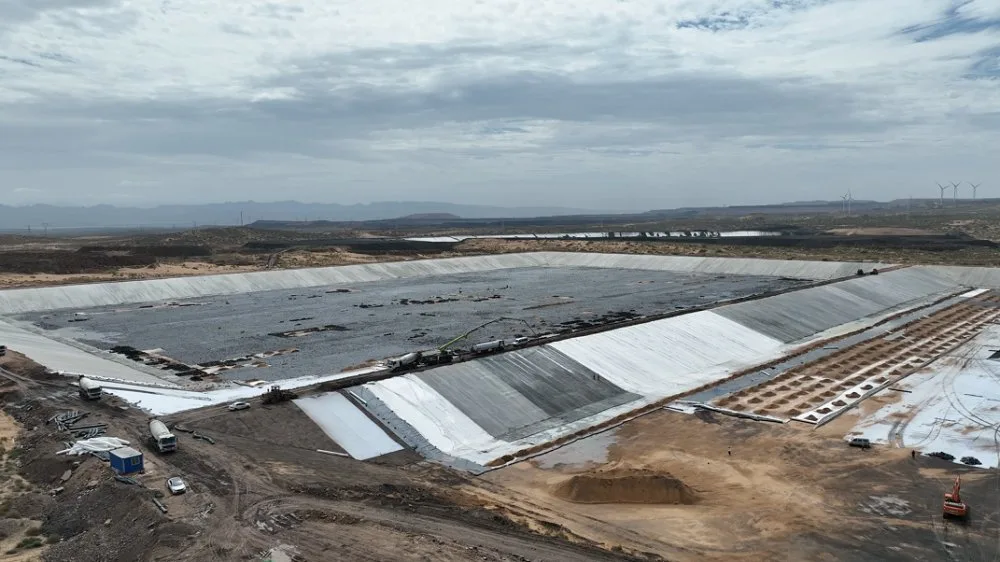
Aquaculture Pond Lining: Safety and Cost Compared
Unlined aquaculture ponds lose 20–40% of water to seepage and suffer high turbidity from bank erosion. This guide compares geomembrane, concrete, and grouted mattress lining for fish ponds and shrimp farms — covering water quality, cost, and fish safety.
HydroBase - China Manufacturer
Ready to Specify Grouted Mattress?
GRI GT16 compliant products, factory test reports included. Engineering support at no cost. 48-hour response.