
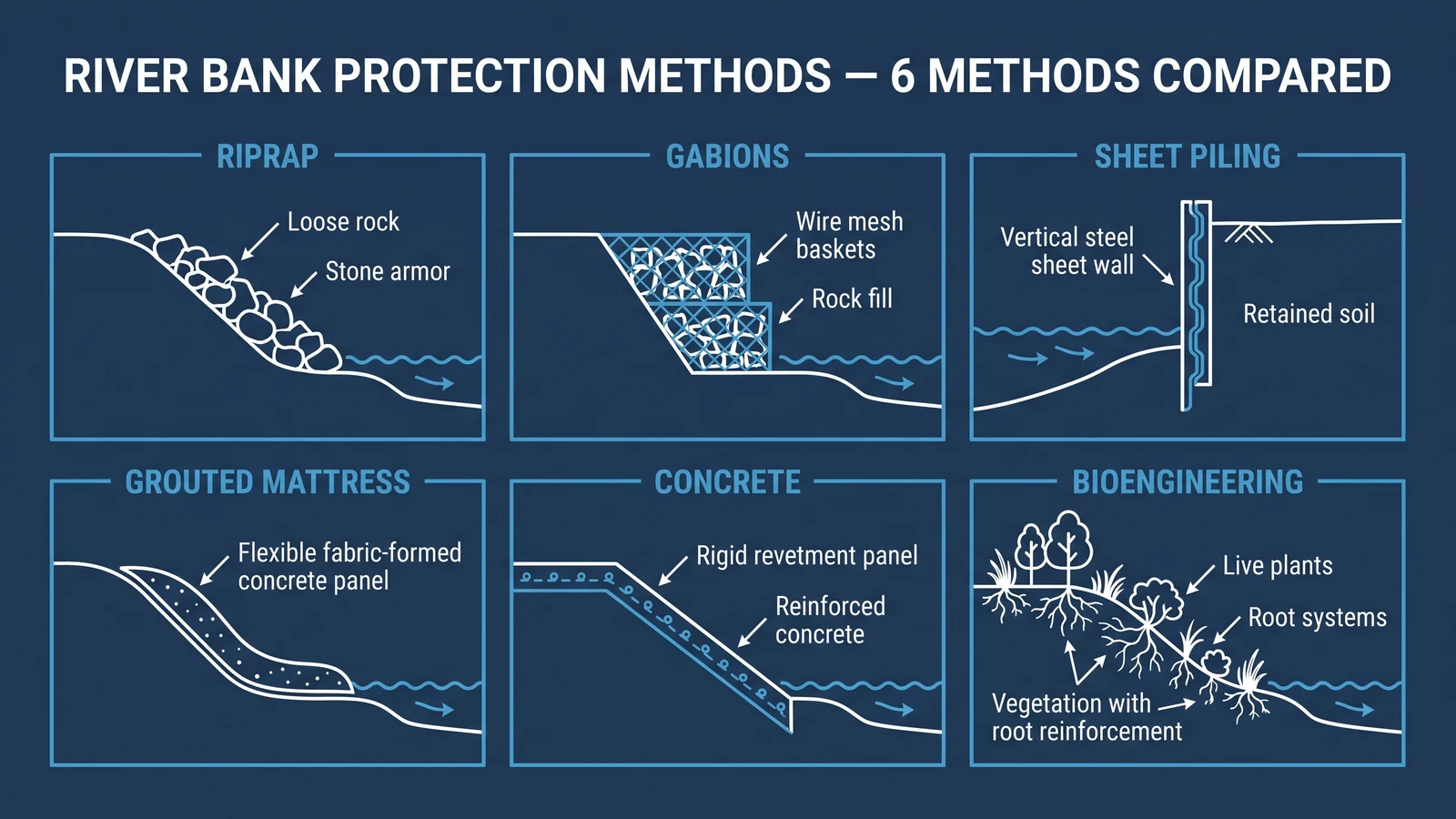
River Bank Erosion Protection: 6 Methods Compared
Quick Summary
Riprap, gabions, sheet piling, grouted mattress, bioengineering, and concrete — a head-to-head comparison of every major river bank protection method on cost, installation, hydraulic performance, and design life.
Quick Answer: For most river bank protection projects requiring scour resistance at velocities above 2.0 m/s, grouted mattress and sheet piling offer the best combination of cost and performance. Riprap remains competitive where local quarried rock is available. Gabions are suited to lower-velocity applications where visual appearance and drainage are priorities. Bioengineering works only where design velocities are below 1.5 m/s and establishment time is available. This guide compares all six methods with cost data and hydraulic limits.
River bank erosion is one of the most persistent challenges in hydraulic engineering. Left unaddressed, lateral erosion undermines roads, bridges, and buildings; destabilises flood embankments; and increases flood risk for downstream communities. Choosing the right protection method requires understanding not just the hydraulics — design velocity, wave action, flood frequency — but also construction constraints, material availability, and long-term maintenance commitment.
This guide compares the six most widely deployed river bank protection methods, drawing on design guidance from the USACE Hydraulic Engineering Center, CIRIA C742 (Manual on Scour at Bridges), and project data from river training works in China, Southeast Asia, and the Middle East. For specific application to bridge pier foundations, see Bridge Pier Scour Protection.
Why River Banks Erode
Bank erosion is driven by four mechanisms, often acting simultaneously:
- Hydraulic shear stress — flowing water exerts a shear force on the bank surface. When shear stress exceeds the critical threshold for the bank material, particles detach and are transported downstream.
- Seepage and piping — water infiltrating the bank during high flows can exit on the falling limb, carrying fine particles and causing internal erosion (piping). This is the mechanism behind many levee failures.
- Wave action — on navigable rivers and reservoirs, vessel wash creates repeated wave loading that loosens surface particles and saturates the near-surface bank.
- Mass wasting — when the bank is saturated and the external water level drops rapidly (rapid drawdown), the elevated pore pressure can trigger planar or rotational failure of the bank face.
An effective protection system must resist the dominant failure mechanism at the site — which is why no single method suits all conditions.
The Six Major River Bank Protection Methods
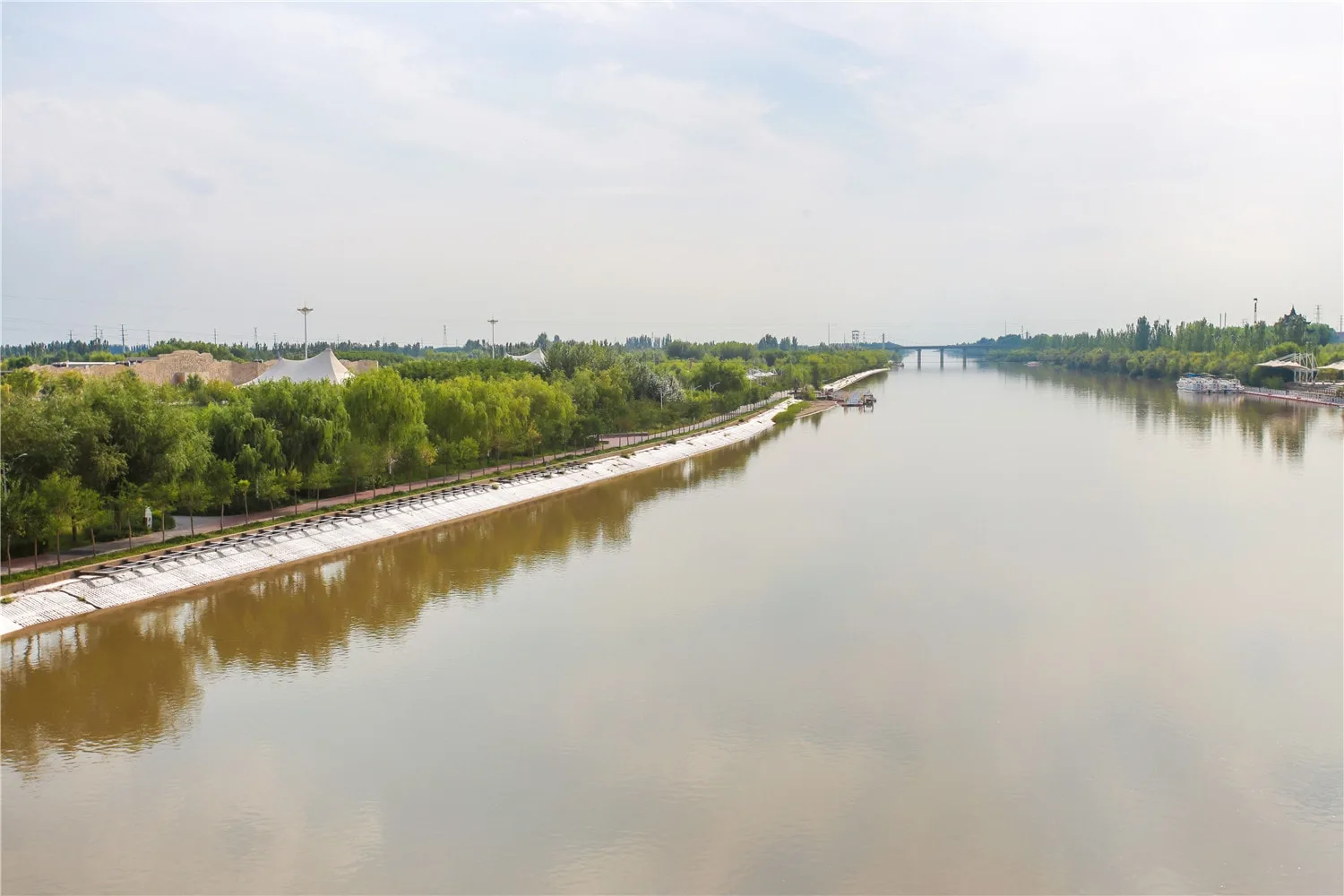
1. Grouted Mattress (GGFM)
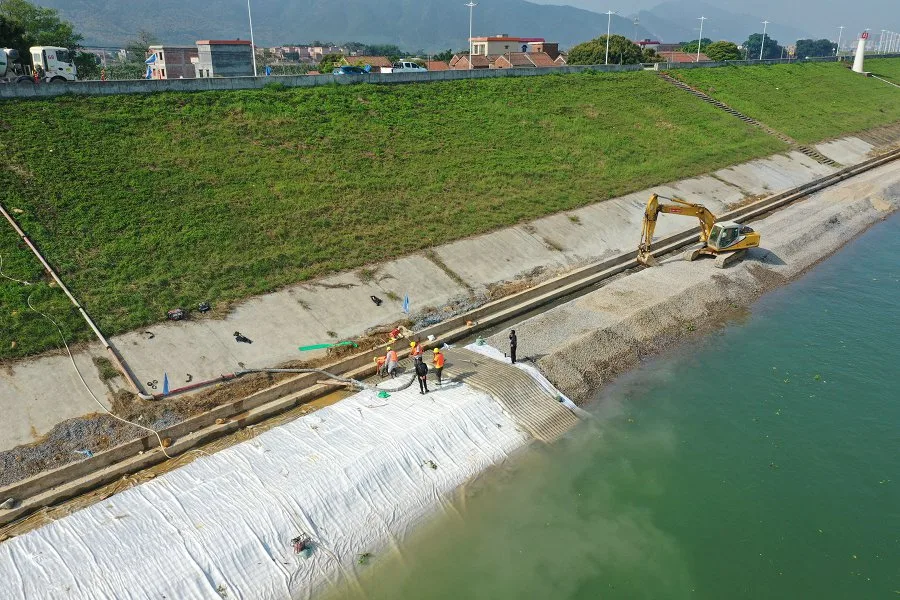
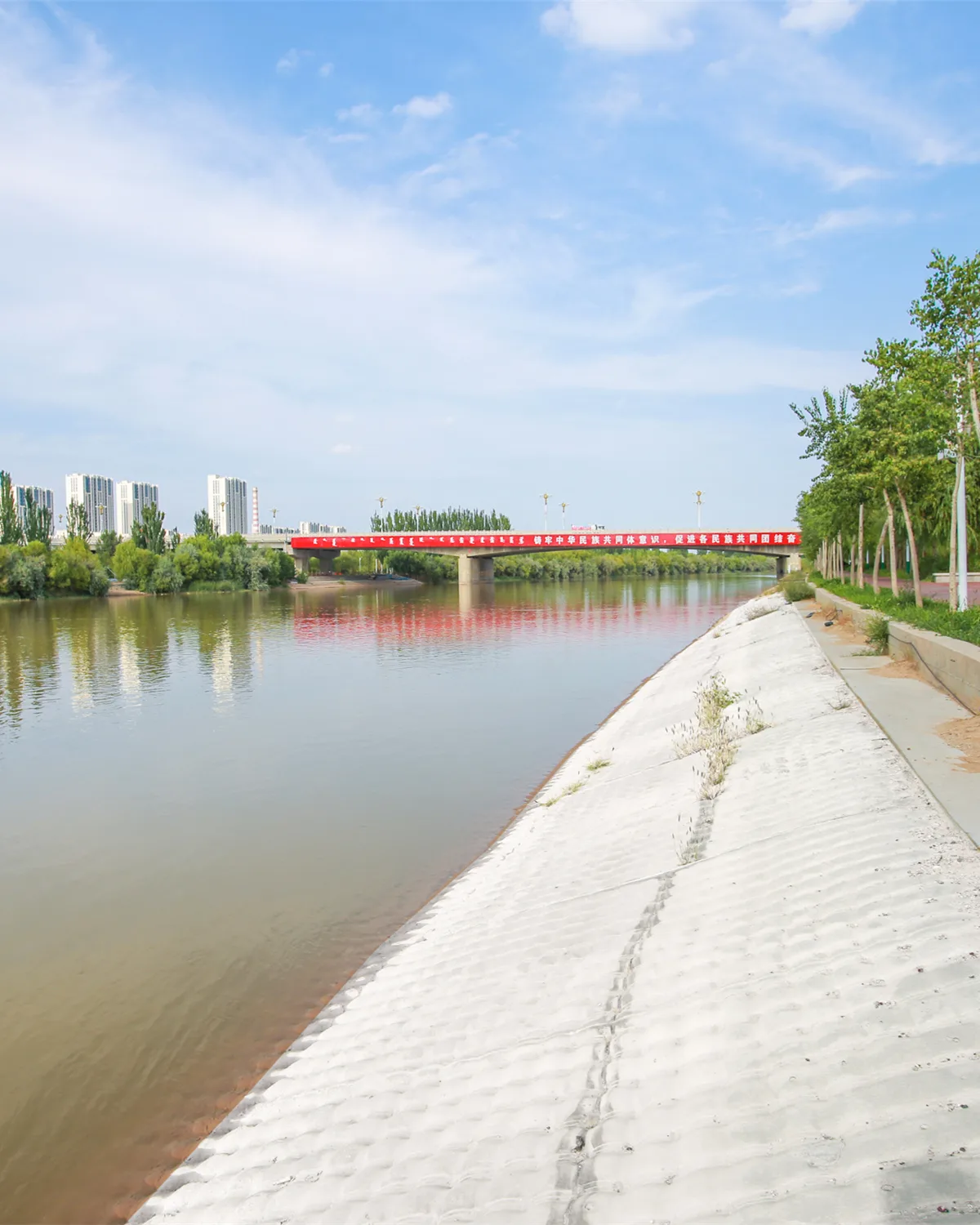
A geotextile grout-filled mattress is deployed as flat rolls over the prepared bank face, then pumped full of cement grout to form a continuous, articulated concrete armour. It conforms to the bank profile — including irregular or previously eroded surfaces — without requiring a perfectly prepared subgrade. Installation does not require dewatering; the mattress can be placed in actively flowing water up to 0.5 m/s, and by divers in deeper applications. Compliant with GRI GT16.
2. Riprap (Rock Armour)
Graded rock placed over a geotextile filter blanket. The most traditional river bank protection method globally. Performance depends critically on correct rock sizing — the median rock size D50 must be selected based on hydraulic shear stress using design equations from USACE EM 1110-2-1601 or FHWA HEC-11. Undersized rock is mobile and provides no protection; oversized rock is expensive to source and handle. Requires dewatering and locally available quarried rock to be cost-competitive.
3. Gabion Mattresses and Baskets
Wire mesh cages filled with graded rock (baskets for vertical walls; mattresses for bank face protection). Gabions are permeable — they allow seepage drainage, which is beneficial in tidal and rapidly fluctuating water level environments. The wire mesh degrades over time in aggressive environments (saline, acidic); galvanised or PVC-coated wire extends life. Suitable for velocities up to approximately 3.0 m/s with properly sized fill rock.
4. Steel Sheet Piling
Interlocking steel sections driven into the bank to form a vertical retaining wall. The most space-efficient solution where right-of-way is constrained — no batter slope is required. Best suited to contained urban reaches and bridge approach embankments. Sheet piling does not address bank toe scour — a grouted mattress or riprap apron at the toe is typically specified in conjunction. Highest first cost of any method; also highest design life (50–80 years with appropriate corrosion protection).
5. Concrete Slope Paving
Cast-in-place concrete slabs or precast panels placed on the bank face. Provides excellent hydraulic resistance and seepage control. Sensitive to differential settlement — panel joints open as the bank consolidates, creating seepage pathways and loss of subgrade support. In actively eroding rivers, the bank is rarely stable enough to provide the uniform subgrade that concrete requires. Repair after flood scour damage is expensive and slow.
6. Bioengineering (Vegetated Bank Protection)
Willow spiling, fascines, coir rolls, or live plant stake installation. Effective in low-energy environments (design velocity <1.5 m/s) where the establishment period of 1–2 growing seasons is acceptable. Root systems reinforce the bank and hydraulic resistance improves progressively as vegetation establishes. Zero scour resistance during the establishment phase — temporary protection (erosion control matting) is required. Not suitable for navigable rivers, high-velocity channels, or sites subject to rapid drawdown.
Cost Comparison
| Method | Installed Cost (USD/m²) | Max Design Velocity | Dewatering Required? | Design Life |
|---|---|---|---|---|
| Grouted Mattress | $28–$55 | Up to 6.0 m/s (200 mm) | No | 50+ years |
| Riprap | $35–$85 | Up to 4.0 m/s (D50 = 300 mm) | Yes | 20–30 years |
| Gabion Mattress | $30–$60 | Up to 3.0 m/s | Yes | 15–25 years |
| Steel Sheet Piling | $120–$280 | Not velocity-limited | No | 50–80 years |
| Concrete Slope Paving | $40–$75 | Up to 8.0 m/s | Yes | 25–35 years |
| Bioengineering | $8–$25 | Up to 1.5 m/s | No | 20–40 years |
Hydraulic Performance Comparison
| Method | Scour Resistance | Seepage Control | Settlement Tolerance | Underwater Install? |
|---|---|---|---|---|
| Grouted Mattress | Excellent | Excellent (standard type) | Excellent | Yes (to 10 m) |
| Riprap | Good (if correctly sized) | None (permeable) | Good | Yes |
| Gabion Mattress | Good | None (permeable) | Good | Limited |
| Sheet Piling | Excellent (vertical) | Good | Poor (rigid) | Yes |
| Concrete | Excellent | Excellent | Poor (rigid) | No |
| Bioengineering | Low | None | Excellent | No |
Choosing the Right Method: A Decision Framework
Use the following decision framework based on the dominant site conditions:
- High velocity (>3.5 m/s) + no dewatering possible: Grouted mattress is the only viable option. Sheet piling if vertical wall is needed.
- High velocity (>3.5 m/s) + dewatering feasible: Grouted mattress or concrete. Concrete if perfectly uniform subgrade is available; grouted mattress if any bank irregularity is present.
- Moderate velocity (2.0–3.5 m/s) + local rock available: Riprap may be cost-competitive — compare local quarry price against grouted mattress landed cost. Gabions if drainage is critical.
- Urban reach + constrained right-of-way: Sheet piling, with grouted mattress toe apron. Highest cost but minimum footprint.
- Low velocity (<1.5 m/s) + ecological objectives: Bioengineering with temporary coir roll protection during establishment. Vegetated grouted mattress where velocity occasionally exceeds 1.5 m/s.
- Tidal or artesian conditions: Filter point grouted mattress or gabions — both allow drainage to prevent uplift under hydrostatic pressure reversal.
Bank Toe Protection: The Critical Detail
Most river bank protection failures initiate at the toe — the junction between the bank face revetment and the channel bed. Scour at the toe undermines the revetment, which then slides and collapses progressively up the bank face. Every bank protection design must address toe scour explicitly.
The standard approach is a toe apron — an extension of the bank face revetment material laid horizontally on the channel bed for a distance of 1.5–2.0 times the anticipated scour depth. For grouted mattress, the toe apron is simply a continuation of the mattress panel, terminated with a free edge weighted by a sand-filled tube. As scour develops, the free toe edge launches into the scour hole, maintaining bed coverage. This self-launching behaviour is a major advantage over concrete and riprap, which require fixed anchoring that can pull the revetment down when scour undermines the toe.
Maintenance Requirements
| Method | Inspection Frequency | Post-Flood Action | 10-Year Maintenance Cost (% of first cost) |
|---|---|---|---|
| Grouted Mattress | Annual visual | Inspect toe apron — minor grout injection if needed | 2–5% |
| Riprap | After each major flood | Stone replenishment at displaced areas | 15–30% |
| Gabion | Annual — check wire integrity | Wire repair; replace settled sections | 20–35% |
| Sheet Piling | 5-year corrosion survey | Cathodic protection top-up | 5–10% |
| Concrete | Annual — check joint sealing | Joint resealing; panel replacement if undermined | 10–20% |
| Bioengineering | Annual + after flood | Re-planting; re-staking where displaced | 10–25% |
Related guides: revetment mattress vs riprap and our bridge scour protection methods article covering adjacent hydraulic engineering challenges.
Frequently Asked Questions
What is the most cost-effective river bank protection method?
On a 25-year lifecycle basis, grouted mattress typically offers the lowest total cost for channels with design velocity above 2.0 m/s — lower maintenance than riprap and gabions, lower first cost than sheet piling, and no dewatering cost unlike concrete. Where local quarried rock is available within 20 km, riprap can be competitive for velocities up to 3.5 m/s.
Can river bank protection be installed without disrupting river flow?
Grouted mattress is the only hard armour system that can be installed in actively flowing water without dewatering. The fabric is deployed and pumped in water flowing at up to 0.5 m/s; deeper installations use diver-assisted placement. Riprap can also be placed in water, but the geotextile filter layer beneath it typically cannot — making full dewatering necessary for filter installation. Sheet piling is driven from the bank and does not require dewatering.
How deep does river bank protection need to go?
The revetment must extend below the maximum anticipated scour depth — typically calculated using the FHWA HEC-18 methodology for bridge crossings, or CIRIA C742 for general river bank works. As a conservative rule of thumb for preliminary design, extend the revetment 2.0 m below the mean low water level in non-tidal rivers, or to the design scour level if scour modelling has been done. Always add a self-launching toe apron of length 1.5–2.0× anticipated scour depth.
What is the best river bank protection for a navigable waterway?
Navigation channels impose wave loading from vessel wash in addition to current-induced shear stress. Grouted mattress handles both loads well and its articulated structure tolerates the cyclic loading without fatigue failure. The impermeable face prevents seepage-induced piping under repeated loading. Sheet piling is the alternative where bank setback is insufficient for a sloped revetment.
HydroBase supplies grouted mattress for river bank protection projects across 30+ countries. Our engineering team will review your hydraulic design data and recommend the correct product thickness and fabric type within 48 hours. Request a free project assessment.
HydroBase Technical Team
HydroBase manufactures grouted mattresses (GRI GT16 compliant) in China and delivers to 30+ countries. Our engineering team provides specification support, grout mix design, and installation guidance.
About HydroBaseMore Articles
View all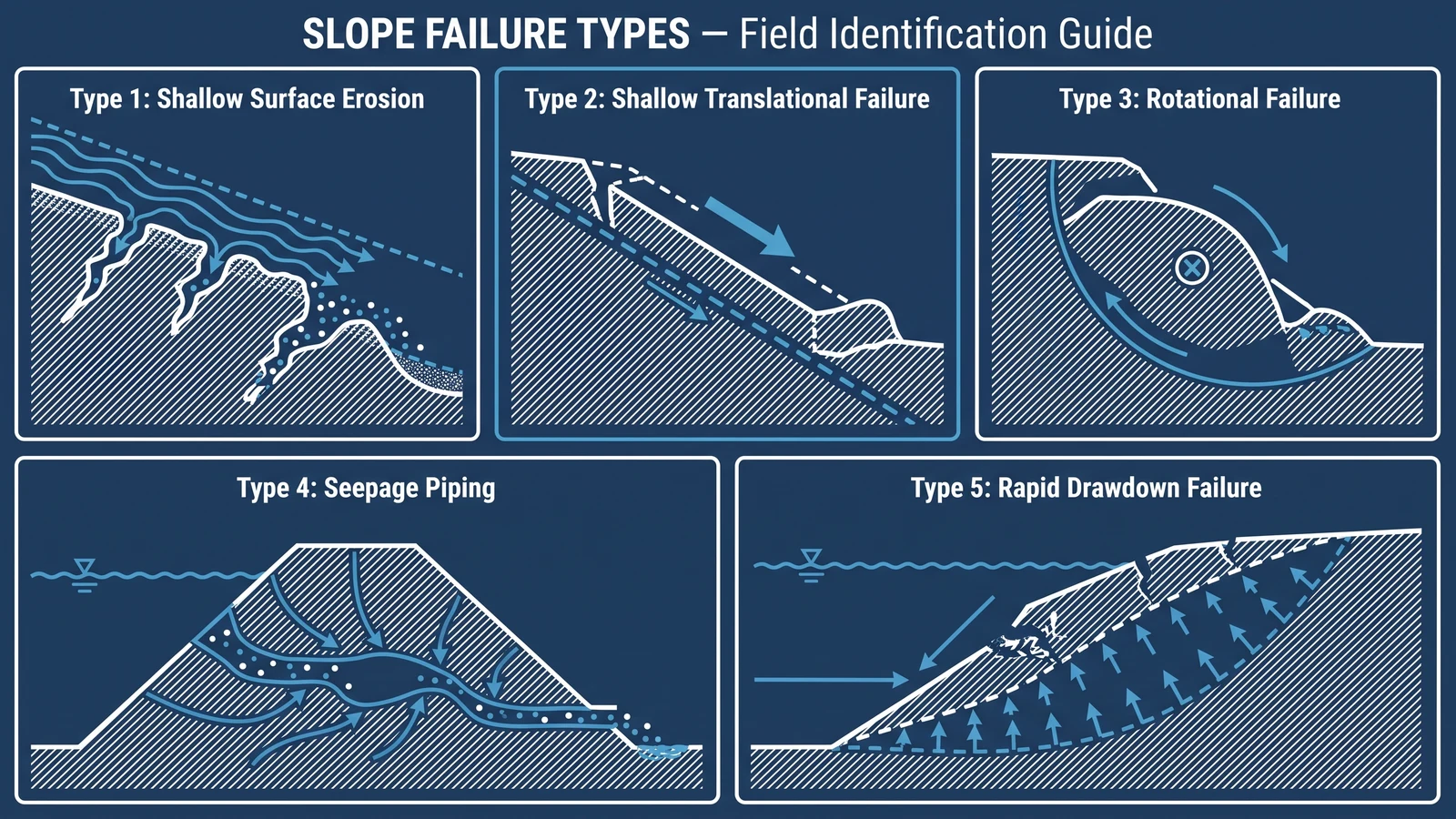
Slope Failure Causes and Prevention: Field Guide
Slope failures on canal embankments, reservoir faces, and road cuttings follow recognisable patterns. This field guide covers the five main slope failure types — shallow surface erosion, shallow translational, rotational, piping, and rapid drawdown — with prevention measures for each.
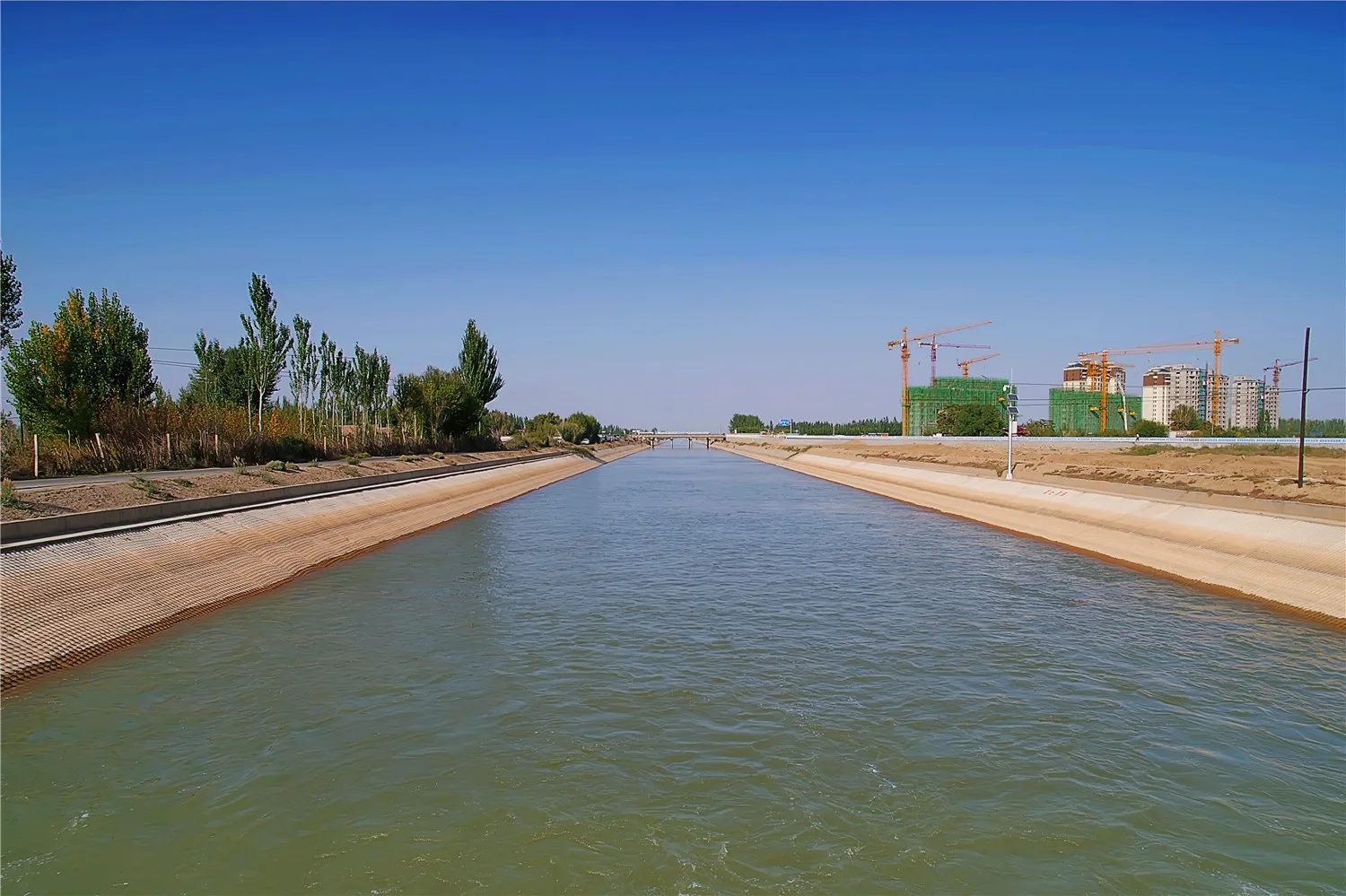
Grouted Mattress Case Studies: 5 Projects, Real Data
Five real grouted mattress installations across canal lining, river bank protection, coastal revetment, reservoir lining, and bridge pier scour — with actual project areas, design parameters, installation programmes, and post-installation performance data.
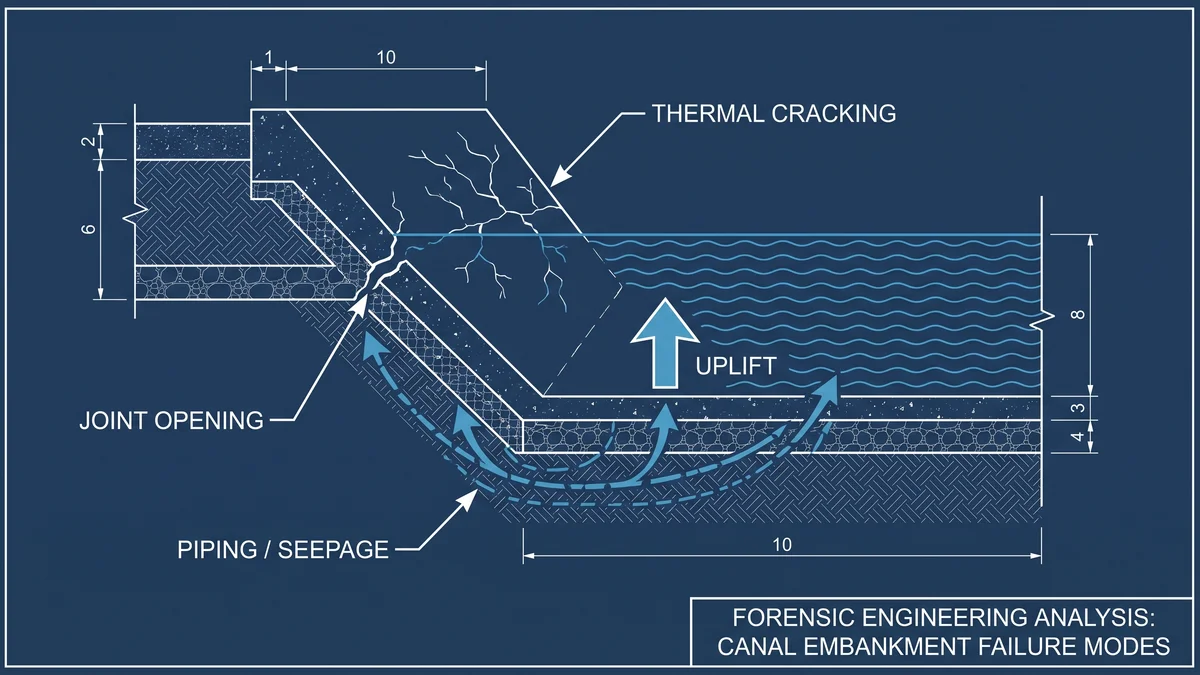
Canal Lining Failure: 7 Causes and How to Prevent Them
Canal lining failures cost irrigation authorities billions annually in emergency repairs and lost water. This forensic guide identifies the 7 most common failure causes — from joint failure to uplift — and explains how to prevent each through better specification and installation.
HydroBase - China Manufacturer
Ready to Specify Grouted Mattress?
GRI GT16 compliant products, factory test reports included. Engineering support at no cost. 48-hour response.