
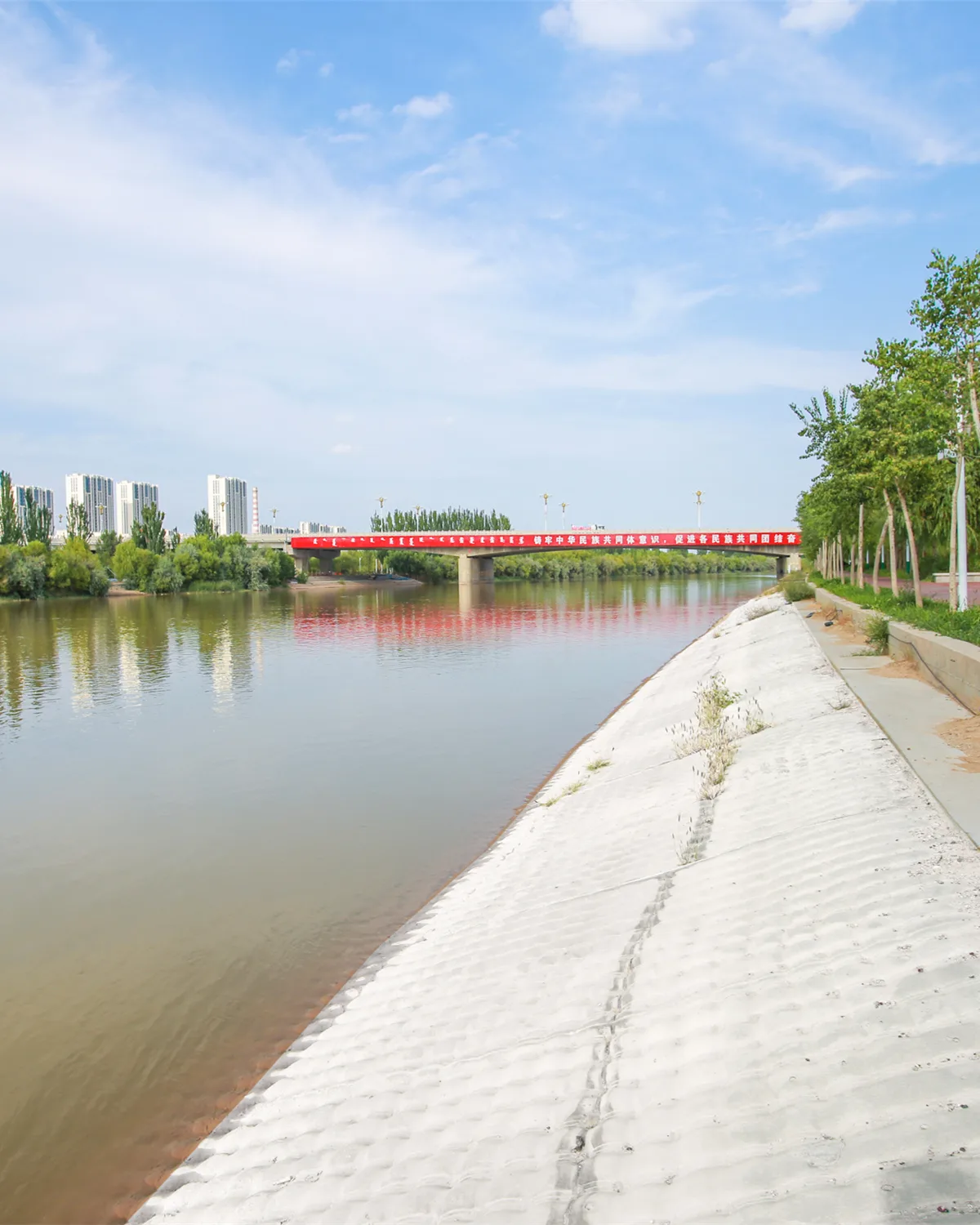
Bridge Scour Protection: What Works Underwater
Quick Summary
Bridge pier scour causes 60% of bridge failures worldwide. This engineer's guide compares riprap, grouted mattress, concrete collars, and sheet piling for scour protection — with FHWA HEC-23 design guidance.
Quick Answer: Bridge pier scour is the leading cause of bridge failure worldwide — responsible for approximately 60% of bridge collapses during flood events according to FHWA research. The most practical scour protection method for existing bridges is a grouted mattress collar installed underwater around the pier base — no dewatering, no cofferdam, no traffic disruption. For new bridge design, integrated concrete collars or sheet piling cutoffs at the foundation level are the primary options. This guide compares all methods with FHWA HEC-23 design guidance.
Scour — the erosion of riverbed material from around bridge foundations — is not a gradual, predictable process. It accelerates dramatically during flood events and can remove metres of riverbed material around a pier within hours. By the time scour is visible during a post-flood inspection, the foundation may already be critically under-supported. The US Federal Highway Administration (FHWA) estimates that scour has caused the failure of more than 1,000 bridges in the United States alone over the past 30 years.
This guide covers the hydraulics of pier scour, the four main countermeasure categories, and the specific design requirements of each — with reference to FHWA HEC-23 (Bridge Scour and Stream Instability Countermeasures) and CIRIA C742. For the grouted mattress application in detail, see Bridge Pier Scour Protection.
How Does Bridge Pier Scour Work?
Water approaching a bridge pier decelerates against the upstream face and is deflected downward, creating a horseshoe vortex that wraps around the base of the pier. This vortex concentrates hydraulic energy at the riverbed surface immediately around the pier — shear stresses at the vortex core can be 4–6× the ambient bed shear stress, far exceeding the critical stress of the riverbed material. The result is a scour hole that deepens progressively as the flood continues.
Three types of scour act simultaneously at a bridge crossing:
- Long-term aggradation/degradation — the riverbed gradually rising or falling over years due to changes in sediment load
- Contraction scour — the reduction in channel width at the bridge opening accelerates flow and erodes the bed across the full channel width
- Local pier scour — the horseshoe vortex erosion immediately around individual piers and abutments
Scour protection must address all three types. Local pier scour countermeasures alone are not sufficient if contraction scour is significant.
The Four Main Bridge Scour Countermeasure Categories
1. Riprap Collar
The traditional and most widely used scour countermeasure — a layer of graded rock placed around the pier base on the riverbed. Simple to design (FHWA HEC-23 provides explicit rock sizing equations), straightforward to install, and easy to inspect. Key limitations: the rock must be correctly sized (HEC-23 recommends D50 = 0.5× the local scour depth as a starting point); rock must be placed on a geotextile filter to prevent sub-riprap piping; and inspection after each flood event is required to confirm the riprap has not been displaced.
2. Grouted Mattress Collar
A geotextile grout-filled mattress collar installed around the pier base — the most practical retrofit option for existing bridges. Panels are sized to fit around the pier shape, lowered to the riverbed by divers or guide frame, and pumped with cement grout from a surface pump unit. The completed collar is rigid, heavy (155–310 kg/m²), and conforms to the existing scoured bed profile. Critically, it does not require dewatering, cofferdams, or traffic disruption. The river stays open throughout installation.
3. Concrete Collar (Poured or Precast)
A poured-concrete or precast-concrete collar cast around the pier at or below the riverbed level. The most structurally robust option — provides mass resistance to scour and is directly tied to the pier structure. Requires cofferdam construction and full dewatering — a significant programme and cost item, typically adding 4–8 weeks and $150,000–$400,000 to a single pier repair project. Standard specification for new bridge design where the collar can be cast as part of the original foundation works. For retrofit of existing bridges, the cofferdam requirement generally makes this option 3–5× more expensive than grouted mattress.
4. Sheet Piling Cutoff
Steel sheet piles driven into the riverbed around the pier perimeter, creating a closed cell that prevents horseshoe vortex erosion. Effective but expensive — typically reserved for critical bridges with high consequences of failure where a permanent, inspectable solution is required. Sheet piling can be driven without dewatering and does not require divers. Long-term maintenance requires corrosion monitoring and periodic cathodic protection.
Cost and Programme Comparison
| Method | Cost per Pier (USD) | Programme | River Closure? | Design Life |
|---|---|---|---|---|
| Riprap Collar | $8,000–$25,000 | 2–5 days | Partial (filter placement) | 20–30 years |
| Grouted Mattress Collar | $15,000–$45,000 | 3–7 days | No | 50+ years |
| Concrete Collar (with cofferdam) | $80,000–$300,000 | 4–8 weeks | Yes (partial or full) | 50+ years |
| Sheet Piling Cutoff | $60,000–$200,000 | 1–3 weeks | No | 50–80 years |
FHWA HEC-23 Design Requirements for Grouted Mattress
FHWA HEC-23 (Design Guidance for Bridge Scour and Stream Instability Countermeasures) specifies the following key requirements for flexible mattress scour countermeasures at bridge piers:
| Requirement | FHWA HEC-23 Specification | Grouted Mattress Solution |
|---|---|---|
| Collar extent | Minimum 2× pier width in all directions from pier face | Panels pre-cut to pier shape; standard collar extends 2–3 m each side |
| Minimum thickness | 0.5× local scour depth (HEC-18 estimate); minimum 200 mm for GGFM | 200 mm standard for bridge piers regardless of velocity |
| Filter layer | Geotextile filter required under any permeable revetment | Mattress fabric serves as filter if filtration criterion met for bed material |
| Toe extension | Self-launching apron; free edge = 1.5× anticipated scour depth | Ungrouted apron panels extend from mattress perimeter; self-launch into developing scour hole |
| Minimum unit weight | Sufficient to resist hydrodynamic lift at design velocity | 200 mm mattress ≈ 310 kg/m²; meets HEC-23 requirements to 5.0 m/s |
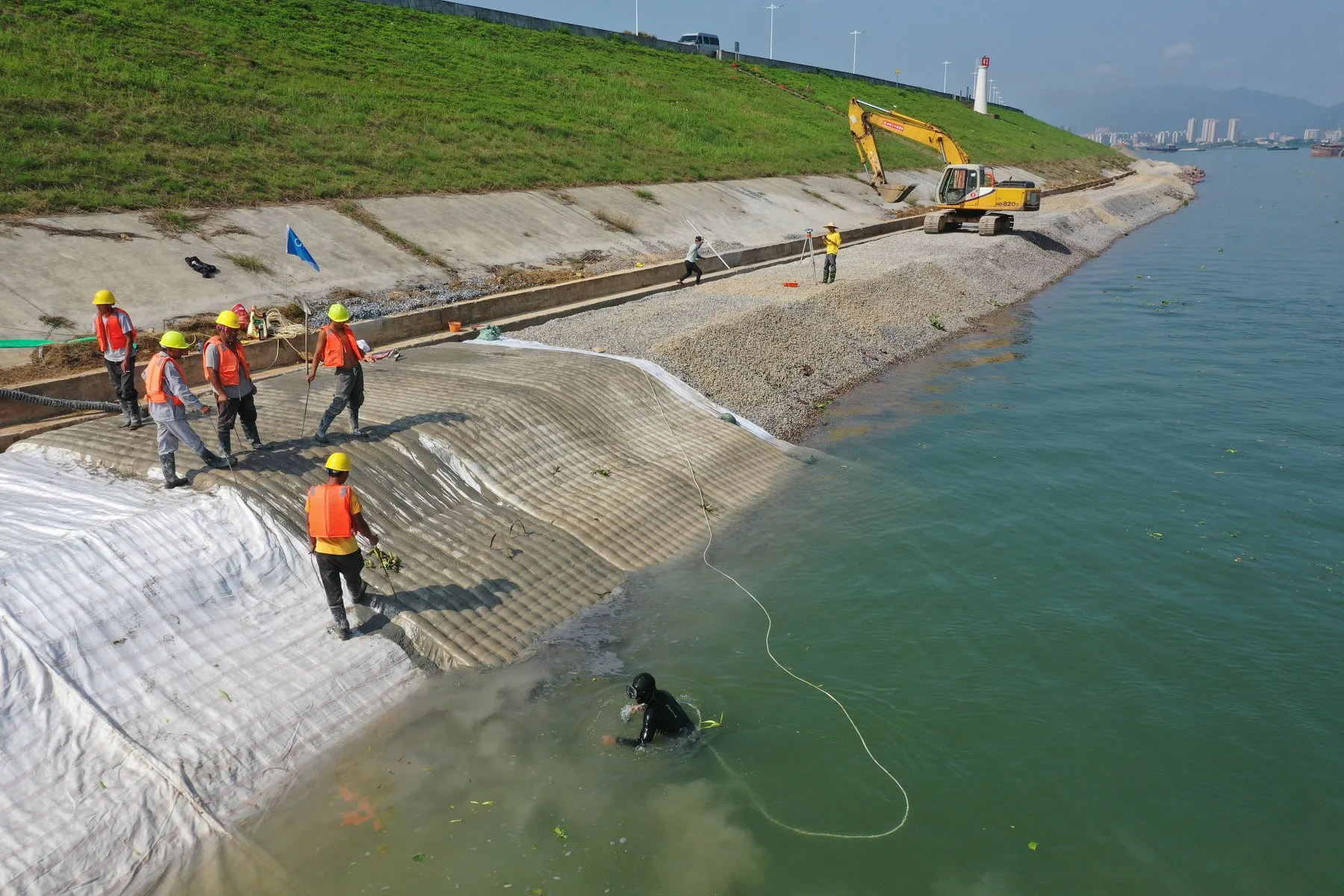
Underwater Installation Procedure
Grouted mattress installation around existing bridge piers follows a standard underwater procedure that does not require dewatering:
- Pre-installation survey — divers or multibeam sonar survey the existing scour hole geometry around each pier
- Panel fabrication — mattress panels are pre-cut at the factory to fit around the pier plan shape, with overlapping flaps at the pier face
- Guide frame positioning — a steel guide frame is positioned over the pier from a work platform or pontoon to ensure accurate panel placement
- Panel lowering — rolled panels are lowered through the guide frame; divers confirm correct positioning and connect adjacent panels
- Grout injection — a standard pump truck connects to the injection hose; grout is pumped from the surface with diver confirmation of fill progress
- Post-installation survey — divers confirm full collar coverage and toe apron position
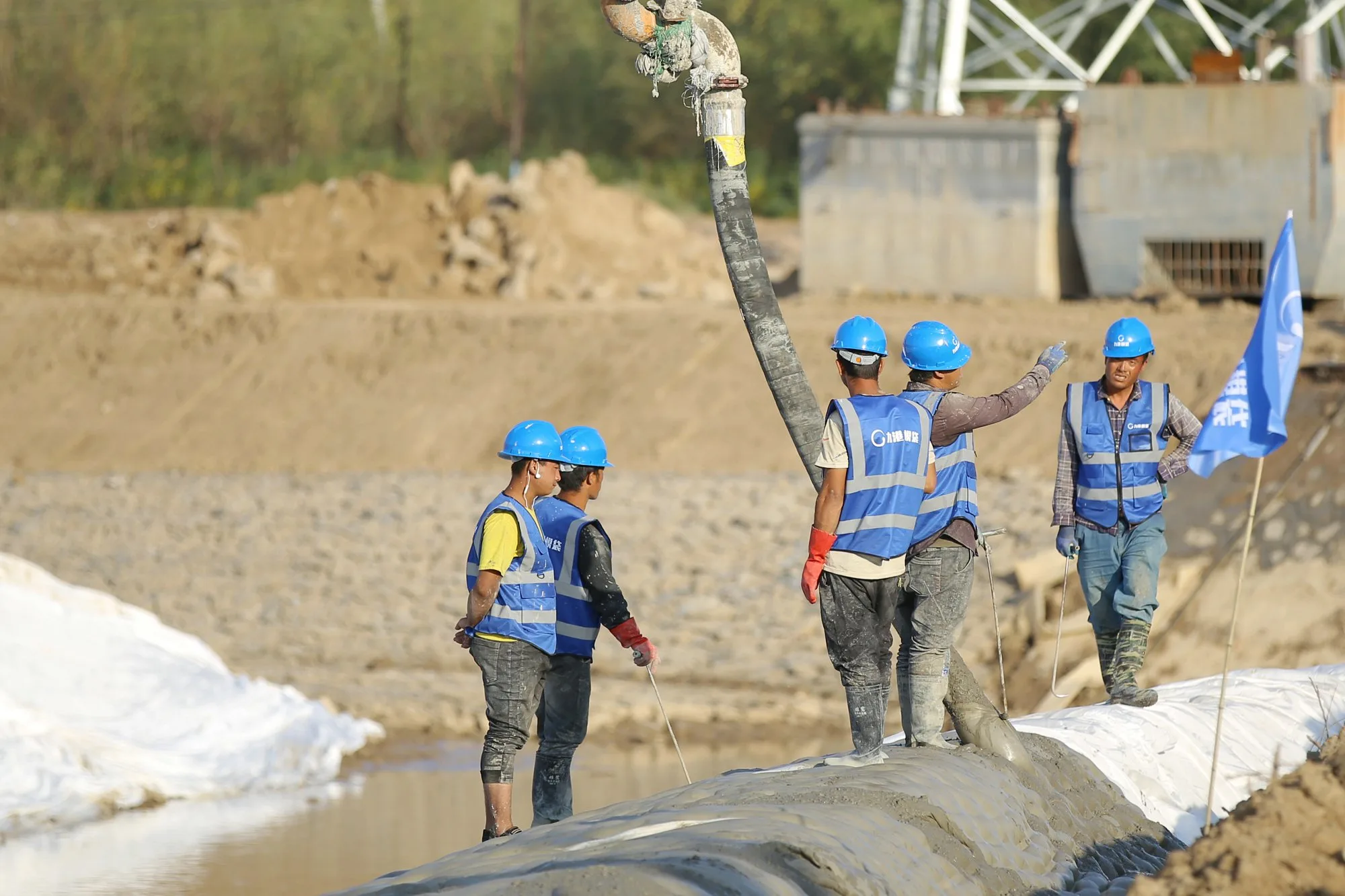
See also: how grouted mattress protects bridge pier foundations and our grouted mattress vs rip-rap comparison.
Frequently Asked Questions
How do I know if my bridge needs scour protection?
All bridges over waterways should be assessed for scour vulnerability. In the United States, FHWA requires scour assessment for all National Highway System bridges and recommends it for all other bridges over watercourses. Key indicators of scour risk: the bridge was built before modern scour design standards (pre-1990s in most countries); the pier is in a channel that has visibly migrated or is actively eroding; post-flood inspections have identified changes in riverbed level around the piers; or the bridge is classified as a scour-critical structure in the national bridge inventory.
Can grouted mattress be installed around piers in fast-flowing rivers?
Yes, up to approximately 1.5 m/s surface velocity for diver-assisted installation using guide frames. Above 1.5 m/s, a temporary flow diversion or the use of a larger guide frame with additional weight is required to hold panels in position during placement. HydroBase has completed pier scour installations in flow velocities up to 2.5 m/s using specialised guide frame systems. Contact our engineering team to discuss high-velocity pier installations.
How thick should the grouted mattress be for bridge pier scour?
FHWA HEC-23 recommends a minimum of 200 mm for grout-filled mattress at bridge piers, regardless of the hydraulic design velocity. The 200 mm thickness provides sufficient mass (approximately 310 kg/m²) to resist hydrodynamic lift and to self-launch into developing scour holes. In high-velocity environments (>4.0 m/s at the bed level), additional ballasting may be required — consult a hydraulic engineer for site-specific design.
Does bridge pier scour protection require an engineer's stamp?
Yes — in virtually all jurisdictions, scour countermeasure design for highway bridges requires review and approval by a licensed civil or structural engineer. The design must demonstrate compliance with the applicable national standard (FHWA HEC-18/23 in the US; BD 97/12 in the UK; GB 50286 in China). HydroBase provides material specifications and installation guidance; the hydraulic design and engineering certification are the responsibility of the project engineer of record.
HydroBase manufactures grouted mattress for bridge pier scour protection to GRI GT16. Panels pre-cut to your pier geometry, dispatched in 48 hours. Our engineering team will review your scour assessment data and recommend the correct collar dimensions. Request a free scour protection assessment.
HydroBase Technical Team
HydroBase manufactures grouted mattresses (GRI GT16 compliant) in China and delivers to 30+ countries. Our engineering team provides specification support, grout mix design, and installation guidance.
About HydroBaseMore Articles
View all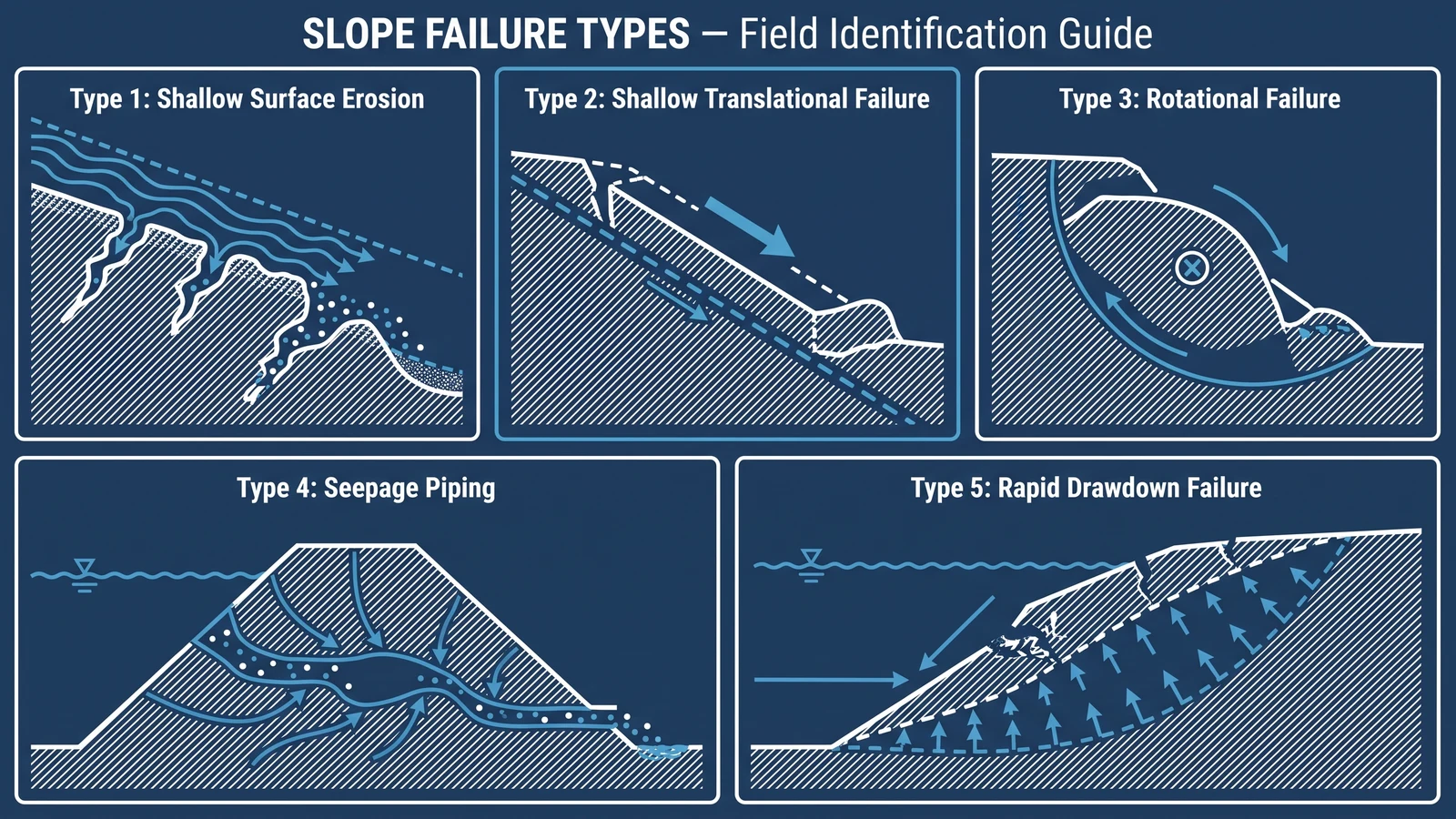
Slope Failure Causes and Prevention: Field Guide
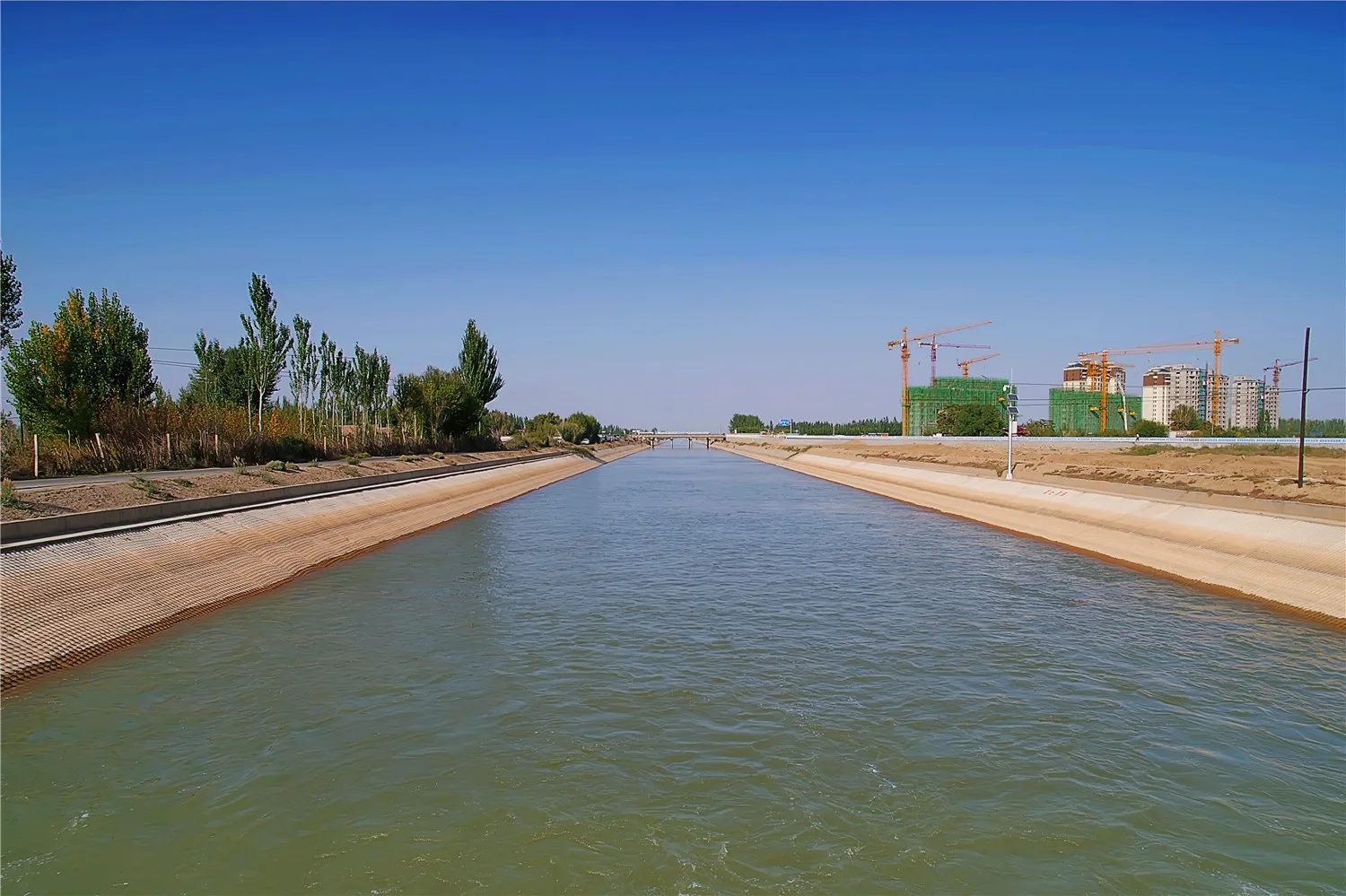
Slope failures on canal embankments, reservoir faces, and road cuttings follow recognisable patterns. This field guide covers the five main slope failure types — shallow surface erosion, shallow translational, rotational, piping, and rapid drawdown — with prevention measures for each.
Grouted Mattress Case Studies: 5 Projects, Real Data
Five real grouted mattress installations across canal lining, river bank protection, coastal revetment, reservoir lining, and bridge pier scour — with actual project areas, design parameters, installation programmes, and post-installation performance data.
Canal Lining Failure: 7 Causes and How to Prevent Them
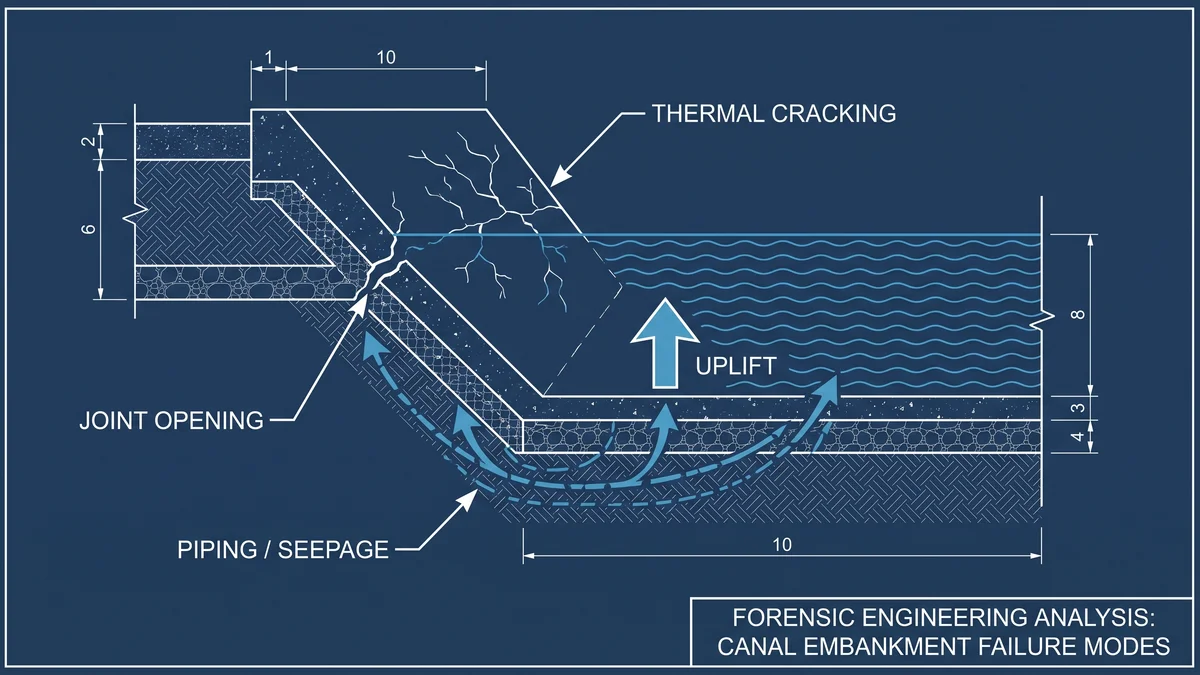
Canal lining failures cost irrigation authorities billions annually in emergency repairs and lost water. This forensic guide identifies the 7 most common failure causes — from joint failure to uplift — and explains how to prevent each through better specification and installation.
HydroBase - China Manufacturer
Ready to Specify Grouted Mattress?
GRI GT16 compliant products, factory test reports included. Engineering support at no cost. 48-hour response.