
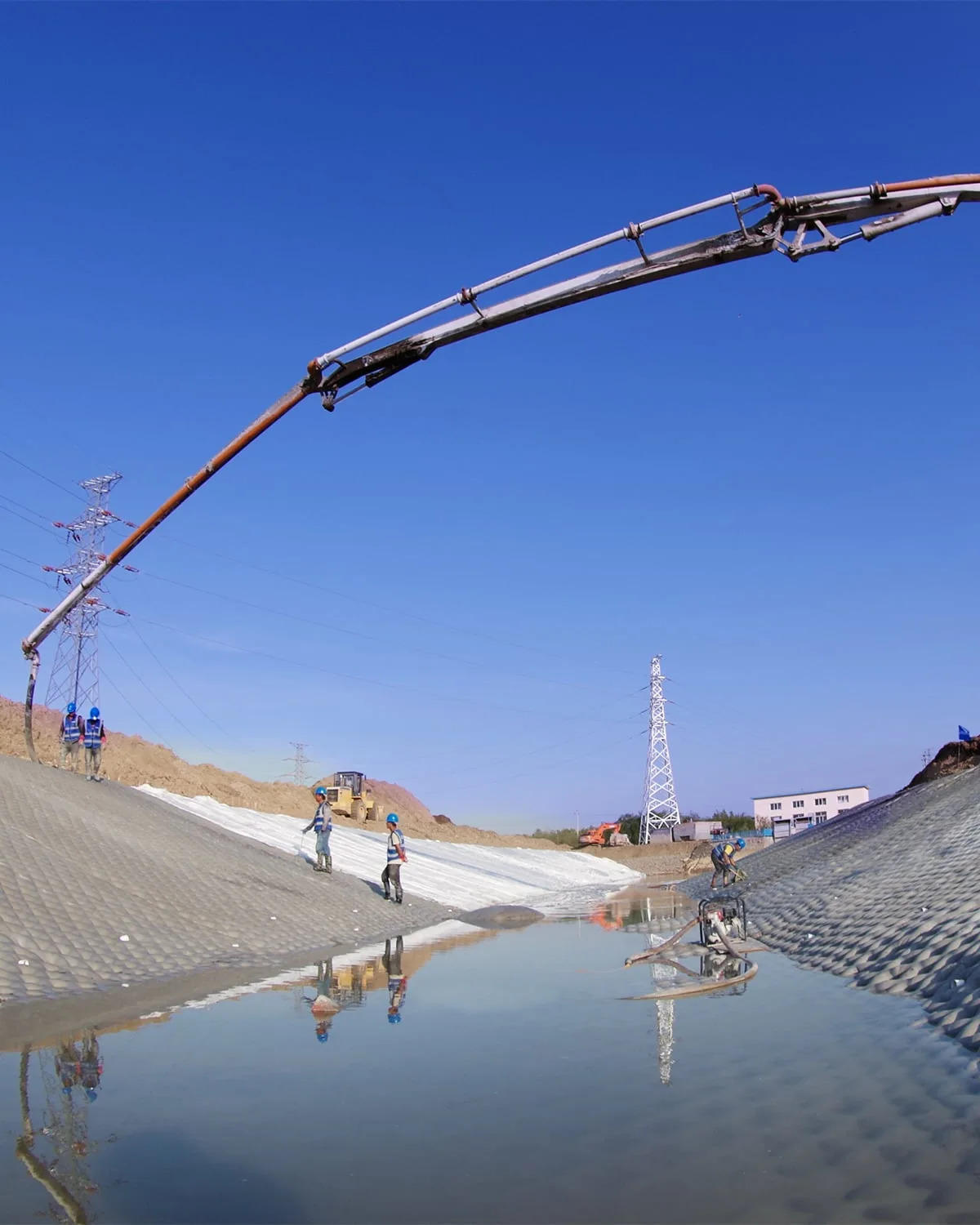
Flood Embankment Overtopping Protection: Design Guide
Quick Summary
Levee failures during overtopping are almost always due to erosion of the downstream slope. Grouted mattress provides concrete-hard overtopping protection for flood embankments — this guide covers design, installation, and regulatory requirements.
Quick Answer: Most levee failures during major floods are caused by overtopping erosion of the downstream slope — not by the overtopping itself. A flood embankment protected with grouted mattress on the downstream face can resist overtopping erosion at velocities up to 4.5 m/s (150 mm mattress) — significantly longer than an unprotected clay slope — buying hours or days of emergency response time. Performance depends on correct mattress thickness selection and grout strength; no protection eliminates flood risk entirely. This guide covers the hydraulic design of overtopping protection for flood embankments and levees.
The distinction between a flood embankment that fails at first overtopping and one that survives for hours is almost entirely about the downstream slope protection. Clay slopes erode rapidly once overtopping begins — research from the USACE and Deltares shows that unprotected clay levees typically fail within 30–120 minutes of overtopping at design head. A grouted mattress protected slope can sustain the same overtopping flow for 6–24+ hours, depending on the velocity and mattress thickness.
This time differential is critical for emergency management — it determines whether there is time to execute an evacuation, deploy temporary barriers, or close upstream gates before catastrophic breach. For flood defence infrastructure in populated areas, this resilience margin is increasingly specified as a design requirement.
How Levees Fail During Overtopping
The failure sequence for an overtopped clay levee without downstream protection is well-documented:
- Overtopping begins at the low point of the levee crest — initially a thin sheet flow
- Flow accelerates down the downstream face — velocities of 2.0–4.0 m/s typical for a 3–5 m high levee
- Surface erosion begins on the clay slope — grass roots detach within minutes at >2.0 m/s
- A rilling pattern develops — small channels deepen progressively, concentrating flow
- A headcut migrates up the slope — a near-vertical erosion face that progresses rapidly once established
- Breach occurs — typically within 1–3 hours of initial overtopping for unprotected clay
Grouted mattress interrupts this sequence at step 3 — the concrete surface provides shear resistance far exceeding the hydraulic shear stress generated by the overtopping flow, preventing surface erosion and the rilling pattern that leads to headcut formation.
How Long Can a Slope Survive Overtopping?
Research by Deltares (EroGrass project, 2012) and USACE testing at the Engineering Research and Development Center quantified failure times for common downstream slope protection types at overtopping discharges of 0.1–1.0 m³/s/m. The data below reflects representative results for a 3 m high levee with 1:3 downstream slope:
| Downstream Slope Protection | Time to Breach (q = 0.1 m³/s/m) | Time to Breach (q = 0.5 m³/s/m) | Emergency Action Time Available |
|---|---|---|---|
| Bare clay (no protection) | 30–90 min | 15–30 min | Minimal — often insufficient for evacuation |
| Good grass cover (temperate) | 2–6 hours | 30–90 min | Moderate — adequate for alert, limited evacuation |
| Grouted mattress 100 mm | >12 hours | 4–8 hours | Good — allows organised response and evacuation |
| Grouted mattress 150 mm | >24 hours | 8–24 hours | Excellent — sustained overtopping survivable |
Design Velocity for Levee Overtopping Protection
The design velocity on the downstream slope during overtopping is calculated from:
- Overtopping unit discharge q (m³/s/m) — derived from the design overtopping scenario (typically the 1-in-1000-year event, or the probable maximum flood depending on the consequence classification)
- Downstream slope angle — steeper slopes generate higher velocities
- Manning's roughness of the slope surface — grouted mattress n = 0.016–0.020
For a typical secondary flood levee (3 m height, 1:3 downstream slope, design overtopping q = 0.1 m³/s/m), the downstream slope velocity is approximately 1.5–2.0 m/s — within the capacity of 100 mm grouted mattress. For primary flood defences in major floodplains (5 m height, q = 0.5–1.0 m³/s/m), design velocities of 3.0–4.5 m/s require 150–200 mm mattress.
| Levee Class | Design Overtopping q | Slope Velocity (1:3 slope) | Recommended Mattress |
|---|---|---|---|
| Agricultural (low consequence) | 0.01–0.05 m³/s/m | 0.8–1.5 m/s | 100 mm |
| Secondary (medium consequence) | 0.05–0.20 m³/s/m | 1.5–2.5 m/s | 100–150 mm |
| Primary (high consequence) | 0.20–1.0 m³/s/m | 2.5–4.0 m/s | 150–200 mm |
| Critical (urban, major infrastructure) | > 1.0 m³/s/m | > 4.0 m/s | 200 mm + specialist design |
Crest and Upstream Face: What Protection Is Needed?
The crest of the levee is exposed to the highest turbulence during overtopping — flow transitions from subcritical to supercritical as it passes the crest, generating locally very high shear stresses. The crest should be protected with the same thickness specified for the downstream slope, extending from the upstream berm edge to the downstream crest edge (typically the full 3–6 m crest width).
The upstream face of the levee during a flood event is exposed to wave action and rapid drawdown on the receding flood — same design scenario as a reservoir upstream face. Filter point grouted mattress is specified on the upstream face for the same rapid drawdown reason as reservoir applications.
Regulatory Requirements for Levee Overtopping Protection
Post-Katrina (2005), the US levee safety programme has driven significant upgrading of flood embankment design standards. Key references:
- USACE ETL 1110-2-583 — Engineering and Design: Filter Design for Levees
- FEMA P-1015 — Design Guide for Improving Critical Facility Safety from Flooding
- In the Netherlands (the global benchmark for flood defence), the Deltawerken standards require overtopping protection capable of withstanding 10× the design overtopping discharge without failure
In the UK, Environment Agency standards (HA 78/06) specify that levee downstream slopes must be assessed for overtopping resilience as part of every levee safety review. Grouted mattress is listed as an accepted hard armour in all these frameworks.
For related design guidance, see our articles on slope protection design for canals and reservoirs and river bank erosion protection methods.
Frequently Asked Questions
Can grouted mattress be retrofitted to existing levees?
Yes — this is one of the most common flood risk reduction interventions. The existing vegetation and topsoil on the downstream slope is stripped (typically 150 mm depth), the slope regraded to ±50 mm tolerance, and grouted mattress deployed and pumped. The installation is completed from the crest working downward. No dewatering is required — even if the levee is moist from recent flooding, the mattress can be installed on the damp slope surface. Typical programme: 2,000–3,000 m²/week per crew.
Does grouted mattress on the downstream slope change the levee stability?
The weight of the completed mattress (155–310 kg/m² depending on thickness) adds mass to the downstream slope. This is a stabilising effect in most cases — the added weight increases the normal force on the slope, improving overall slope stability. A slope stability check (Bishop simplified method or similar) should be performed for the as-built condition, confirming that the added mattress weight does not reduce the factor of safety below design requirements. In practice, this is rarely a constraint — the weight is modest compared to the embankment fill.
Is grouted mattress suitable for peat or very soft subgrade levees?
Peat and soft organic subgrades present a bearing capacity challenge — the completed mattress weight of 155–310 kg/m² must be supported by the subgrade without excessive settlement. For peat levees with CBR <1%, a load-spreading geogrid layer beneath the mattress may be required to distribute the mattress weight. HydroBase engineering team can review subgrade test data and confirm whether a geogrid layer is required. For CBR <0.5% (very soft peat), an alternative lightweight slope protection system may be recommended.
HydroBase has supplied grouted mattress for flood embankment overtopping protection projects across China, the Netherlands, Bangladesh, and Southeast Asia. Our engineering team can review your levee cross-section and overtopping scenario and recommend the correct mattress specification. Request a free levee protection assessment.
HydroBase Technical Team
HydroBase manufactures grouted mattresses (GRI GT16 compliant) in China and delivers to 30+ countries. Our engineering team provides specification support, grout mix design, and installation guidance.
About HydroBaseMore Articles
View all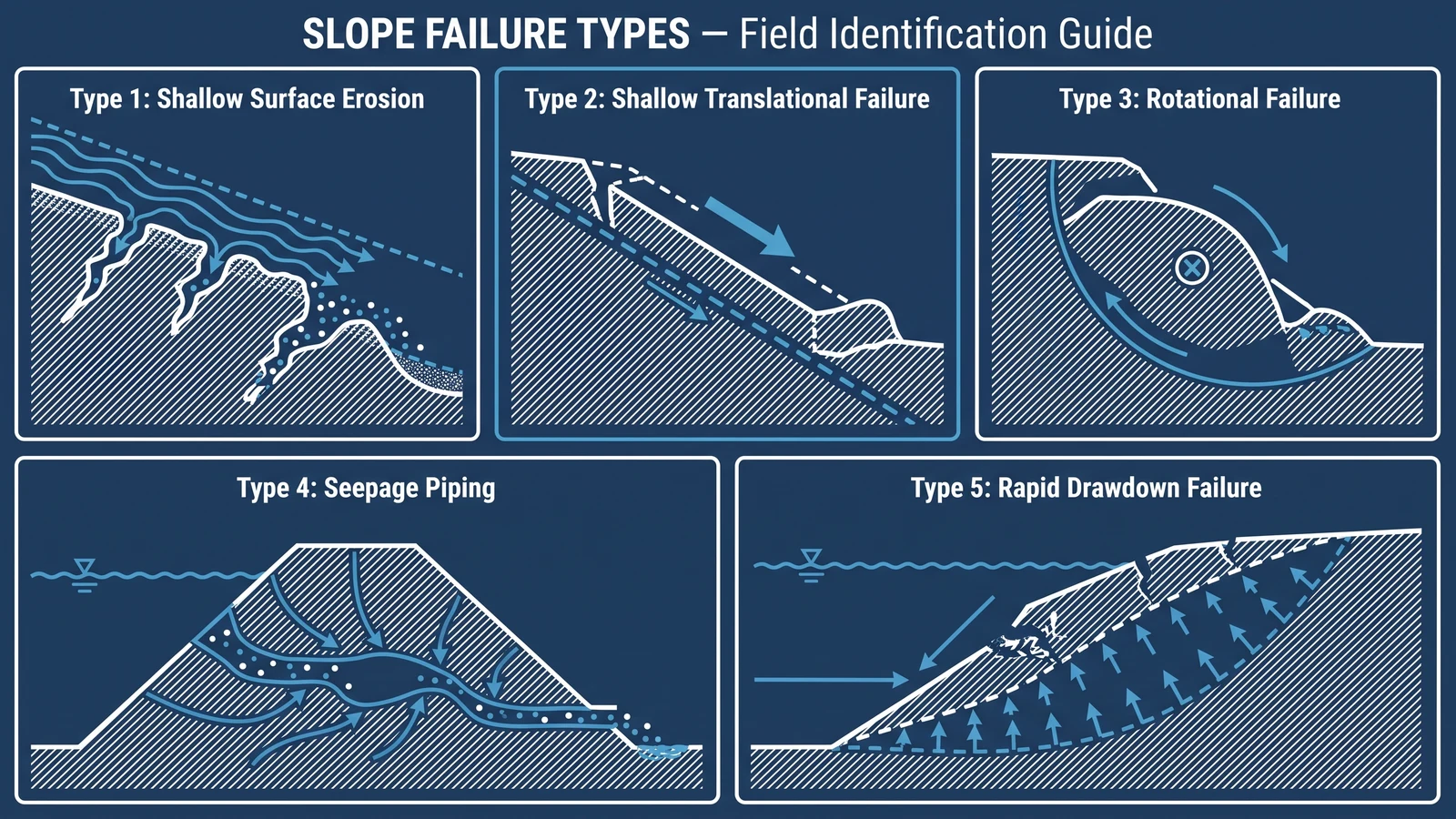
Slope Failure Causes and Prevention: Field Guide
Slope failures on canal embankments, reservoir faces, and road cuttings follow recognisable patterns. This field guide covers the five main slope failure types — shallow surface erosion, shallow translational, rotational, piping, and rapid drawdown — with prevention measures for each.
Grouted Mattress Case Studies: 5 Projects, Real Data
Five real grouted mattress installations across canal lining, river bank protection, coastal revetment, reservoir lining, and bridge pier scour — with actual project areas, design parameters, installation programmes, and post-installation performance data.
Canal Lining Failure: 7 Causes and How to Prevent Them
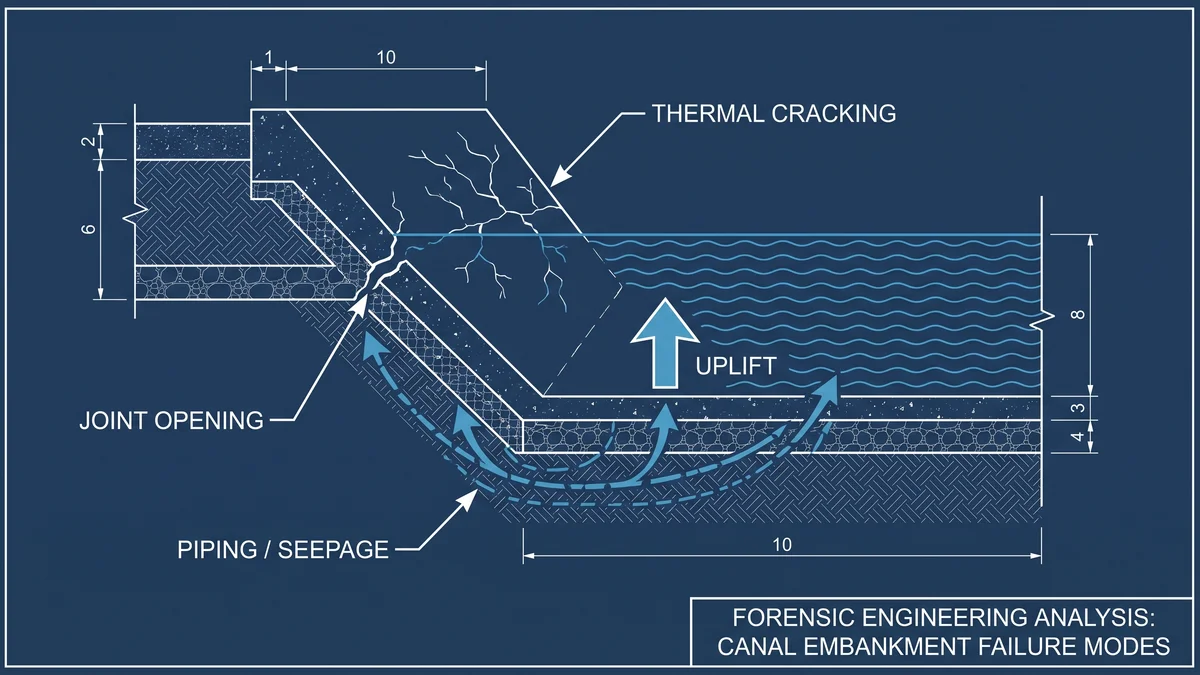
Canal lining failures cost irrigation authorities billions annually in emergency repairs and lost water. This forensic guide identifies the 7 most common failure causes — from joint failure to uplift — and explains how to prevent each through better specification and installation.
HydroBase - China Manufacturer
Ready to Specify Grouted Mattress?
GRI GT16 compliant products, factory test reports included. Engineering support at no cost. 48-hour response.