
Canal & Reservoir Slope Protection: Design Guide
Quick Summary
A complete design guide to slope protection for irrigation canals, reservoir faces, and embankment slopes. Covers hydraulic shear stress, system selection, thickness design, and installation requirements.
Quick Answer: For reservoir upstream faces and canal slopes with design velocity above 2.0 m/s where dewatering is impractical, grouted mattress (100–200 mm) is often the most cost-effective slope protection system — flexible enough to tolerate settlement, concrete-hard once cured, and installable without dewatering. For lower-velocity agricultural canal slopes, compacted clay or thin concrete may be adequate. This guide walks through the full design process from hydraulic shear stress calculation to system selection and installation specification.
Canal and reservoir slope protection is specified on nearly every major irrigation, water storage, and flood management project worldwide. Yet specification errors are common — systems specified too thin fail under design velocity; systems specified for seepage control but not scour resistance fail when the water level drops rapidly. This guide covers the complete design process.
For a broader comparison of all lining options including flat canal inverts, see Canal Lining Methods: Complete Comparison. For river bank applications, see River Bank Erosion Protection: 6 Methods Compared.
Understanding the Loads on a Canal or Reservoir Slope
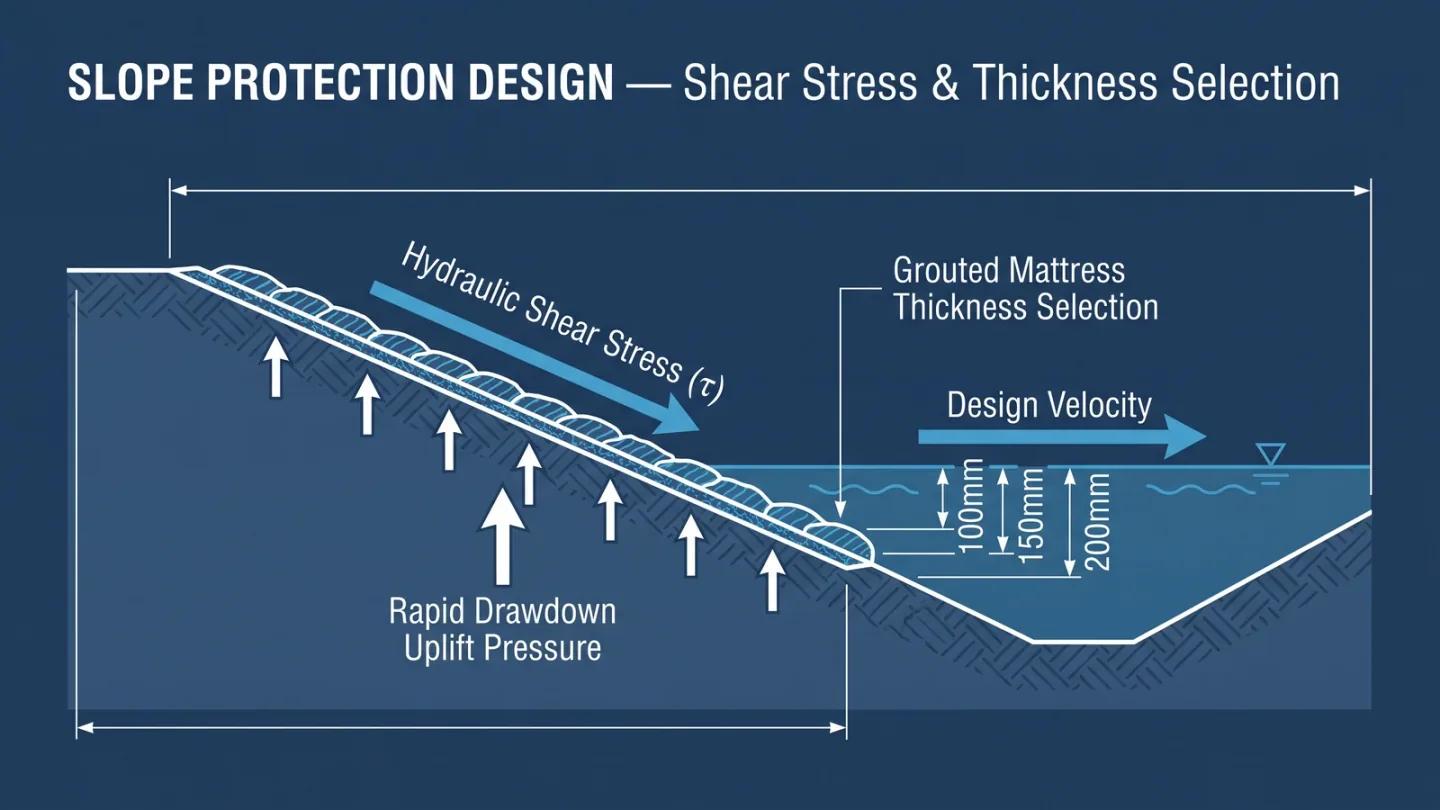
A slope protection system on a canal or reservoir faces three distinct load types, and the design must address all three:
1. Hydraulic Shear Stress (Flow-Induced Erosion)
Water flowing along a canal exerts a shear stress on the lining surface. The critical shear stress — the stress at which the lining material begins to fail — is the key design parameter. For grouted mattress, the critical shear stress exceeds 1,000 N/m² (far above the 200–400 N/m² typical of design conditions). For riprap, it depends on rock size. For clay, it depends on plasticity and compaction — typically 10–50 N/m².
2. Uplift from Hydrostatic Pressure Reversal (Rapid Drawdown)
When a reservoir is drawn down rapidly — during drought operation, emergency release, or maintenance — the pore pressure in the embankment remains elevated while the external water pressure drops. The resulting net upward pressure can detach a rigid, impermeable lining from the slope face. This is why filter point grouted mattress is specified for reservoir upstream faces rather than the standard impermeable type — the filter openings allow controlled drainage of pore pressure.
3. Wave Action and Vessel Wash
On reservoirs, the wave run-up zone on the upstream face is subject to repeated wave loading. Wave height and period determine the required armour weight. On navigable canals, vessel wash creates similar cyclic loading. The lining system must resist both the upward rush of the breaking wave and the backwash drawdown on the receding wave face.
Hydraulic Design: Selecting the Right Protection System
The design velocity at the slope surface determines which protection system is adequate. Use the mean channel velocity (from Manning's equation or hydraulic model) reduced by a slope correction factor — velocity on a canal side slope is typically 0.7–0.85× the mean channel velocity depending on the slope angle.
| Design Velocity at Slope (m/s) | Suitable Protection Systems | Notes |
|---|---|---|
| < 0.6 | Compacted clay, vegetation, GCL | Low energy — minimum protection needed |
| 0.6 – 1.5 | Compacted clay (high PI), riprap (D50 = 75 mm), gabion mattress | Moderate energy — vegetated options possible if establishment time available |
| 1.5 – 2.5 | Riprap (D50 = 150–200 mm), gabion, grouted mattress 75 mm | Hard protection required |
| 2.5 – 3.5 | Grouted mattress 100 mm, concrete 100 mm, riprap (D50 = 250 mm) | Standard grouted mattress range |
| 3.5 – 4.5 | Grouted mattress 150 mm, concrete 150 mm | High velocity — riprap uneconomic (large rock) |
| > 4.5 | Grouted mattress 200 mm, concrete 200 mm+ | Only rigid armour systems viable |
Grouted Mattress Thickness Selection for Slope Protection
Grouted mattress thickness is selected from the hydraulic design velocity and the relevant national standard (GRI GT16 for international projects; GB 50286 for Chinese water conservancy projects; CIRIA C742 for UK and Commonwealth projects).
| Thickness | Max Velocity (m/s) | Weight (kg/m²) | Typical Application |
|---|---|---|---|
| 75 mm | 2.5 | ~115 | Small irrigation laterals, minor drainage slopes |
| 100 mm | 3.5 | ~155 | Canal main stems, embankment slopes, river training |
| 150 mm | 4.5 | ~230 | Reservoir upstream face, coastal slopes, high-velocity canals |
| 200 mm | 6.0 | ~310 | Bridge pier collars, exposed coastal revetments, spillway slopes |
Fabric Type Selection: Standard vs Filter Point
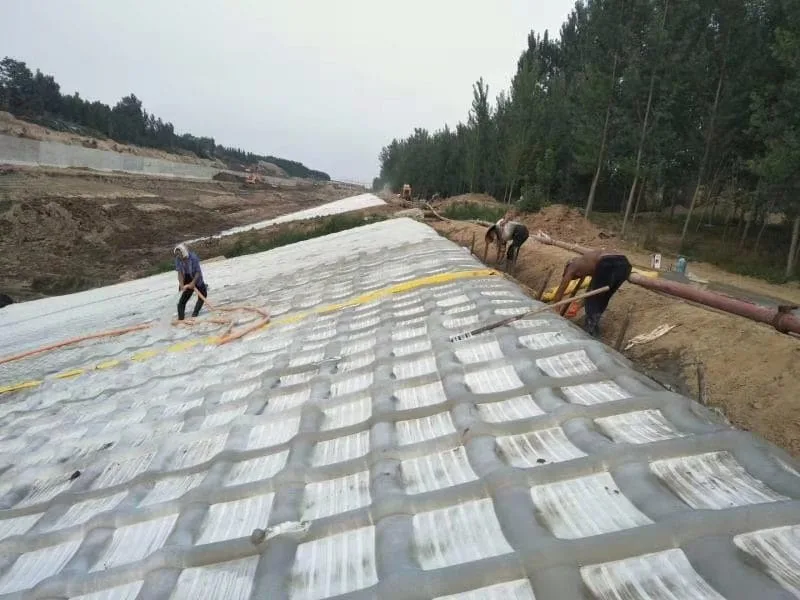
For canal slopes where seepage control is required, use standard grouted mattress — the impermeable woven face prevents through-seepage and provides full hydraulic efficiency. For reservoir upstream faces and tidal zones where rapid drawdown uplift is a design concern, use filter point grouted mattress — the drainage openings at cell intersections equalise pore pressure during drawdown, preventing detachment.
A useful rule of thumb: if the water level on one face of the slope can drop faster than excess pore pressure can dissipate through the embankment, filter point mattress is required. For most irrigation canal applications — where the canal is drawn down slowly and the embankment has adequate permeability — standard mattress is correct.
Slope Preparation Requirements
Grouted mattress tolerates significantly more subgrade irregularity than concrete — but subgrade preparation is still important for two reasons: (1) the fabric must lie flat for the grout to fill uniformly, and (2) the subgrade must provide adequate bearing for the finished mattress weight.
- Trim and compact the slope to the design profile within ±50 mm tolerance (compared to ±10 mm for concrete)
- Remove vegetation — grass and root matter will decompose under the mattress and create voids
- Geotextile separator — required on subgrades with CBR <3% to prevent piping. On competent clay or granular subgrades, the mattress fabric itself acts as the filter layer
- Slope stability check — confirm the completed mattress weight (155–310 kg/m²) does not exceed the slope's bearing capacity at the design subgrade strength
Installation on Slopes: Key Requirements
Slope installation differs from flat canal invert work in several important ways:
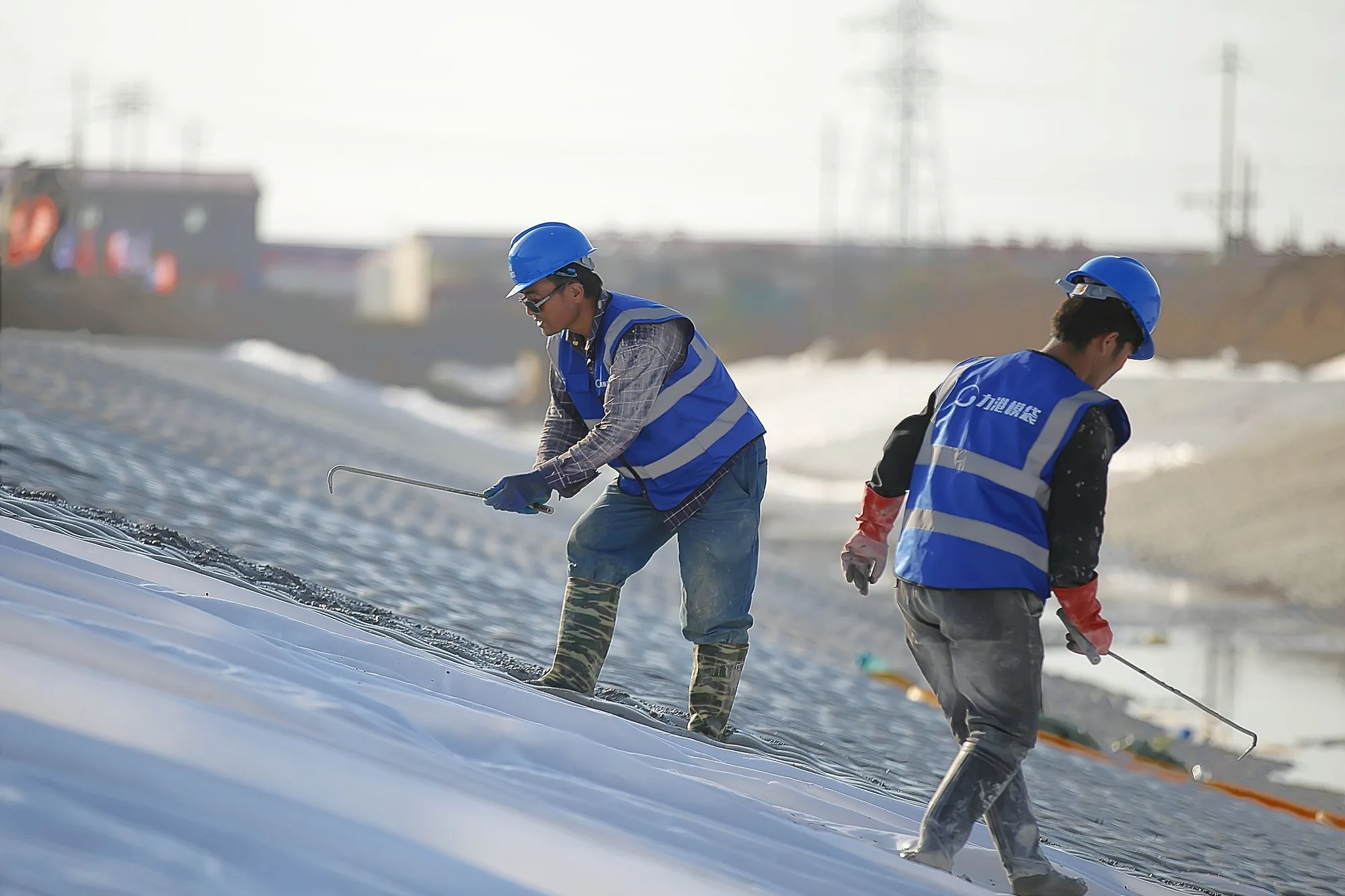
- Top-down placement — panels are unrolled from the crest downward, held at the top by steel anchor stakes at 2 m centres driven 600 mm into the crest
- Panel overlap — adjacent panels overlap 300 mm minimum in the direction of flow, with the upslope panel on top (shingle lap)
- Grout injection sequence — pump from the bottom of the panel upward to ensure air is expelled; avoid pumping from the top down as this traps air at the lower end
- Curing on slopes — water retention is more difficult on slopes; hessian sheets or curing compound applied immediately after pumping; misting for minimum 7 days
- Toe termination — the lower edge of the mattress should be anchored in a toe trench 300–500 mm deep, or lapped onto a horizontal apron on the canal invert
Key standards: USACE EM 1110-2-1601 Hydraulic Design of Flood Control Channels provides allowable velocity and slope stability design guidance. The Geosynthetic Institute publishes GRI GT16, the internationally recognised test standard for grouted geotextile mattress systems.
Frequently Asked Questions
What slope angle can grouted mattress be installed on?
Grouted mattress has been successfully installed on slopes from 1:5 (near-flat) to 1:1.5 (steep). Steeper slopes are possible but require additional anchor stakes and careful grout injection management to prevent the wet grout from flowing to the bottom of the panel before it sets. The practical limit for standard installation is approximately 1:1.25 (38.7°); steeper slopes require specialist installation procedures.
Does grouted mattress need a geotextile filter beneath it on a reservoir slope?
On a well-graded embankment fill with CBR ≥3%, no separate filter is required — the mattress fabric performs the filter function. On silty or gap-graded fills susceptible to piping, a non-woven geotextile separator (minimum 150 g/m², 4,500 N CBR puncture resistance) should be placed first. Always confirm with a particle size analysis and filter criteria check per USACE EM 1110-2-1901.
Can grouted mattress be used on the downstream face of an embankment dam?
Yes, though the downstream face is a less common application. The primary concern on a downstream face is overtopping — if the dam overtops, the grouted mattress can significantly reduce erosion damage to the downstream slope. Some dam safety rehabilitation projects specify grouted mattress on the downstream face specifically for overtopping resilience. The design velocity in this case is taken from the overtopping flow calculation, not normal operational conditions.
How is grouted mattress anchored at the top of a canal slope?
The standard detail is a crest anchor trench — a 300 mm × 300 mm trench at the top of the slope, into which the upper edge of the mattress is laid. After pumping, the trench is backfilled and compacted. This provides passive resistance against the hydrostatic weight of the grout sliding down the slope before it sets. For steep slopes, additional anchor pins through the mattress fabric into the slope face are used at 1.0–1.5 m centres.
HydroBase provides complete slope protection solutions for canal, reservoir, and embankment projects. Our engineering team will review your hydraulic design data — velocity, slope gradient, drawdown rate — and specify the correct product and installation details. Request a free technical review or download our specification sheet.
HydroBase Technical Team
HydroBase manufactures grouted mattresses (GRI GT16 compliant) in China and delivers to 30+ countries. Our engineering team provides specification support, grout mix design, and installation guidance.
About HydroBaseMore Articles
View all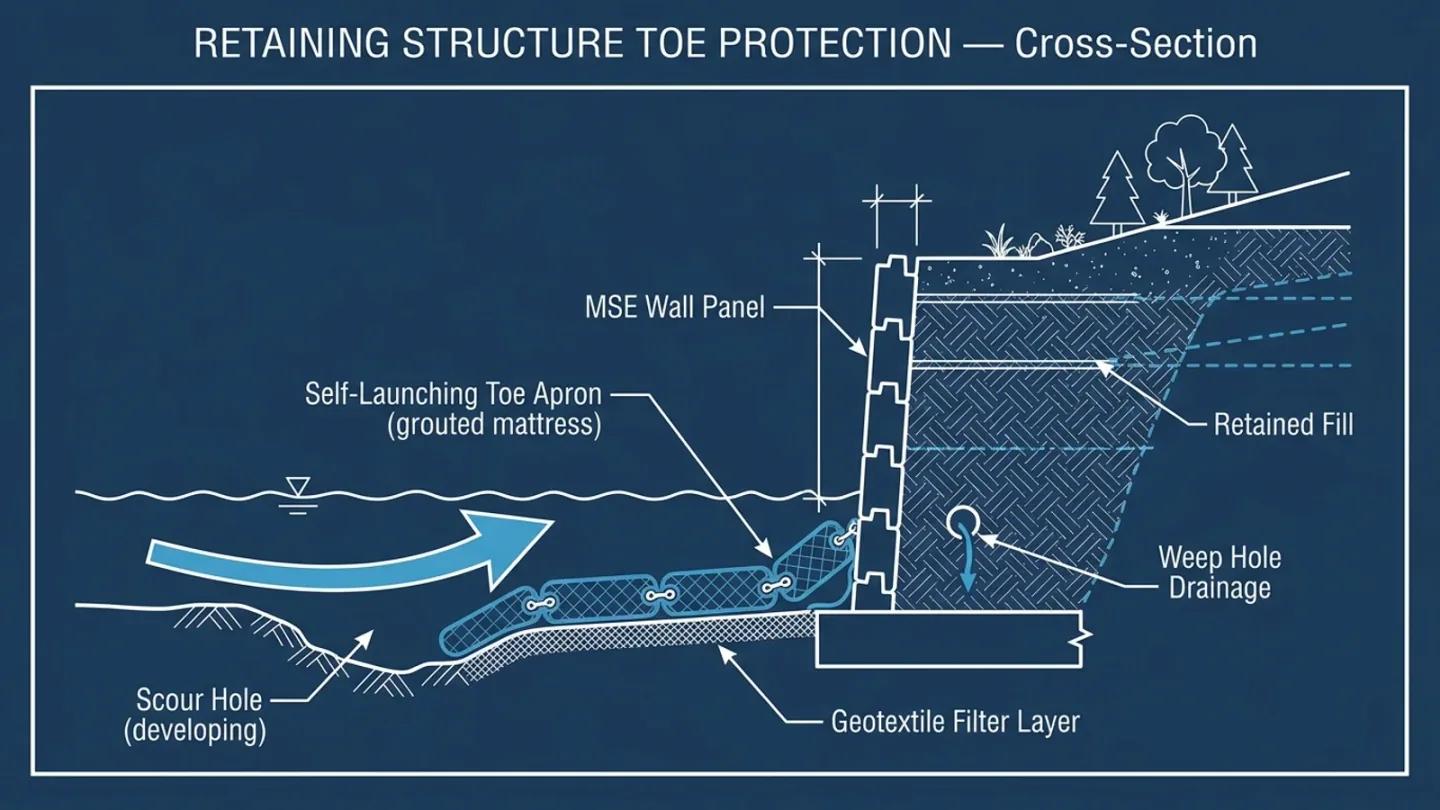
Erosion Control for Engineered Retaining Structures: MSE Walls, Canal Retaining, and Dam Toe Protection
Retaining structures fail more often from toe erosion and drainage problems than from the wall itself. This guide covers erosion control design at MSE walls, canal retaining structures, and dam toes.
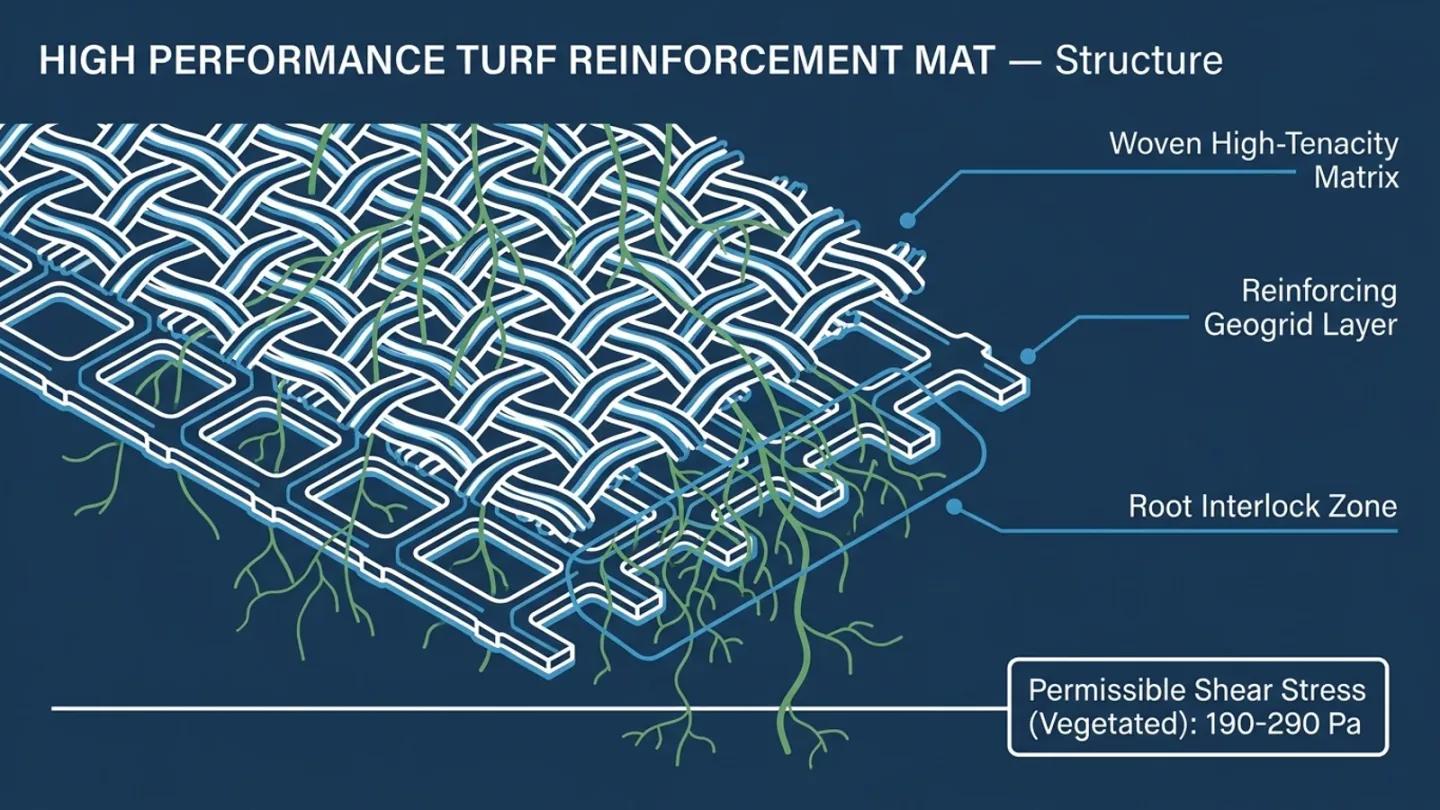
High Performance Turf Reinforcement Mat (HPTRM): Design and Specification Guide
High performance turf reinforcement mat extends vegetated erosion control into higher-velocity channels than standard TRM can handle. This guide covers the shear stress design method, matrix types, and specification requirements.
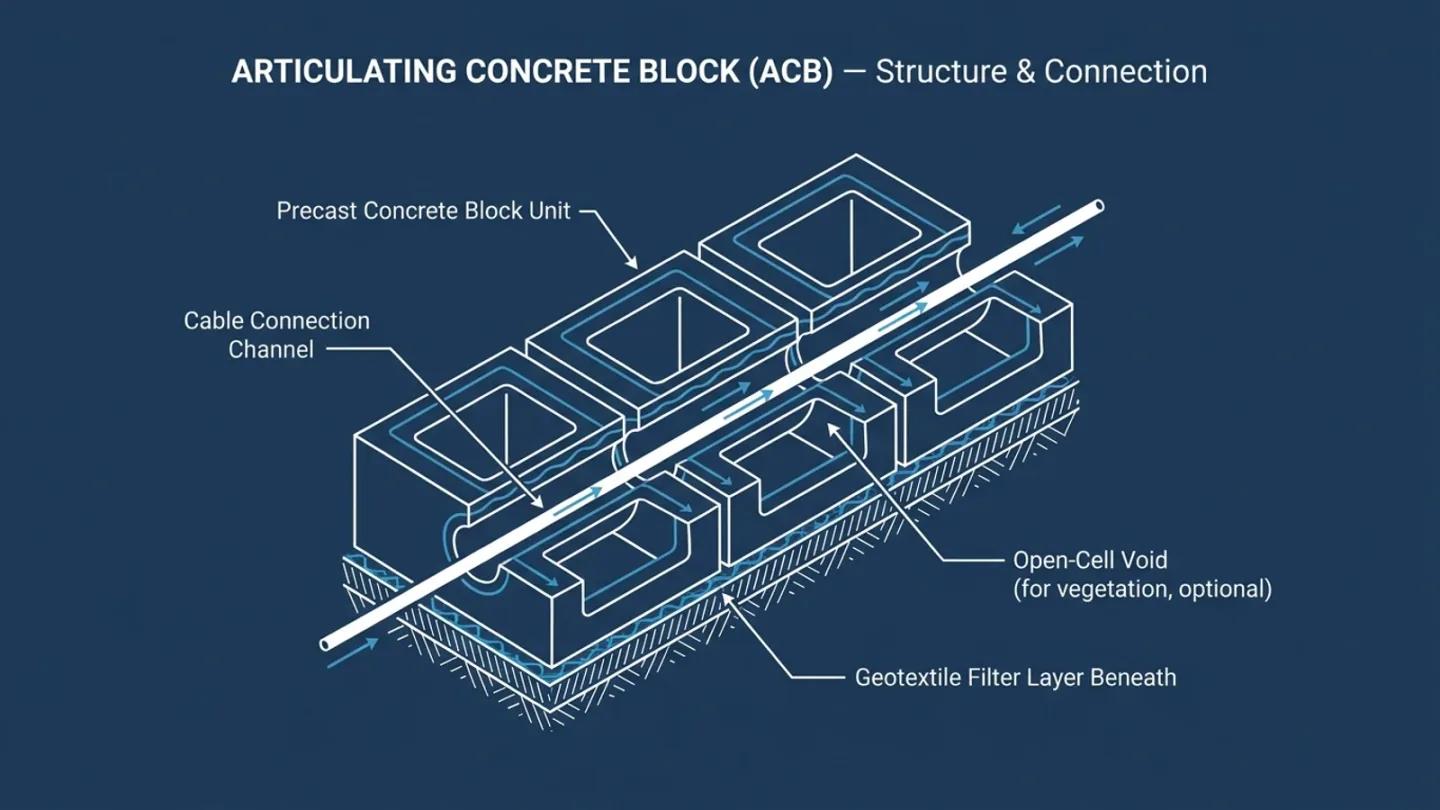
Articulating Concrete Block (ACB): Types, Cost, Specifications, and When to Choose It Over Grouted Mattress
Articulating concrete block (ACB) is a precast alternative to grouted mattress, connected by cables or geotextile through cast openings. This guide covers block types, costs, specification, and when each system is the better fit.
HydroBase - China Manufacturer
Ready to Specify Grouted Mattress?
GRI GT16 compliant products, factory test reports included. Engineering support at no cost. 48-hour response.