
Erosion Control for Engineered Retaining Structures: MSE Walls, Canal Retaining, and Dam Toe Protection
Quick Summary
Retaining structures fail more often from toe erosion and drainage problems than from the wall itself. This guide covers erosion control design at MSE walls, canal retaining structures, and dam toes.
Quick Answer: Engineered retaining structures — mechanically stabilised earth (MSE) walls, canal retaining walls, and dam toe structures — rarely fail from the retained soil mass itself. They fail from erosion and scour at the toe, undermining the foundation, or from uncontrolled drainage behind the wall face causing hydrostatic pressure buildup. Erosion protection at these structures needs to address both the toe scour condition and the drainage detail, not just armour the visible face.
Key Takeaways
- Retaining structures rarely fail from the retained soil; they fail from toe scour and blocked drainage.
- Toe scour that undermines 200 to 300 mm of foundation bearing can start a progressive failure (HydroBase design guidance, 2026).
- Size the toe apron at 1.5 to 2.5 times the anticipated scour depth, self-launching into the scour hole.
- Spillway toe protection of 150 to 200 mm grouted mattress is sized for stilling-basin exit velocity.
- Grouted mattress is protection in front of a retaining structure, never a substitute for it.
An MSE wall (mechanically stabilised earth wall) is a retaining wall whose backfill is reinforced in layers. Toe scour is erosion of the bed at the base of a structure. Hydrostatic pressure is the water pressure that builds behind a wall when drainage is blocked.
This guide is written for the large-scale infrastructure retaining condition — canal retaining walls, dam toes, and MSE walls on water-adjacent civil works — rather than residential or landscape retaining walls, which face a very different (much lower) hydraulic loading regime and are outside the scope of this article.
Why Retaining Structures Fail at the Toe, Not the Face
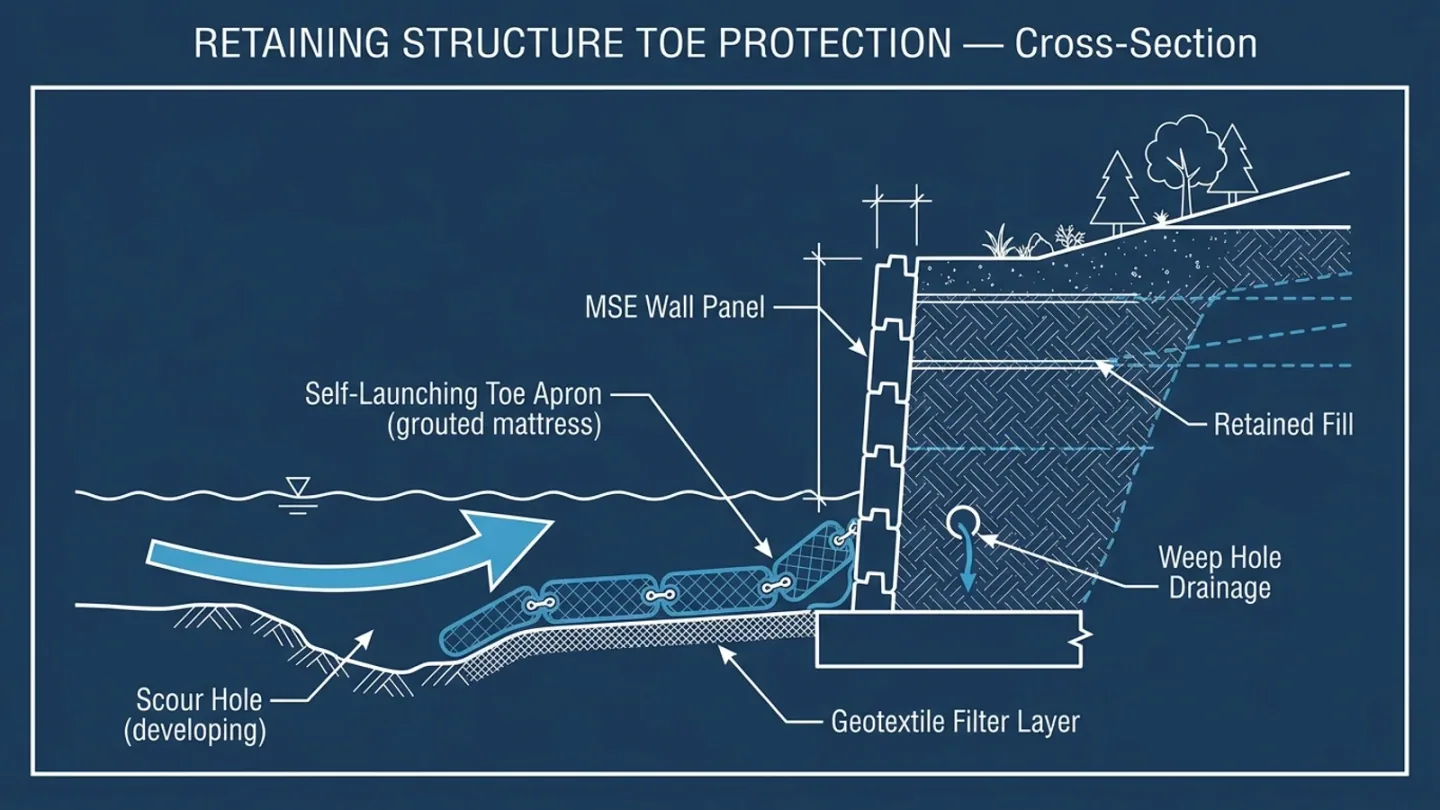
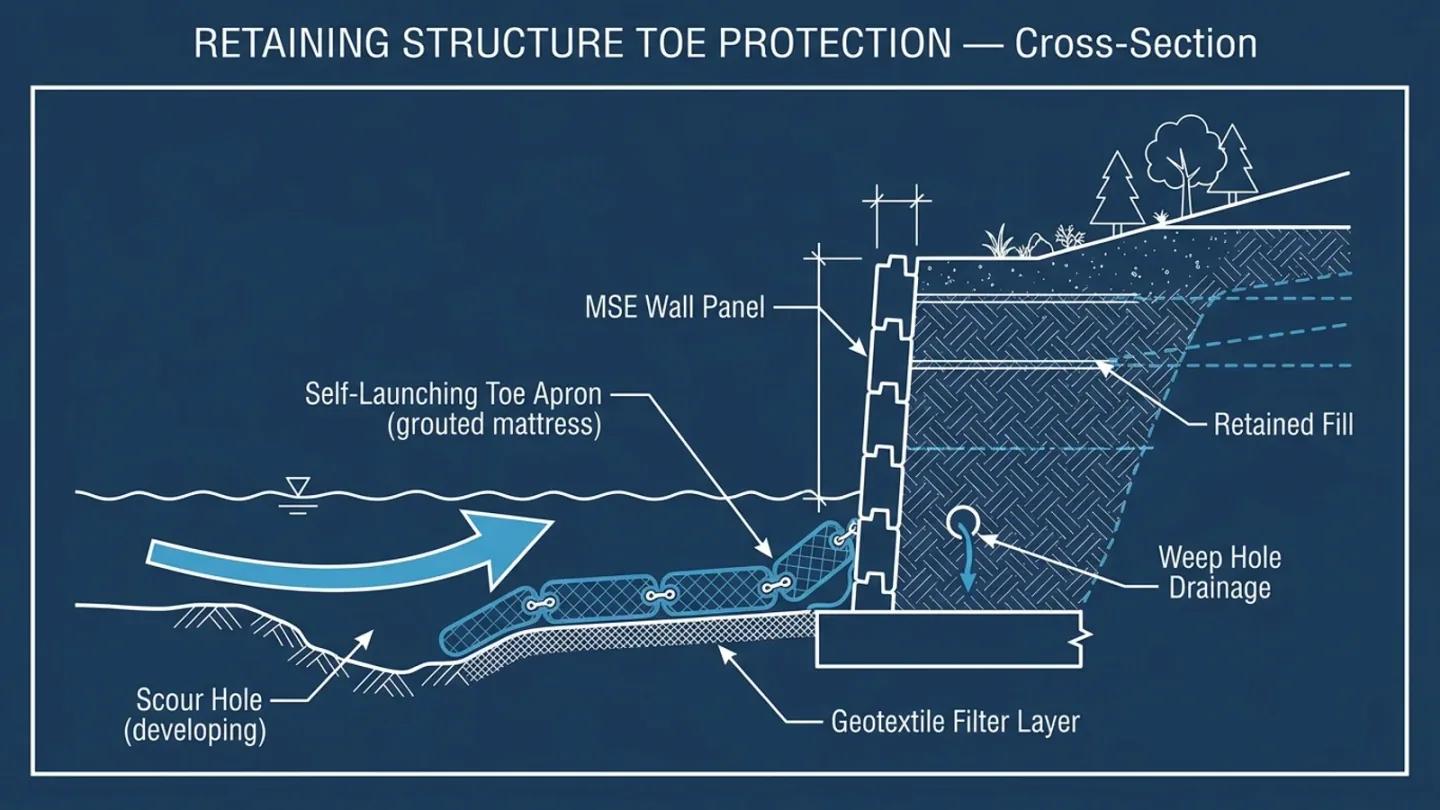
A correctly designed retaining wall resists the lateral earth pressure it was built for. What design calculations frequently underestimate is the erosive action of water at the structure's base — flow concentration at the wall toe, wave reflection off a vertical or near-vertical face, and scour from turbulence where flow velocity increases around the structure's leading edge. Toe scour that undermines even 200–300 mm of foundation bearing can initiate a progressive failure that has nothing to do with the wall's structural design.
MSE Wall Toe Protection
Mechanically stabilised earth walls used in canal, reservoir, or riverbank applications need toe protection sized for the local scour condition, not a generic thickness. Where an MSE wall sits adjacent to flowing water:
- Toe apron — a grouted mattress or riprap apron extending 1.5–2.5× the anticipated scour depth outward from the wall face, self-launching into the scour hole as it develops (a self-launching detail allows the apron to progressively settle into a developing scour hole rather than remaining rigid and being undermined)
- Filter layer — geotextile between the apron and the retained fill to prevent fines migration through the apron under seepage pressure reversal
- Drainage — weep holes or a drainage composite behind the wall panel to relieve hydrostatic pressure that would otherwise add to the design lateral load
Canal Retaining Wall Drainage and Erosion Detail
Canal retaining structures face a specific failure mode: rapid drawdown during maintenance shutdowns, when pore pressure in the retained fill remains elevated after the water level in the canal drops. See Canal Lining Failure Causes for the mechanics of this failure mode in lining generally — the same physics applies at retaining structures, with the added complication that a rigid wall cannot equalise pressure the way an articulated lining can.
Filter point grouted mattress is frequently specified as apron protection immediately in front of canal retaining walls precisely because its drainage openings allow pore pressure to dissipate during drawdown events without displacing the apron — the same seepage-control principle documented in the USACE engineer manual on seepage control for dams and levees.
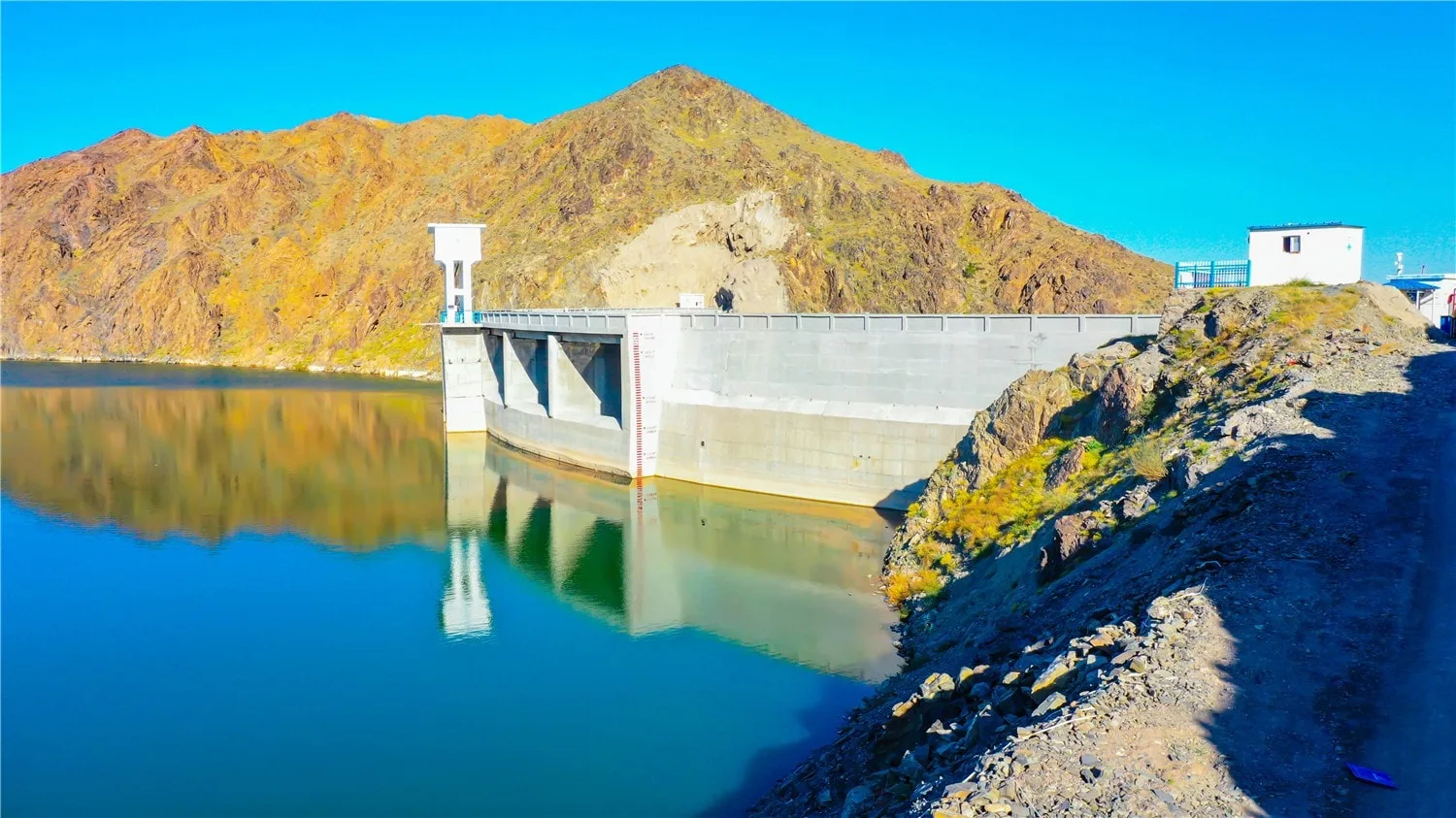
Dam Toe Erosion Protection
| Design Condition | Toe Protection Requirement |
|---|---|
| Spillway discharge energy dissipation | High-velocity resistant armour (grouted mattress 150–200 mm) sized for the stilling basin exit velocity, not the reservoir design velocity |
| Downstream toe drainage | Filter point system or drainage blanket to manage seepage exit gradient and prevent piping at the toe |
| Overtopping protection (emergency spillway or crest) | Full-crest and downstream-slope armour rated for overtopping flow — see Flood Embankment Overtopping Protection |
How Do You Size a Toe Apron? A Worked Example
Suppose the hydraulic study gives an anticipated scour depth of 1.5 m in front of a canal retaining wall. An apron extending 1.5 to 2.5 times that depth outward from the wall face would run from 2.25 m to 3.75 m. The apron should be self-launching, so that as the scour hole deepens the outer edge settles into it and keeps covering the bed. For a spillway stilling basin the governing figure is different: the apron thickness is chosen from the basin exit velocity, not the reservoir design velocity, and a 150 to 200 mm grouted mattress is rated for 4.5 to 6.0 m/s.
Which Specification Errors Recur at Retaining Structures?
- Armouring the visible face and leaving the toe to a generic apron thickness that was never checked against scour depth.
- Treating drainage as a wall detail only, so that weep holes discharge onto an apron that blocks them.
- Ignoring rapid drawdown at canal walls, where a rigid wall cannot equalise pore pressure the way an articulated lining can.
- Specifying mattress as the retaining element. It is protection in front of a structure, with no meaningful resistance to lateral earth pressure.
How Should Toe Protection Be Inspected?
Toe protection is often the first place to show distress, well before the wall itself moves. Walk the apron at least annually, and after any flood that approached the design discharge, looking for exposed apron edges, gaps between apron and wall, and fines washed out at the filter interface. Record the toe level against the as-built survey so that progressive scour is measured rather than guessed.
What Does a Toe Protection Clause Look Like?
A clause that works states the design basis and the performance requirement, not just a thickness. For example: the toe apron shall extend outward from the wall face a distance of not less than the stated multiple of the design scour depth confirmed by the hydraulic study, shall be self-launching, shall be laid over a geotextile filter separating it from the retained fill, and shall use grout-filled mattress complying with GRI GT16 with batch-specific third-party certificates. Add a separate drainage clause for weep holes or a drainage composite, and say that the apron shall not block their outlets.
What Does a Toe and Drainage Risk Register Include?
| Risk | Typical cause | Mitigation |
|---|---|---|
| Foundation undermined | Scour deeper than the apron was sized for | Confirm scour depth by hydraulic study, use a self-launching apron |
| Hydrostatic pressure behind wall | Blocked or missing drainage | Weep holes or drainage composite, apron outlets kept clear |
| Piping at the apron | No filter between apron and fill | Filter geotextile under the apron |
| Apron displaced | Under-anchored or under-sized armour | Anchor the apron and size it for the outlet or basin velocity |
| Late discovery | No toe monitoring | Annual inspection and post-flood checks against the as-built level |
Sources and Further Reading
- FHWA HEC-23: bridge scour and stream instability countermeasures.
- ICOLD: bulletins of the International Commission on Large Dams.
- Geosynthetic Research Institute: index of GRI specifications, including the GT series.
Frequently Asked Questions
How is toe scour depth estimated for design purposes?
Common methods include the Lacey regime equations for alluvial channels and site-specific hydraulic modelling for structures with complex flow patterns (spillways, wall corners, bends), consistent with the methodology in FHWA HEC-23. A geotechnical and hydraulic engineer should confirm the design scour depth before sizing any toe apron — using an undersized generic apron thickness is one of the most common specification errors at retaining structures.
Can grouted mattress be used as the retaining structure itself, not just toe protection?
No — grouted mattress is an erosion and scour protection facing, not a structural retaining system. It has no significant resistance to lateral earth pressure and should always be specified as protection applied to, or in front of, an engineered retaining structure (MSE wall, gravity wall, sheet pile wall), not as a substitute for one.
What inspection frequency is recommended for toe protection at dams and major retaining structures?
Per ICOLD dam safety guidance, annual visual inspection at minimum, with more frequent inspection following any flood event that approached or exceeded the design discharge. Toe protection is one of the first areas to show early distress before a structural problem becomes visible in the retaining structure itself.
Send the HydroBase engineering team your retaining structure type and hydraulic conditions for a toe protection recommendation within 48 hours.
HydroBase Technical Team
HydroBase manufactures grouted mattresses (GRI GT16 compliant) in China and delivers to 30+ countries. Our engineering team provides specification support, grout mix design, and installation guidance.
About HydroBaseMore Articles
View all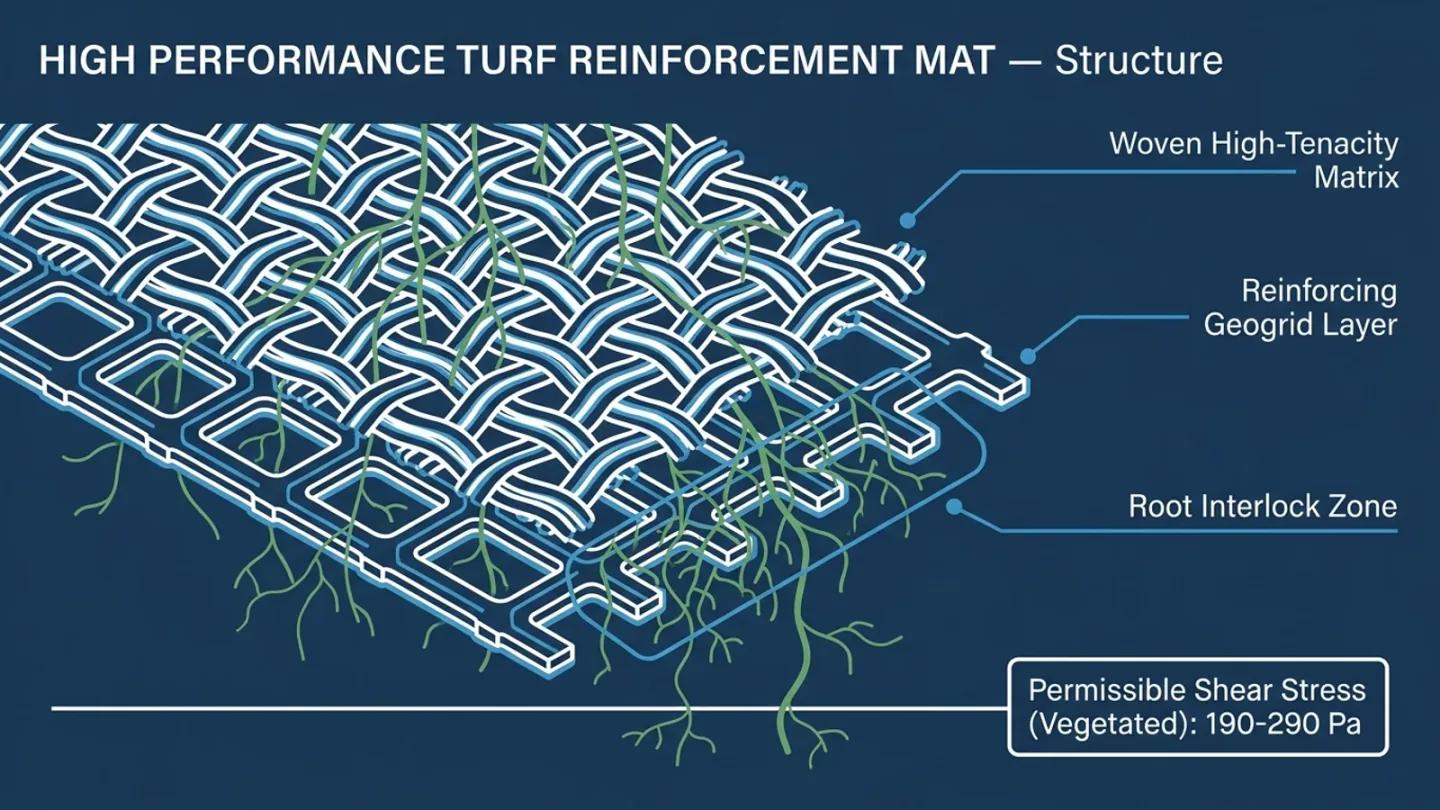
High Performance Turf Reinforcement Mat (HPTRM): Design and Specification Guide
High performance turf reinforcement mat extends vegetated erosion control into higher-velocity channels than standard TRM can handle. This guide covers the shear stress design method, matrix types, and specification requirements.
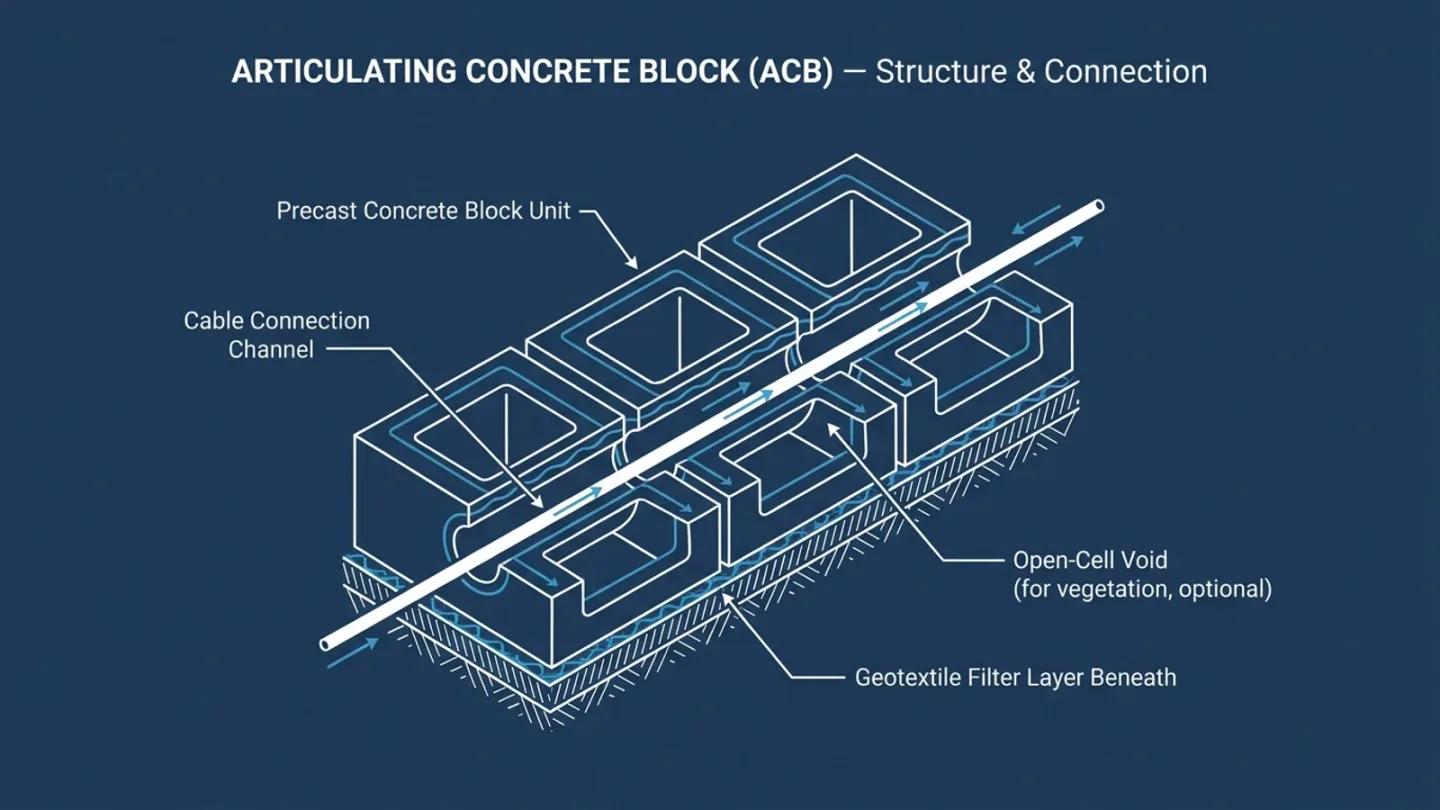
Articulating Concrete Block (ACB): Types, Cost, Specifications, and When to Choose It Over Grouted Mattress
Articulating concrete block (ACB) is a precast alternative to grouted mattress, connected by cables or geotextile through cast openings. This guide covers block types, costs, specification, and when each system is the better fit.
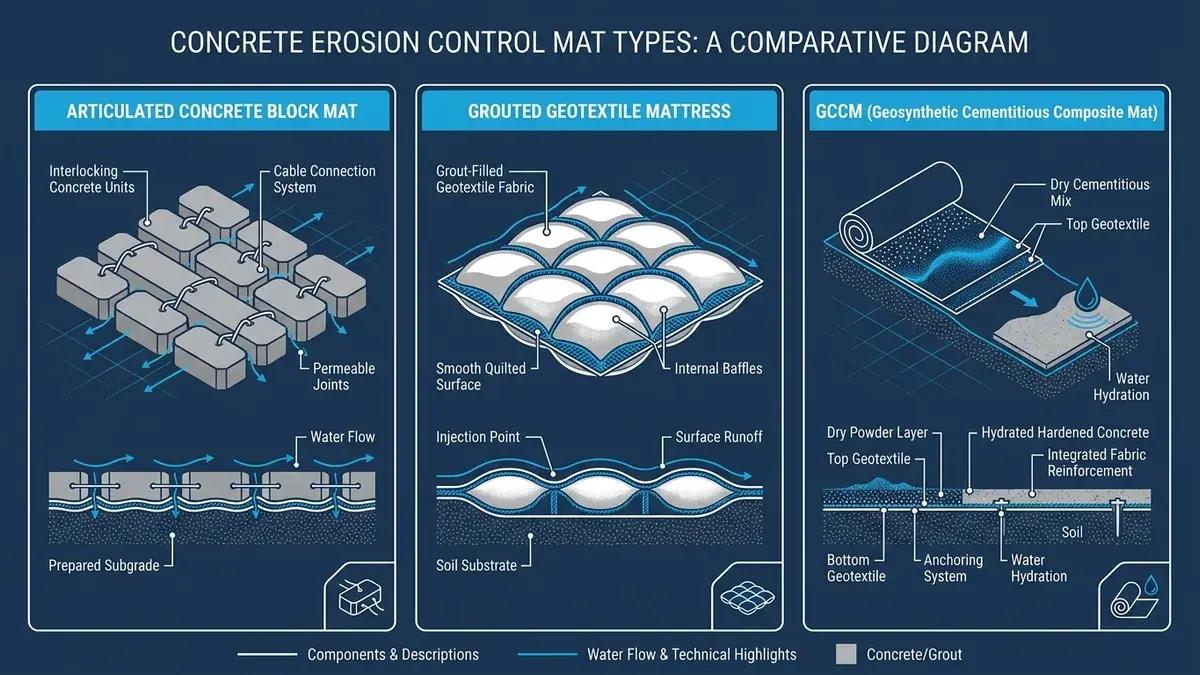
Geosynthetic Cementitious Composite Mat (GCCM): Complete Guide
Geosynthetic cementitious composite mat (GCCM) is a roll-out concrete fabric that cures on contact with water. This guide explains how it works, what it's suited for, and where it stops being the right choice.
HydroBase - China Manufacturer
Ready to Specify Grouted Mattress?
GRI GT16 compliant products, factory test reports included. Engineering support at no cost. 48-hour response.