
Articulating Concrete Block (ACB): Types, Cost, Specifications, and When to Choose It Over Grouted Mattress
Quick Summary
Articulating concrete block (ACB) is a precast alternative to grouted mattress, connected by cables or geotextile through cast openings. This guide covers block types, costs, specification, and when each system is the better fit.
Quick Answer: Articulating concrete block (ACB) is a precast, interlocking or cable-connected block revetment system, factory-cast and shipped ready to install — as distinct from grouted mattress (GGFM), which is a geotextile fabric form pumped with cement grout on site. ACB suits sites with straightforward access, dry installation, and a need for a walkable, open or closed-cell surface. GGFM suits sites requiring underwater or flowing-water installation, irregular subgrade conformance, or the highest design velocities. Installed cost for both systems typically falls in the $30–$55/m² range, with the deciding factor usually being installation conditions rather than price.
ACB and GGFM are frequently specified against each other, and frequently confused, because both are described in marketing material as "articulated concrete" erosion protection. The construction method, and consequently the site conditions each is suited to, are fundamentally different.
What Is Articulating Concrete Block?
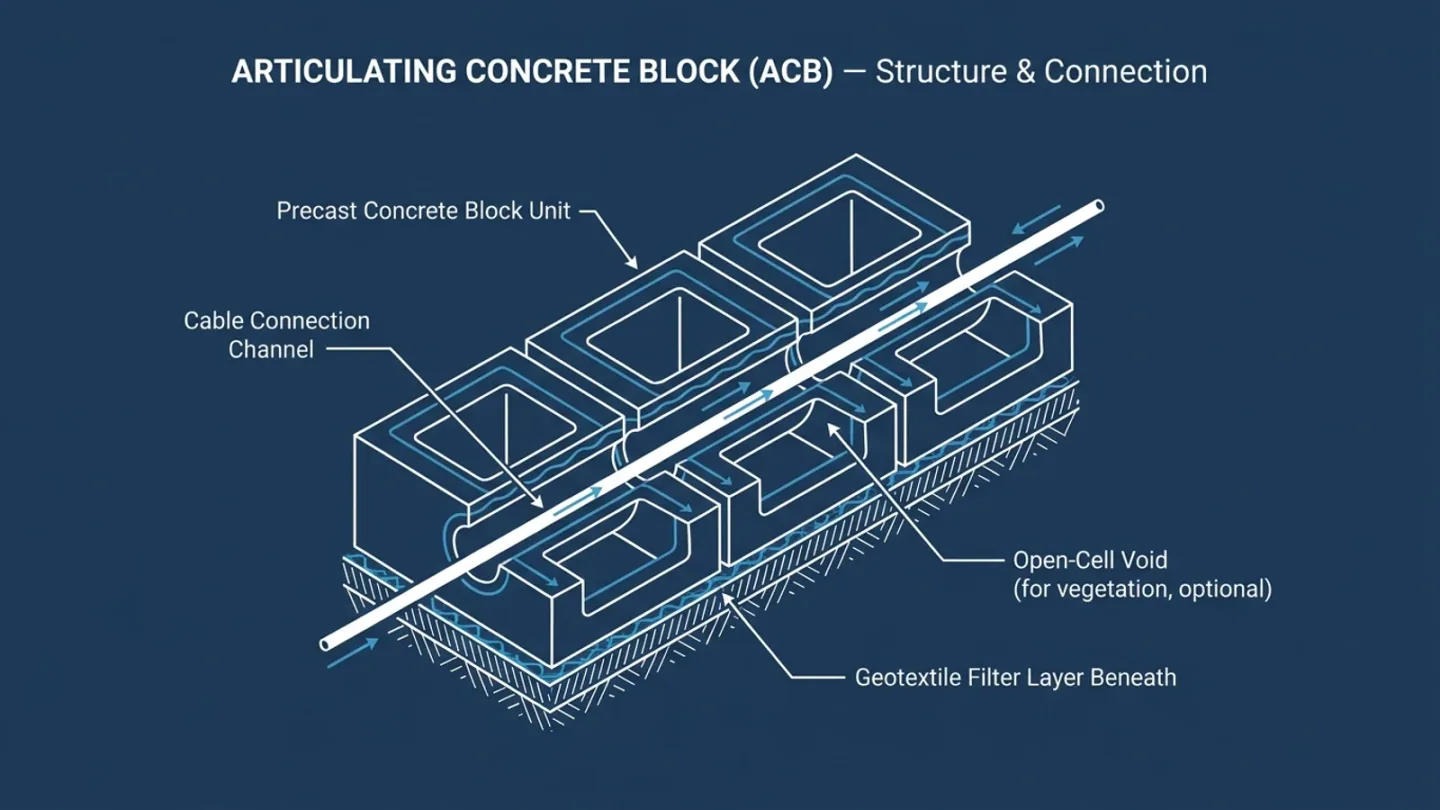
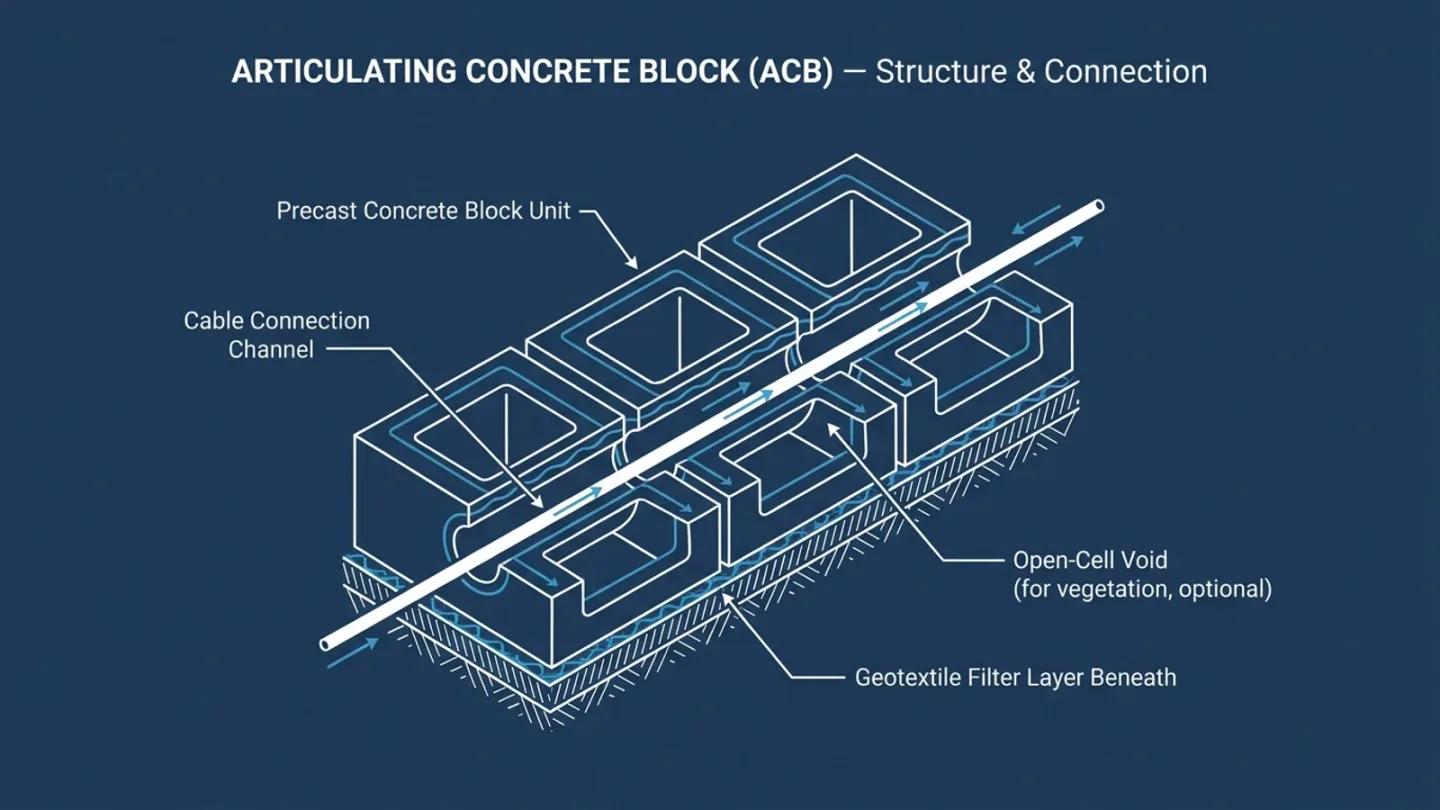
ACB systems consist of individual precast concrete units — commonly 100–150 mm thick, in interlocking or keyed shapes — connected to adjacent units either through cast-in cable channels threaded with steel or synthetic cable, or by placement on a geotextile mat with the blocks mechanically or adhesively bonded to it. The result is a flexible, articulated mat that can conform to moderate subgrade irregularities and settlement while each block remains individually rigid.
ACB is manufactured off-site in a precast yard, cured to full strength before delivery, and shipped as finished units or pre-assembled mats. Installation is essentially a placement operation — no on-site curing, grout pumping, or hydration step is required, which is the system's principal advantage over GGFM on accessible, dry sites. Both ACB and GGFM are recognised as scour countermeasures in FHWA's countermeasure selection matrix, and precast unit strength is verified against ASTM concrete/geotechnical standards.
Open-Cell vs Closed-Cell ACB
- Open-cell ACB — blocks with void spaces that can be filled with topsoil and vegetated, similar in function to vegetated grouted mattress. Used where ecological integration and reduced runoff velocity from vegetation are required alongside structural protection.
- Closed-cell ACB — solid block units providing maximum impermeability and scour resistance, comparable in application to standard (impermeable) grouted mattress.
ACB Cost and Specification
| Block Type | Thickness | Design Velocity | Installed Cost (USD/m²) |
|---|---|---|---|
| Open-cell ACB | 100 mm | Up to 4.5 m/s | $30–$48 |
| Closed-cell ACB | 100–150 mm | Up to 5.5 m/s | $35–$55 |
| Grouted Mattress (GGFM) | 100–200 mm | Up to 6.0 m/s | $28–$48 |
At comparable thickness, ACB and GGFM sit in a similar cost band. The specification decision is rarely made on unit cost alone — it is driven by three practical questions: can the channel be dewatered, is the subgrade regular enough for precast units to bed correctly, and does the project programme favour off-site manufacture (ACB) or on-site forming (GGFM)?
Where ACB Is the Better Choice
- Dry, accessible sites with regular subgrade — ACB units bed most reliably on a subgrade prepared to tight tolerance; irregular or soft subgrades are better served by GGFM's ability to conform during grout injection.
- Projects prioritising a walkable, inspectable surface — precast block surfaces are commonly specified for pedestrian or vehicle-accessible revetments, boat ramps, and maintenance access paths.
- Sites where local precast supply reduces lead time — where a qualified precast yard is nearby, ACB can mobilise faster than importing GGFM fabric and arranging grout supply.
Where Grouted Mattress Is the Better Choice
- Flowing or standing water that cannot be dewatered — GGFM fabric can be positioned and pumped in water up to 0.5 m/s; ACB units generally require a dry or near-dry working face to bed and connect correctly.
- Irregular or settling subgrade — the fabric conforms during grout injection; precast ACB units are rigid and can lose bearing contact on an irregular surface, creating voids beneath the armour.
- Highest design velocities and underwater bridge pier / coastal scour applications — GGFM's continuous grout-filled section and lack of unit joints gives it an edge at the top of the velocity range and in submerged installation.
- Remote sites without local precast supply — GGFM fabric is lightweight and compact to ship in bulk; grout can be batched locally with standard cement and aggregate, reducing dependency on a nearby precast yard.
Frequently Asked Questions
Can ACB and grouted mattress be combined on the same project?
Yes — a common configuration uses ACB on accessible, dry upper banks or crest areas and GGFM on the toe or submerged sections where dewatering is impractical. This plays to each system's installation strength rather than forcing one system across variable site conditions.
Which system has a longer design life?
Both are concrete-based systems with comparable design life expectations — typically 50 years or more when correctly specified and installed — provided cable connections (ACB) or seam stitching (GGFM) are protected from corrosion and UV degradation per the relevant product specification.
Does ACB require a geotextile filter layer beneath it?
Yes, in almost all applications — a non-woven geotextile filter layer is placed beneath ACB units to prevent subgrade particle migration through the joints between blocks, similar in principle to the filter layer required beneath riprap. GGFM's woven fabric acts as its own filter layer in most standard applications, removing this separate installation step. State DOT programs such as Caltrans' Erosion Control 101 require this filter layer be specified explicitly on the drawings, not left to the installing contractor's discretion.
Send the HydroBase engineering team your site access constraints, subgrade conditions, and design velocity and we will advise honestly on whether ACB, grouted mattress, or a combined approach fits your project — within 48 hours.
HydroBase Technical Team
HydroBase manufactures grouted mattresses (GRI GT16 compliant) in China and delivers to 30+ countries. Our engineering team provides specification support, grout mix design, and installation guidance.
About HydroBaseMore Articles
View all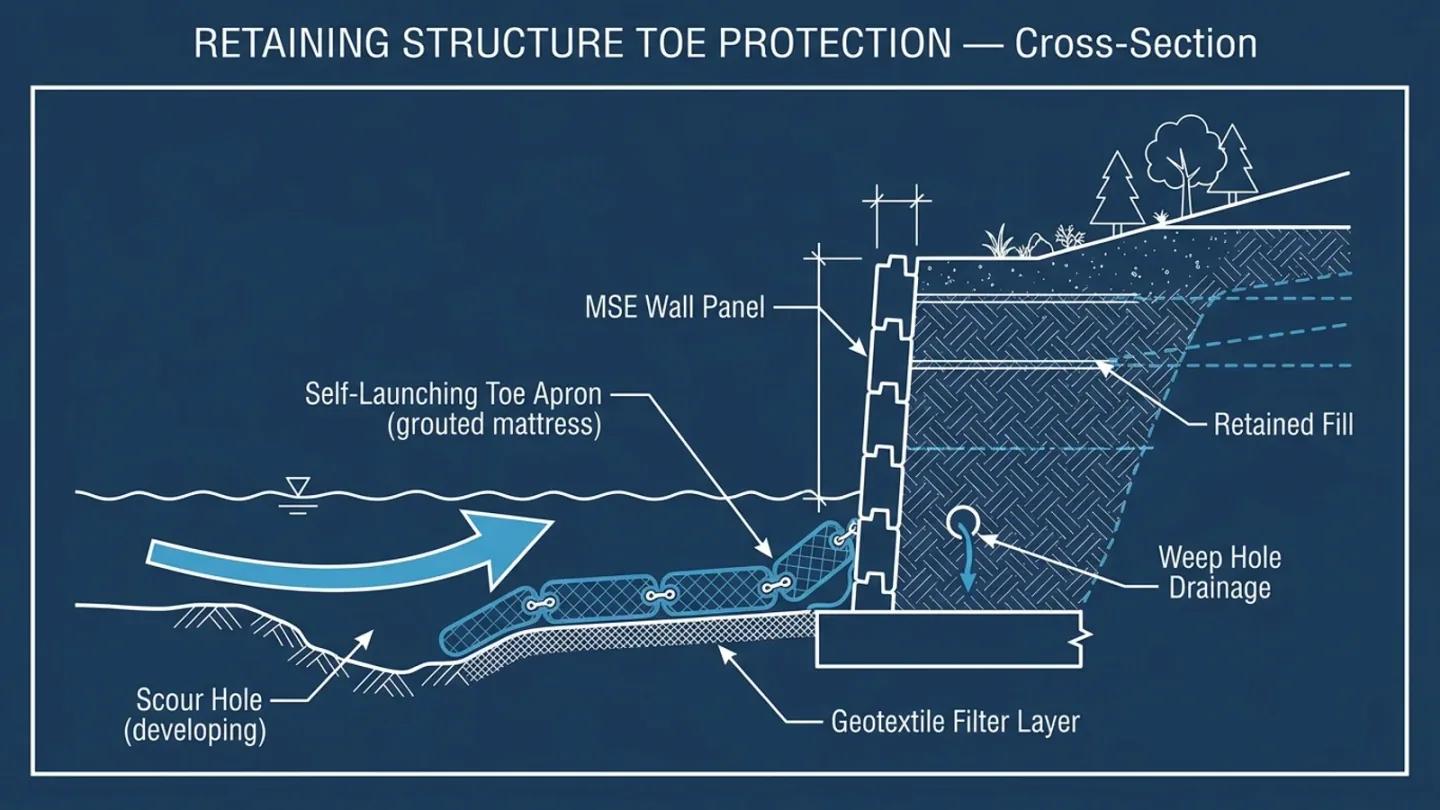
Erosion Control for Engineered Retaining Structures: MSE Walls, Canal Retaining, and Dam Toe Protection
Retaining structures fail more often from toe erosion and drainage problems than from the wall itself. This guide covers erosion control design at MSE walls, canal retaining structures, and dam toes.
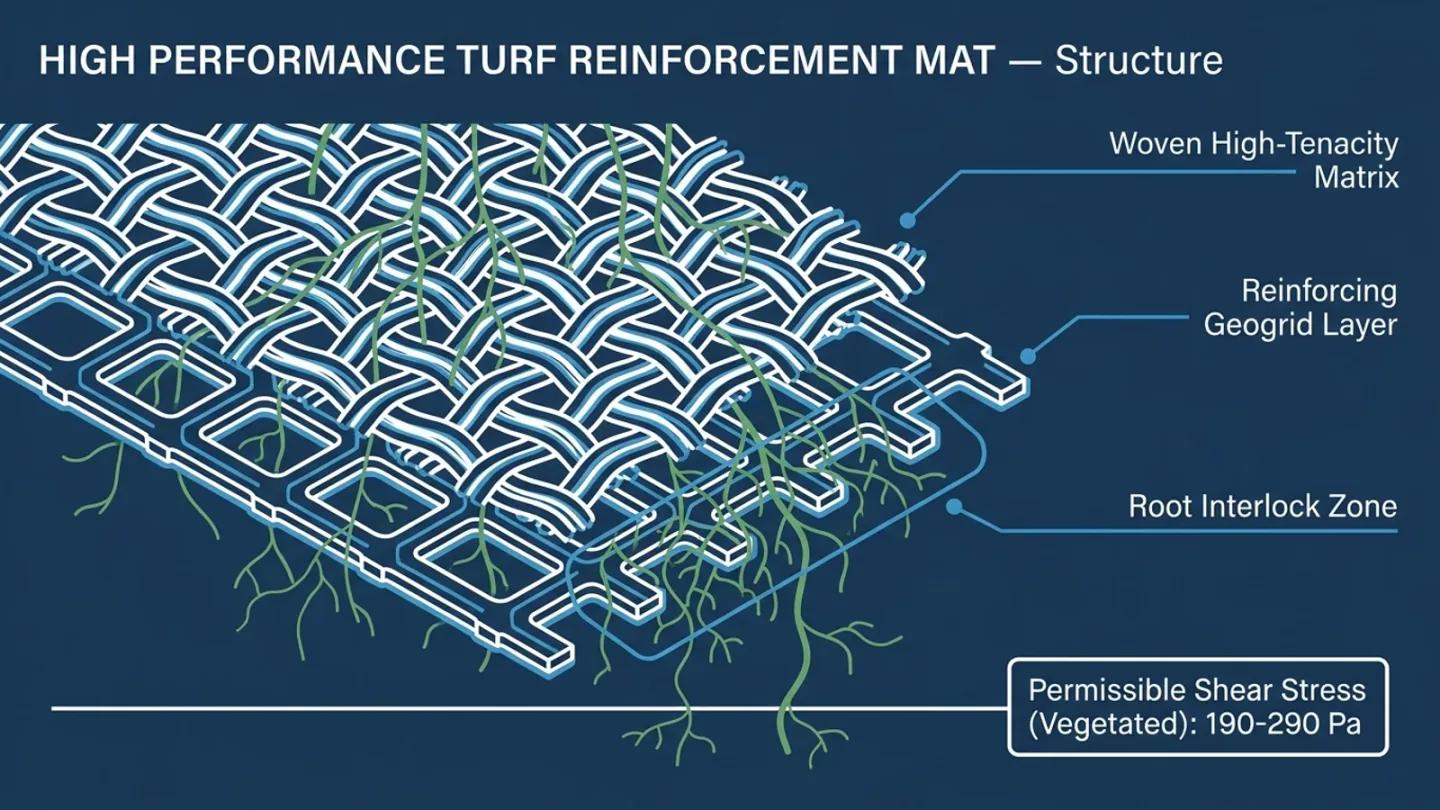
High Performance Turf Reinforcement Mat (HPTRM): Design and Specification Guide
High performance turf reinforcement mat extends vegetated erosion control into higher-velocity channels than standard TRM can handle. This guide covers the shear stress design method, matrix types, and specification requirements.
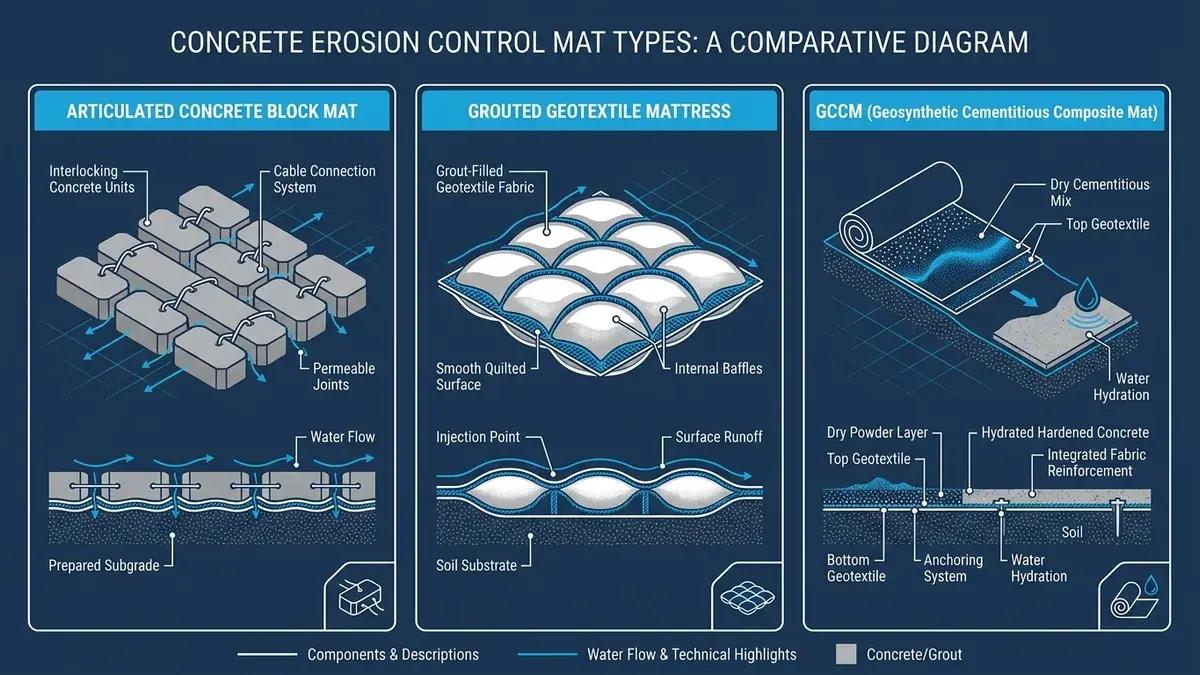
Geosynthetic Cementitious Composite Mat (GCCM): Complete Guide
Geosynthetic cementitious composite mat (GCCM) is a roll-out concrete fabric that cures on contact with water. This guide explains how it works, what it's suited for, and where it stops being the right choice.
HydroBase - China Manufacturer
Ready to Specify Grouted Mattress?
GRI GT16 compliant products, factory test reports included. Engineering support at no cost. 48-hour response.