
Coastal Revetment: Which Erosion System Lasts Longest?
Quick Summary
Wave action, tidal cycling, and storm surges demand the most of any erosion protection system. This guide compares rock armour, concrete revetment, gabions, and grouted mattress for coastal applications — with cost data and design life comparison.
Quick Answer: For coastal slope revetments subject to wave action and tidal cycling, heavy rock armour (tetrapods, Accropode, or large riprap) provides the longest design life (50+ years) but at the highest cost ($150–$400/m²). Grouted mattress is the most cost-effective hard revetment option for moderate wave exposure ($45–$80/m² installed, 50+ year design life), particularly where wave height is below 2.0 m and the tidal range demands a permeable (filter point) system. Cast concrete seawall panels are cost-effective in calm conditions but prone to joint failure in cyclic wave loading. This guide covers all options with design life data.
Coastal erosion protection is among the most demanding applications in hydraulic engineering. Coastal structures must simultaneously resist wave impact, wave run-up and drawdown, tidal water level variation, salt corrosion, and — in many locations — storm surge and vessel wash. A system that performs perfectly in a river or canal may fail rapidly at the coast.
This guide is focused on slope revetments — the protection of sloped bank faces, seawall backs, and beach embankments against wave erosion. For vertical seawalls and breakwaters, specialist coastal engineering guidance is required beyond the scope of this article. Reference standards used include CIRIA C683 (The Rock Manual), USACE Shore Protection Manual, and Eurocodes EN 1997.
The Coastal Environment: What Makes It Different
Coastal erosion protection differs from river or canal protection in several critical ways:
- Wave loading: Waves exert both impact pressure (impulsive, >100 kN/m² at breaking wave crest) and cyclic uplift on the revetment face. Rigid systems must resist impact; flexible systems must absorb it.
- Hydrostatic pressure reversal: As wave run-up occurs and recedes, and as the tide rises and falls, the water pressure on each face of the revetment reverses repeatedly. Impermeable systems can develop uplift under these reversals — filter drainage is critical.
- Salt environment: Seawater accelerates steel corrosion (gabion wire, sheet piling) and can attack the calcium silicate hydrate phases in concrete — specify marine-grade cement (sulphate-resistant Portland or blast furnace slag cement) for grouted mattress in marine applications.
- Toe scour: Wave-induced bed movement around the toe of a coastal revetment is often more severe than at river banks. Toe scour protection is critical — typically a rock apron or self-launching mattress toe extension.
The Main Coastal Revetment Options
1. Heavy Rock Armour (Random Riprap, Tetrapods, Accropode)
The benchmark coastal protection system. Individual armour units — either large quarried rock or cast concrete units (tetrapods, Accropode, Xbloc) — are placed on a graded filter layer. The interlocking mass of the units provides resistance to wave forces. The Hudson formula and Van der Meer equations relate required unit weight to design wave height. Design life of 50+ years for correctly sized units with adequate filter design. Very high cost; requires large quantities of locally quarried stone or precast units.
2. Grouted Mattress (Filter Point Type)
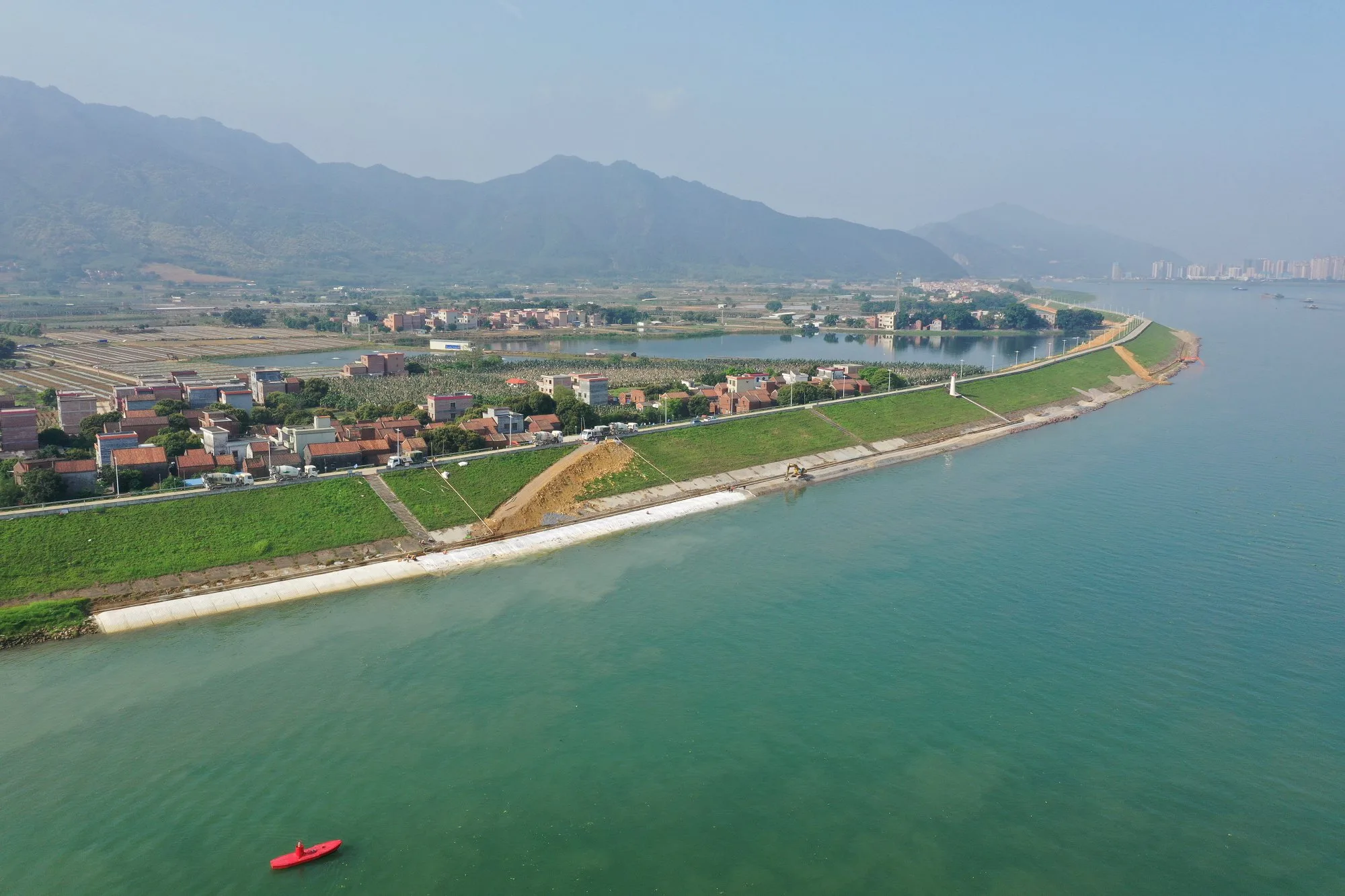
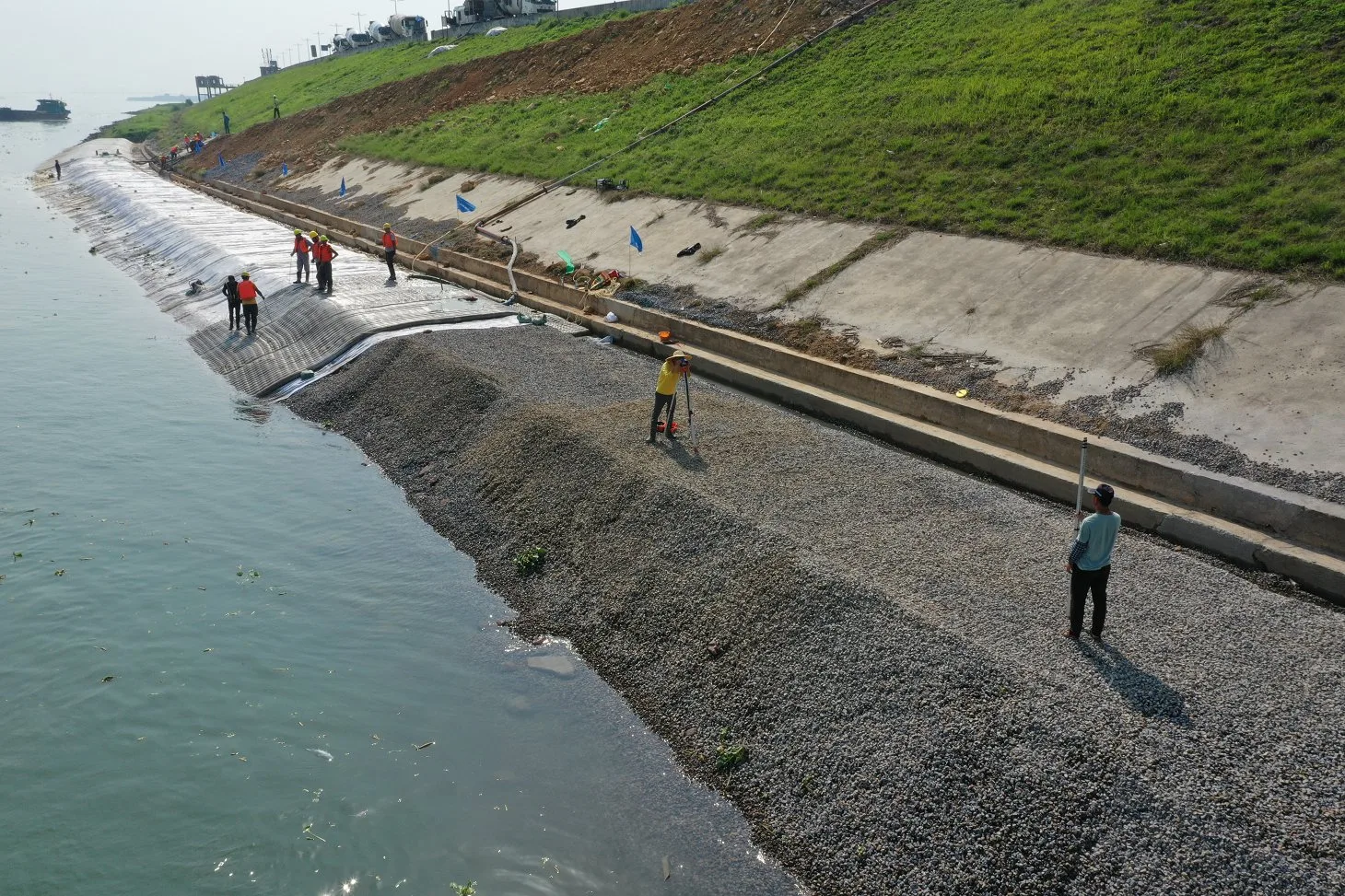
For coastal applications, filter point grouted mattress is specified — the filter openings at cell intersections allow tidal water to drain through the mattress face, preventing uplift under hydrostatic pressure reversal. The articulated mattress conforms to the slope profile and self-launches into developing toe scour holes. Design velocities up to 6.0 m/s and wave heights up to 2.5 m (150–200 mm thickness). No corrosion risk from the polypropylene fabric or cement grout core. Installed cost $45–$80/m².
3. Concrete Slope Paving
Cast-in-place or precast concrete slabs on the revetment slope. Economical in low-wave-energy environments but requires robust drainage design — any impermeable slab without adequate weepholes will fail by uplift under tidal cycling. Construction joints are vulnerable to wave impact and typically require regular resealing. Not recommended for wave heights exceeding 1.5 m without wave-energy dissipation features.
4. Gabion Mattresses
Wire mesh cages filled with graded rock, laid on the slope face. Permeable — good drainage properties in tidal environments. Wire mesh degrades in marine salt environments; expect 15–20 years for galvanised wire; 25–30 years for PVC-coated wire in typical marine exposure. Rock fill must be hard and durable (minimum Micro-Deval coefficient <20). Not suited for exposed coastal sites with wave height >2.0 m — rock fill is displaced by wave action at the upper mesh openings.
5. Geobag Revetment
Geotextile bags filled with sand or gravel and stacked on the slope face. The lowest-cost coastal protection option. Suitable only for low-energy environments — UV degradation of the bag fabric accelerates in the coastal environment, and wave impact displaces unfilled bags rapidly. Typically used for emergency or temporary protection. Not a long-term solution for exposed coasts.
Cost and Performance Comparison
| System | Installed Cost (USD/m²) | Max Wave Height | Tidal Drainage | Design Life |
|---|---|---|---|---|
| Heavy Rock Armour | $150–$400 | 5+ m | Excellent (permeable) | 50+ years |
| Filter Point Grouted Mattress | $45–$80 | Up to 2.5 m | Good (filter points) | 50+ years |
| Concrete Slope Paving | $40–$75 | Up to 1.5 m | Poor (requires weepholes) | 25–35 years |
| Gabion Mattress | $35–$65 | Up to 2.0 m | Excellent (permeable) | 15–30 years |
| Geobag Revetment | $12–$30 | Up to 0.8 m | Good | 5–10 years |
Selecting Coastal Revetment: Decision Framework
| Significant Wave Height (Hs) | Tidal Condition | Recommended System | Key Reason |
|---|---|---|---|
| Hs > 3.0 m (exposed) | Any | Heavy rock armour or concrete armour units (tetrapods, Accropode) | Grouted mattress not designed for these wave loads |
| Hs = 1.5–3.0 m | Any | Heavy riprap (D50 > 500 mm) or 200 mm filter point grouted mattress | Rock armour more robust; grouted mattress lower cost where rock is scarce |
| Hs = 0.5–1.5 m | Tidal range > 2.0 m | Filter point grouted mattress | Tidal drainage eliminates impermeable concrete; wave energy exceeds gabion capacity |
| Hs < 0.5 m | Sheltered or micro-tidal | Concrete slope paving or gabion mattress | Low wave energy — cost drives selection; no drainage requirement |
| Any | Emergency or temporary | Geobags or geotextile-wrapped sand | Lowest first cost; design life 3–5 years |
Toe Protection: The Critical Detail at the Coast
Toe scour is the most common failure mechanism for coastal revetments. Wave-induced bed movement around the toe of the structure removes the foundation support, causing the revetment face to slide into the scour hole. The toe protection design must account for the depth of potential wave-induced scour — typically 0.5–1.5× the design significant wave height for sandy beds.
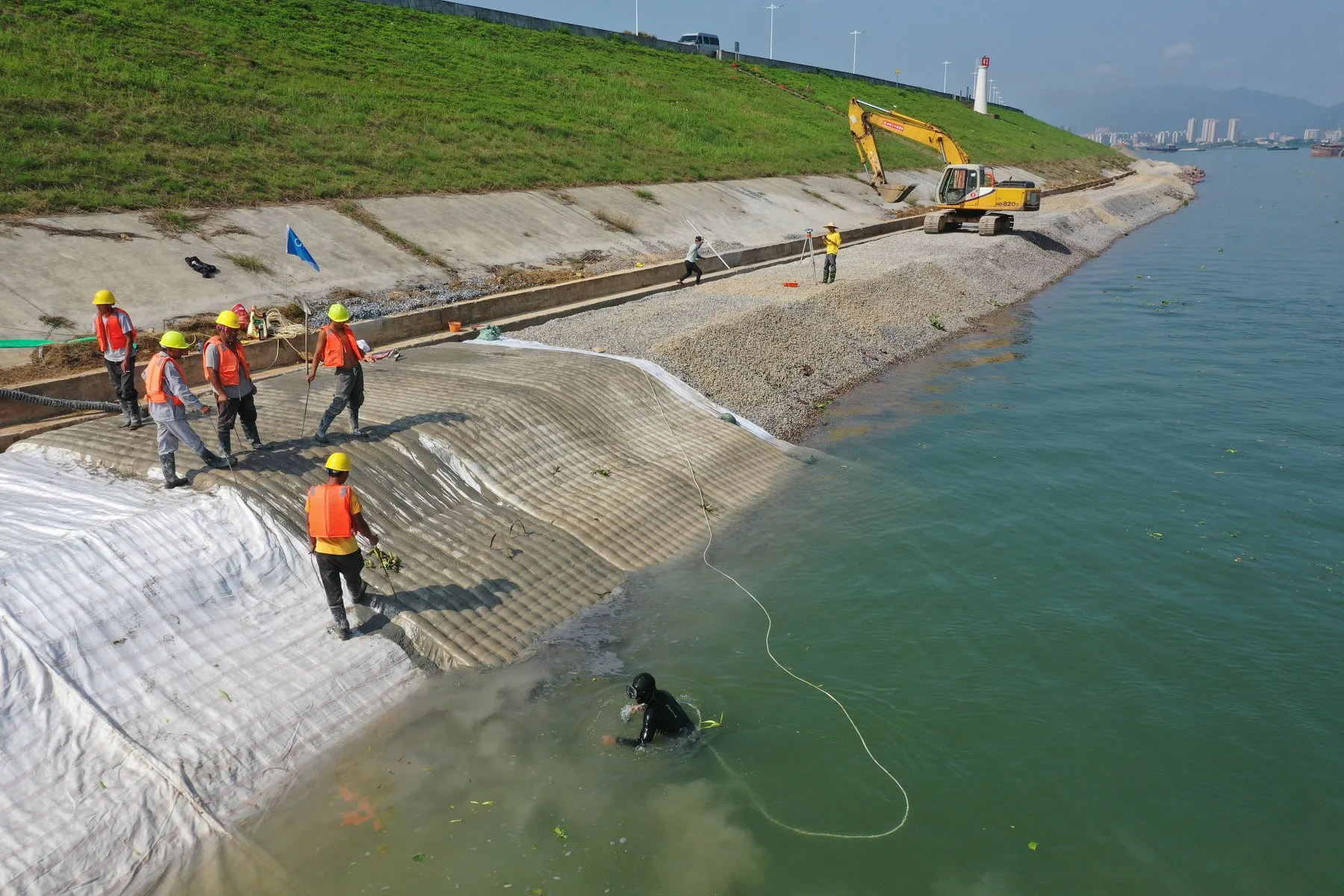
For grouted mattress revetments, the standard toe detail is a self-launching apron — an extension of the mattress panels laid flat on the seabed at the toe of the slope, with a free edge weighted by a sand-filled geotextile tube. As scour develops, the free edge launches into the hole, providing continuous protection without requiring remedial works.
Related: revetment mattress vs riprap and our slope protection design guide.
Frequently Asked Questions
Is grouted mattress suitable for exposed coastal sites?
Filter point grouted mattress is suitable for moderately exposed coastal sites with significant wave height up to approximately 2.5 m (200 mm thickness). For exposed headlands and open-ocean coastlines with Hs > 3.0 m, heavy rock armour or concrete armour units are required. The boundary between "moderately exposed" and "exposed" depends on the site-specific wave climate — a coastal engineering wave transformation model should be used to determine the design wave height at the revetment face.
Why does coastal revetment need filter drainage?
As the tide rises and falls, the water table in the embankment or beach behind the revetment lags the external water level. On the falling tide, the internal water pressure exceeds the external, creating a net outward (uplift) force on the revetment face. If the revetment is impermeable — a standard concrete slab without weepholes — this uplift force can detach the slab from the slope. Filter point grouted mattress has drainage openings that equalise internal and external pressure, eliminating the uplift risk.
How is grouted mattress installed in a tidal zone?
Tidal zone installation takes advantage of the natural tidal window — the period around low tide when the lower slope is exposed. Mattress panels are deployed and pumped during low-tide windows, typically 3–4 hours per tidal cycle. For the permanently submerged toe zone, diver-assisted installation is used. Contact our engineering team for a tidal installation programme specific to your site tidal range and spring tide timing.
HydroBase supplies filter point grouted mattress for coastal revetment projects worldwide. Marine-grade cement specification, 200 mm maximum thickness, GRI GT16 certified. Request a coastal project assessment with your wave climate data and we will recommend the correct product within 48 hours.
HydroBase Technical Team
HydroBase manufactures grouted mattresses (GRI GT16 compliant) in China and delivers to 30+ countries. Our engineering team provides specification support, grout mix design, and installation guidance.
About HydroBaseMore Articles
View all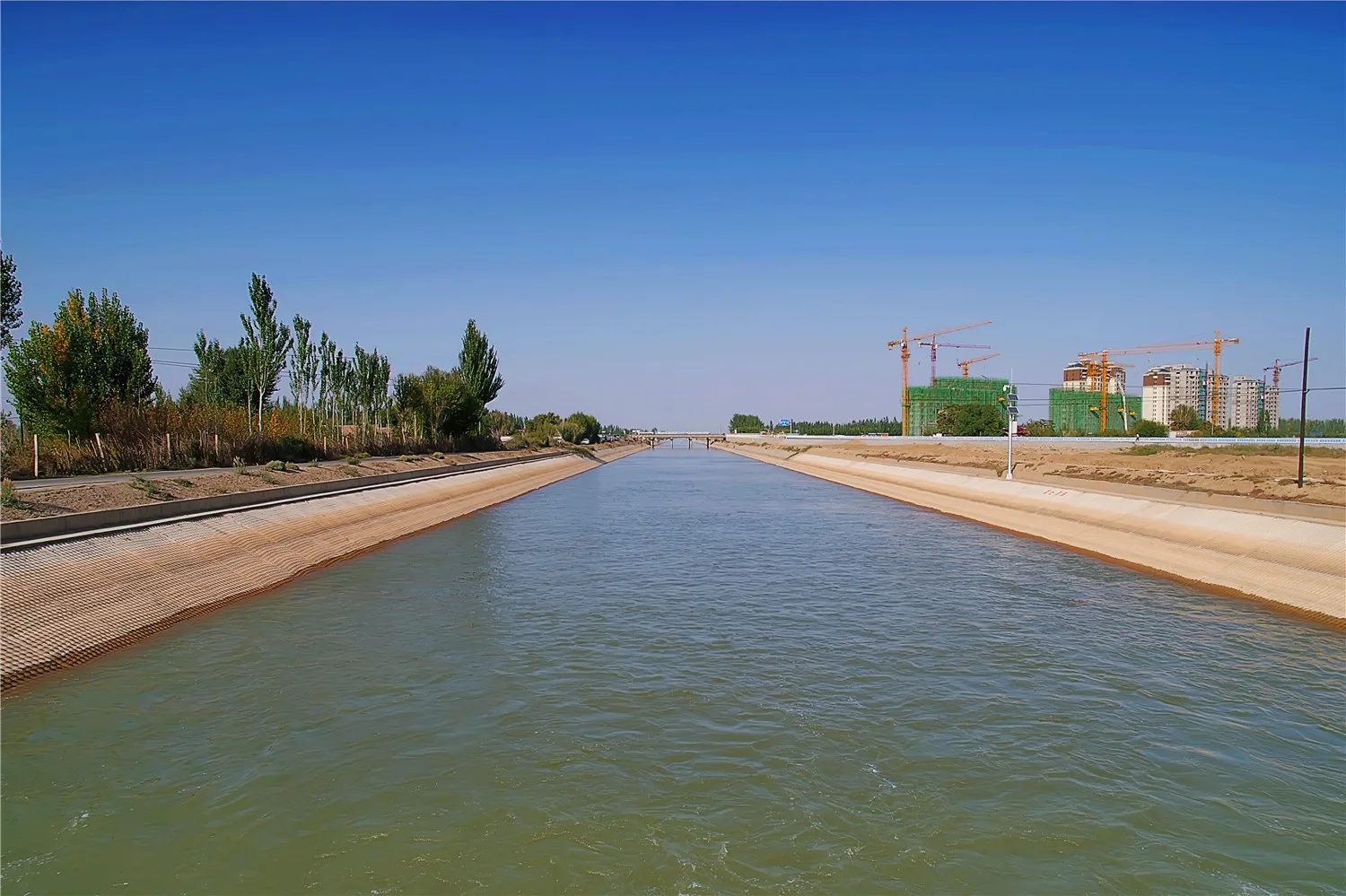
Grouted Mattress Case Studies: 5 Projects, Real Data
Five real grouted mattress installations across canal lining, river bank protection, coastal revetment, reservoir lining, and bridge pier scour — with actual project areas, design parameters, installation programmes, and post-installation performance data.
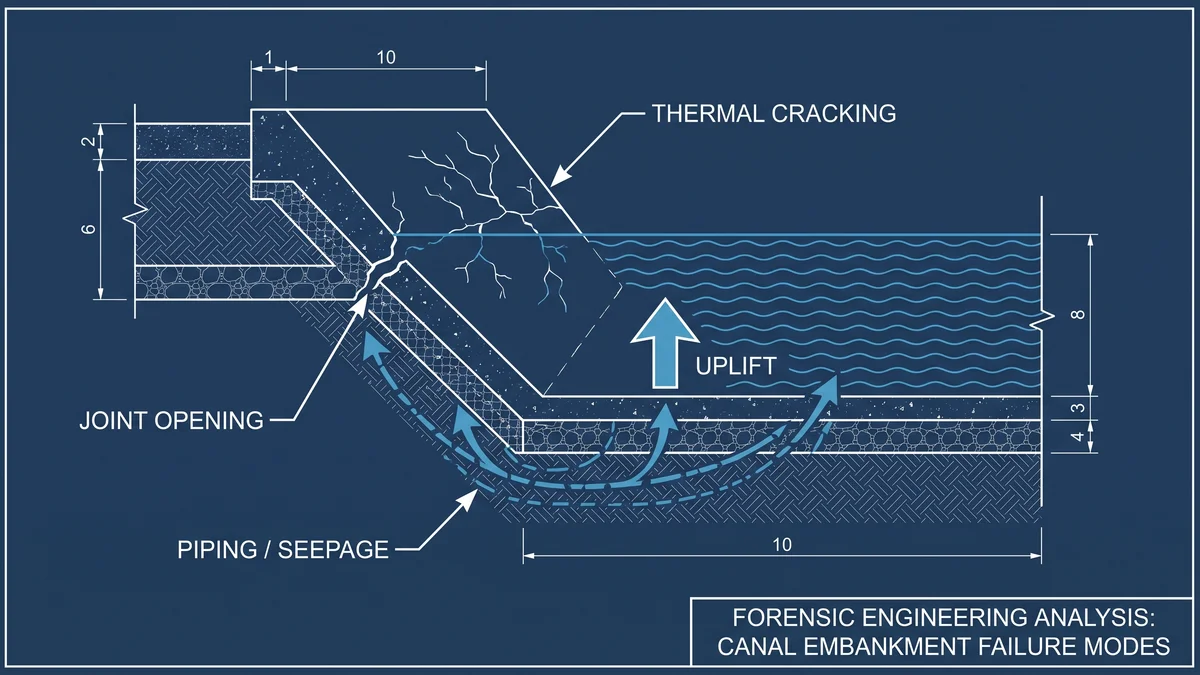
Canal Lining Failure: 7 Causes and How to Prevent Them
Canal lining failures cost irrigation authorities billions annually in emergency repairs and lost water. This forensic guide identifies the 7 most common failure causes — from joint failure to uplift — and explains how to prevent each through better specification and installation.
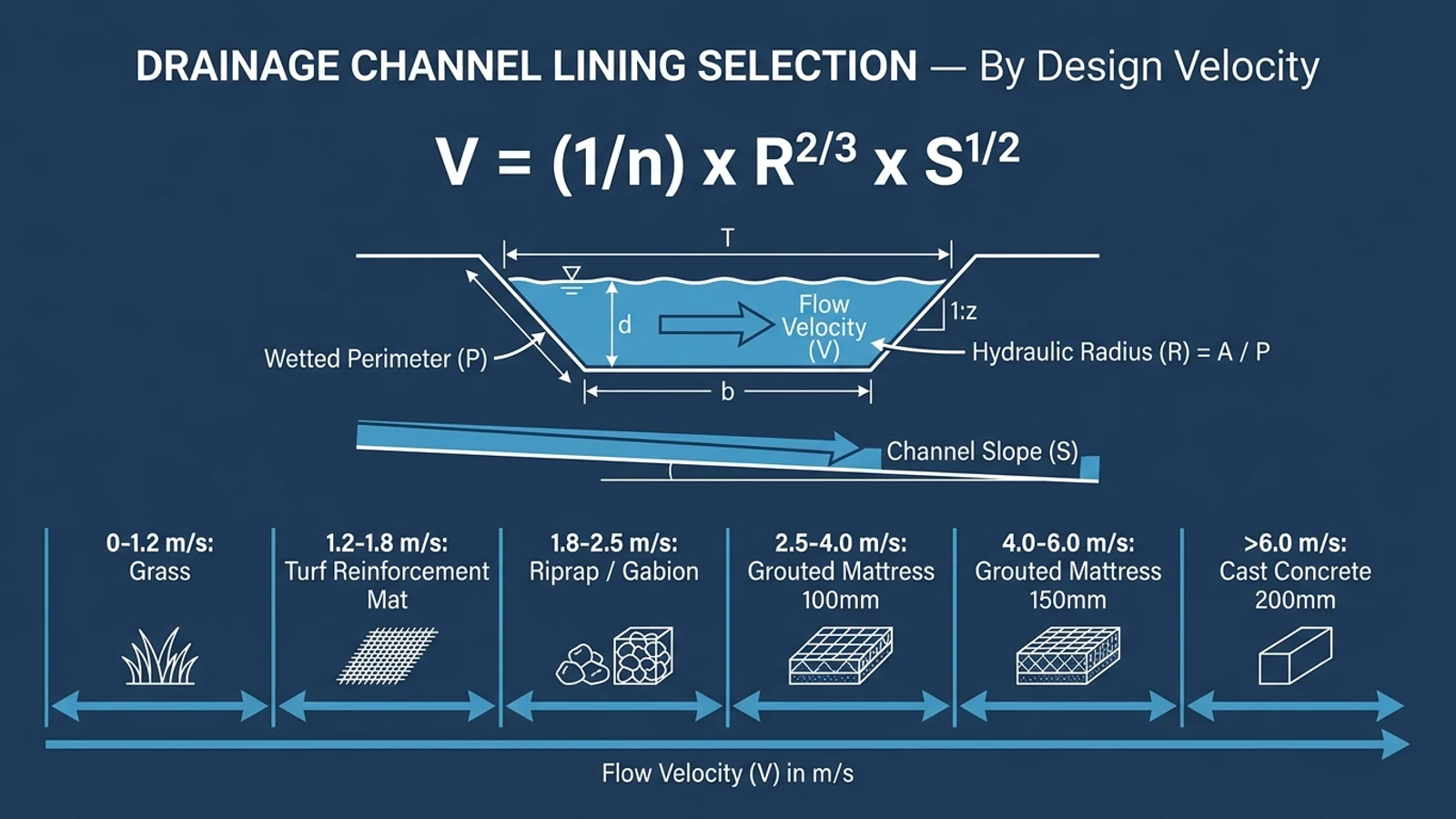
Drainage Channel Lining: Road and Infrastructure Guide
Drainage channels alongside roads, railways, and industrial sites carry high-velocity storm runoff that erodes unlined channels within seasons. This guide covers lining selection, hydraulic design, and installation for roadside drainage channels.
HydroBase - China Manufacturer
Ready to Specify Grouted Mattress?
GRI GT16 compliant products, factory test reports included. Engineering support at no cost. 48-hour response.