
What Is a Revetment? A Complete Guide
Quick Summary
Revetment is one of the most commonly used — and commonly misunderstood — terms in erosion control. This guide explains what a revetment actually is, the main types, and how to select one.
Quick Answer: A revetment is a sloped facing structure built directly onto a bank, shoreline, or embankment to absorb wave and current energy and protect the underlying soil from erosion. Unlike a seawall, which is typically a vertical or near-vertical structure that resists water pressure directly, a revetment works with the natural slope, dissipating energy across its surface rather than reflecting it. Revetments are built from a range of materials — rock (riprap), precast concrete units, gabions, or grouted mattress — and the right material depends on wave or flow exposure, available construction access, and budget.
"Revetment" is used constantly in erosion control and coastal engineering, but it describes a function and a general form — a sloped protective facing — rather than one specific material or product. This guide explains what makes a structure a revetment, the main material types used to build one, and how to select between them.
What Makes a Structure a "Revetment"?
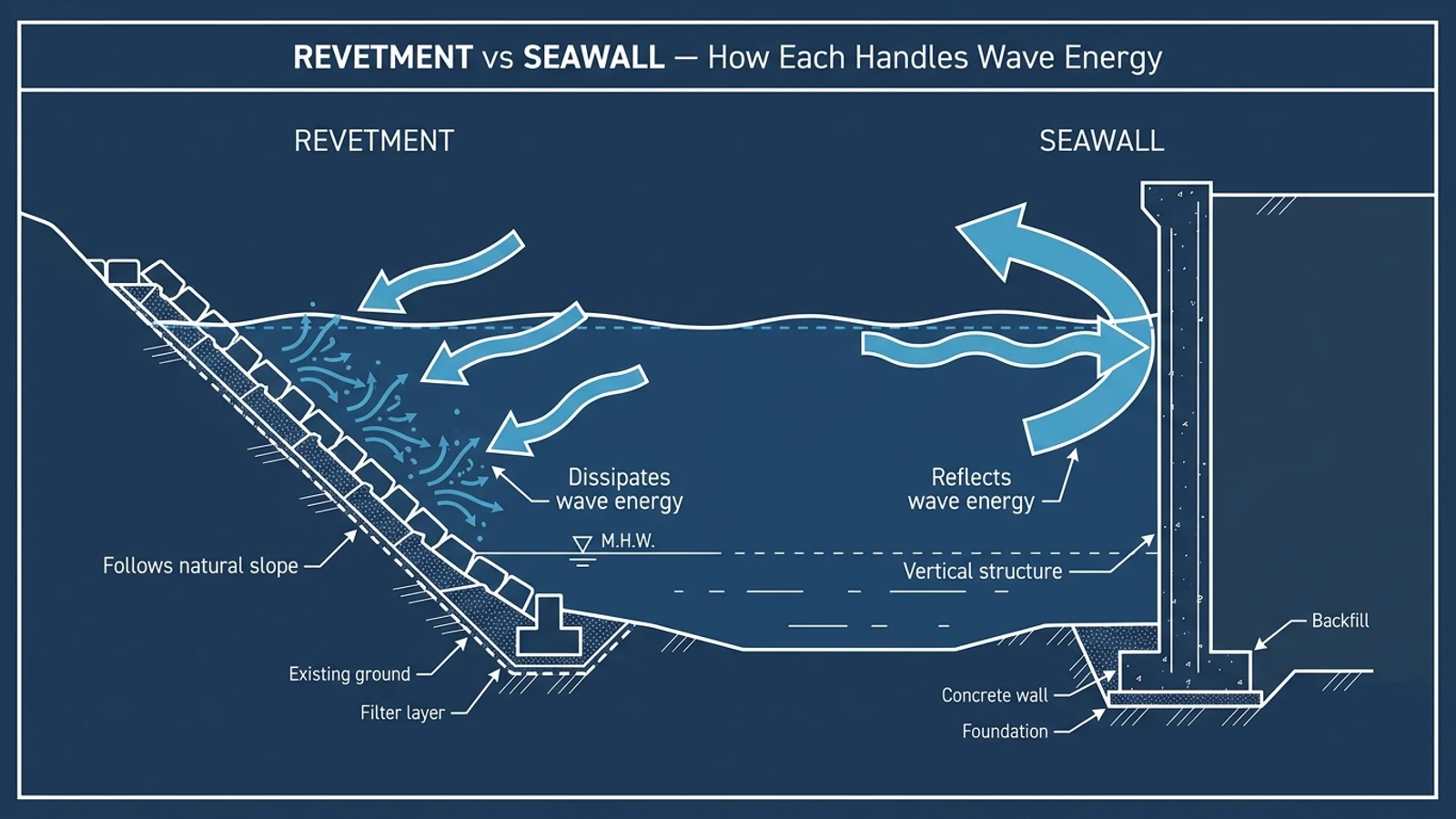
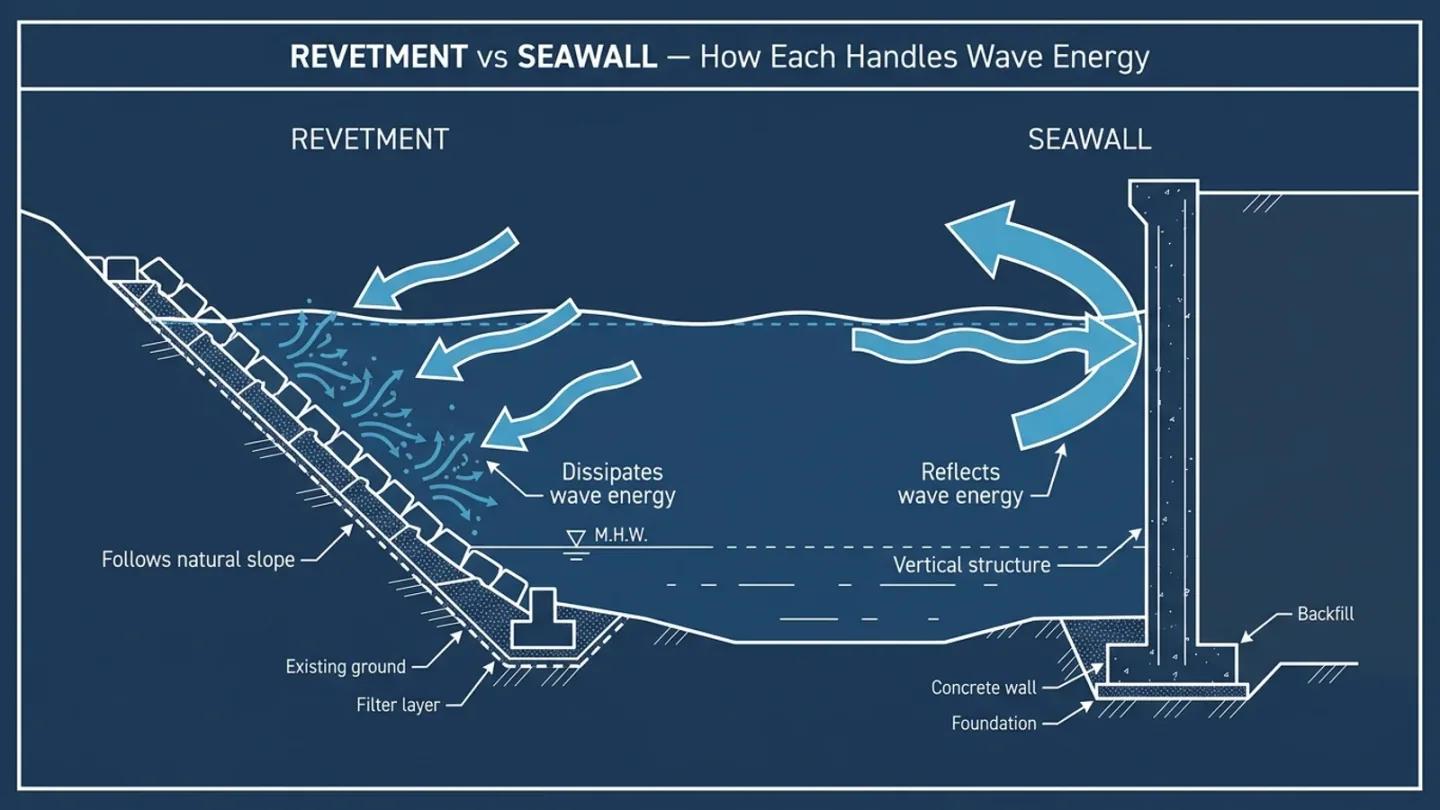
Three features define a revetment, regardless of the material used to build it:
- It follows the existing slope — a revetment is built onto the bank or embankment's natural or graded slope angle, rather than replacing it with a vertical structure.
- It dissipates rather than reflects energy — a sloped, often rough or textured surface spreads incoming wave or current energy across a larger area and over a longer time, reducing peak force compared to a vertical wall that reflects energy back into the water.
- It is a facing, not a retaining structure — a revetment protects the surface of an existing slope from erosion; it is not designed to resist lateral earth pressure the way a retaining wall is. Where both functions are needed, a revetment is applied to the face of a separately engineered retaining structure, not used as a substitute for one.
This is also what distinguishes a revetment from a seawall: a seawall is typically a vertical or steep structure built to hold back water and resist wave pressure directly at a fixed line, often used where space is too constrained for a sloped structure. A revetment needs more lateral space to achieve its slope, but generally performs better against wave energy and causes less reflected wave disturbance to adjacent areas — a distinction set out in detail in the USACE Coastal Engineering Manual and PIANC's harbour and coastal works guidelines.
Main Revetment Types
| Type | Construction | Best Suited To |
|---|---|---|
| Rock (riprap) revetment | Graded rock placed over a geotextile filter layer meeting IGS testing standards | Sites with local rock supply, moderate to high wave/flow exposure |
| Precast concrete armour units | Factory-cast interlocking or articulated units | High-energy open coast, exposed breakwaters |
| Gabion revetment | Wire-mesh baskets filled with rock | Moderate exposure, sites wanting some permeability and flexibility |
| Grouted mattress revetment | Woven geotextile fabric pumped with cement grout on site | Moderate to high wave/current exposure, sites needing underwater installation without dewatering |
| Vegetated / bioengineered revetment | Live plant material, sometimes combined with a structural toe | Low-energy sites, ecological value a priority |
Where Revetments Are Used
- Coastal shorelines — protecting against wave action and storm surge; see Coastal Revetment for the wave-exposure application detail
- River banks — protecting against current-induced erosion and bank retreat; see River Bank Erosion Protection: 6 Methods Compared
- Canal and reservoir slopes — combined erosion protection and, depending on material, seepage control; see Slope Protection for Canals and Reservoirs
- Bridge abutments and approach embankments — protecting the fill slope adjacent to a bridge structure from scour
How to Choose a Revetment Type
- Local rock available at reasonable haulage cost: riprap remains a strong, well-understood default for moderate exposure.
- Cannot dewater the site, or subgrade is irregular: grouted mattress conforms during installation and can be pumped in flowing water.
- Very high wave energy, open coast: precast concrete armour units, sized per detailed wave design using wave run-up methods such as those in the USACE Coastal Engineering Manual.
- Habitat or ecological value is a project requirement: vegetated or bioengineered revetment where exposure genuinely allows it — always balanced against the site's real hydraulic exposure, not habitat preference alone.
Frequently Asked Questions
Is "revetment" the same as "riprap"?
No — riprap is one material used to build a revetment, but not the only one. "Revetment" describes the sloped protective structure in general; riprap, grouted mattress, gabions, and precast armour units are all materials that can be used to construct one.
What is the difference between a revetment and a breakwater?
A revetment is built directly onto and follows the shoreline or bank it protects. A breakwater is typically a separate offshore structure, built some distance from the shoreline, intended to intercept and reduce wave energy before it reaches the coast — protecting a wider area (often a harbour or anchorage) rather than armouring a specific slope face directly.
Does a revetment need a toe structure?
In almost all cases, yes — toe scour from wave reflection or current concentration at the base of a revetment is one of the most common failure mechanisms, undermining an otherwise well-armoured slope from beneath. See Erosion Control for Engineered Retaining Structures for toe protection design principles that apply directly to revetment toes as well.
Send us your site's exposure conditions and slope geometry and the HydroBase engineering team will advise on the appropriate revetment type and thickness for your project.
HydroBase Technical Team
HydroBase manufactures grouted mattresses (GRI GT16 compliant) in China and delivers to 30+ countries. Our engineering team provides specification support, grout mix design, and installation guidance.
About HydroBaseMore Articles
View all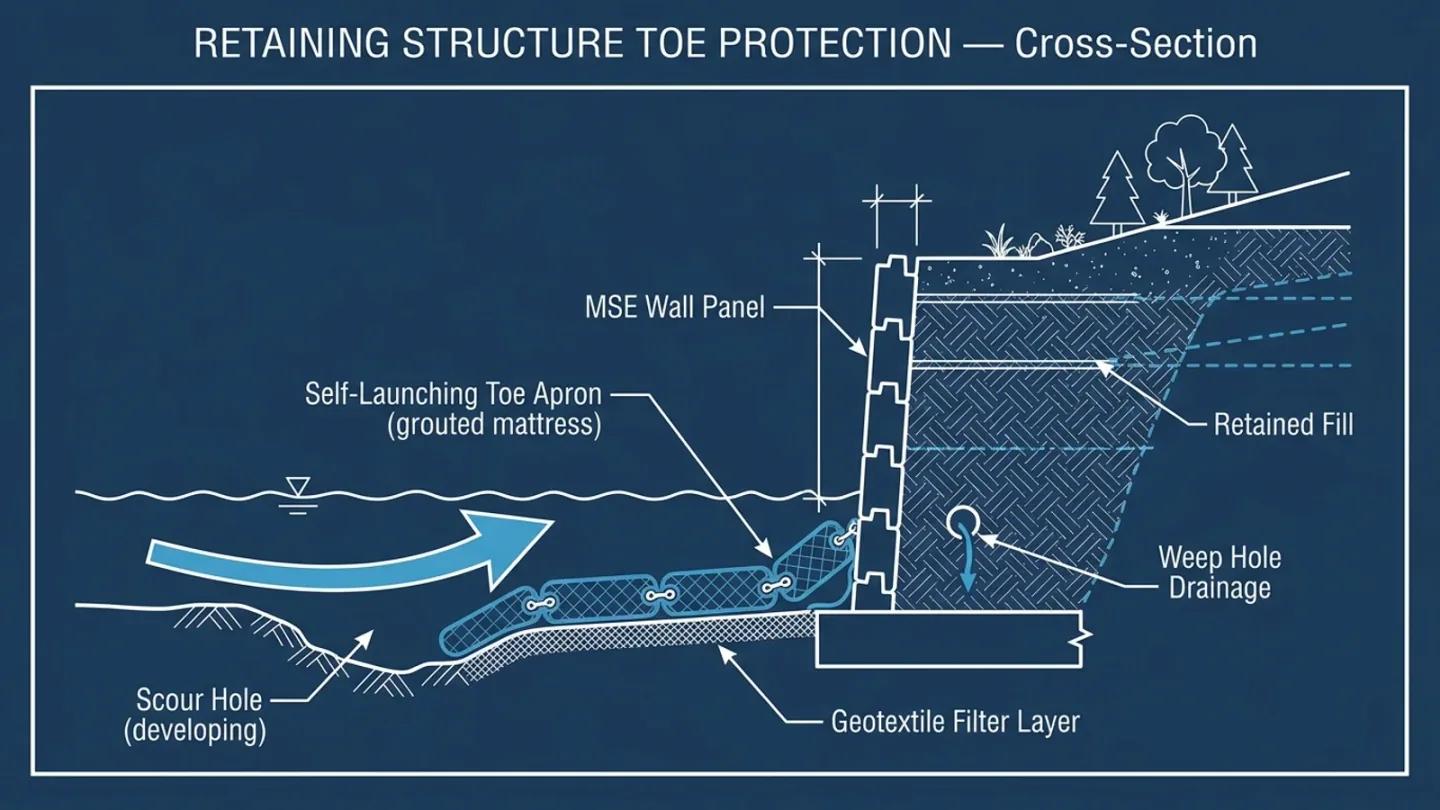
Erosion Control for Engineered Retaining Structures: MSE Walls, Canal Retaining, and Dam Toe Protection
Retaining structures fail more often from toe erosion and drainage problems than from the wall itself. This guide covers erosion control design at MSE walls, canal retaining structures, and dam toes.
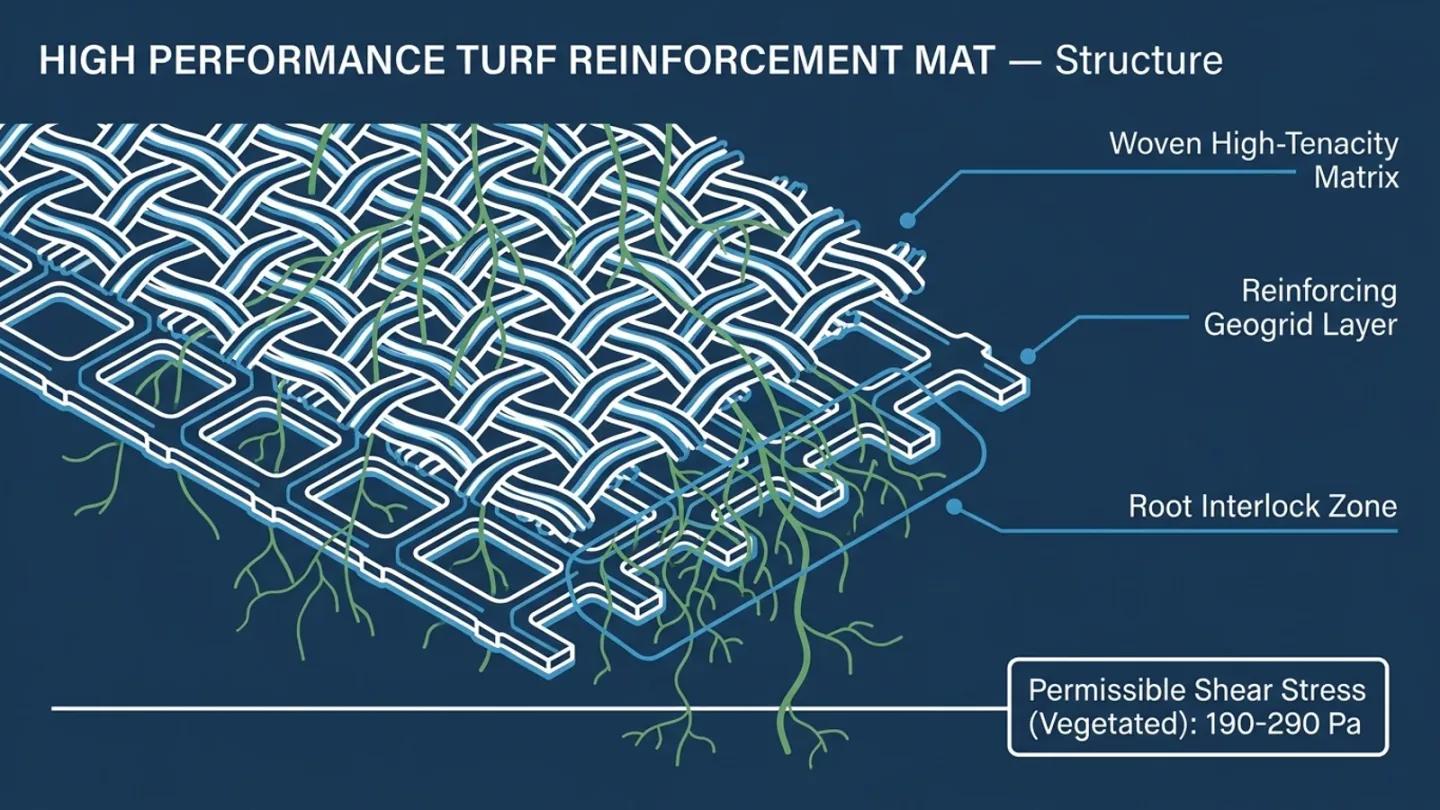
High Performance Turf Reinforcement Mat (HPTRM): Design and Specification Guide
High performance turf reinforcement mat extends vegetated erosion control into higher-velocity channels than standard TRM can handle. This guide covers the shear stress design method, matrix types, and specification requirements.
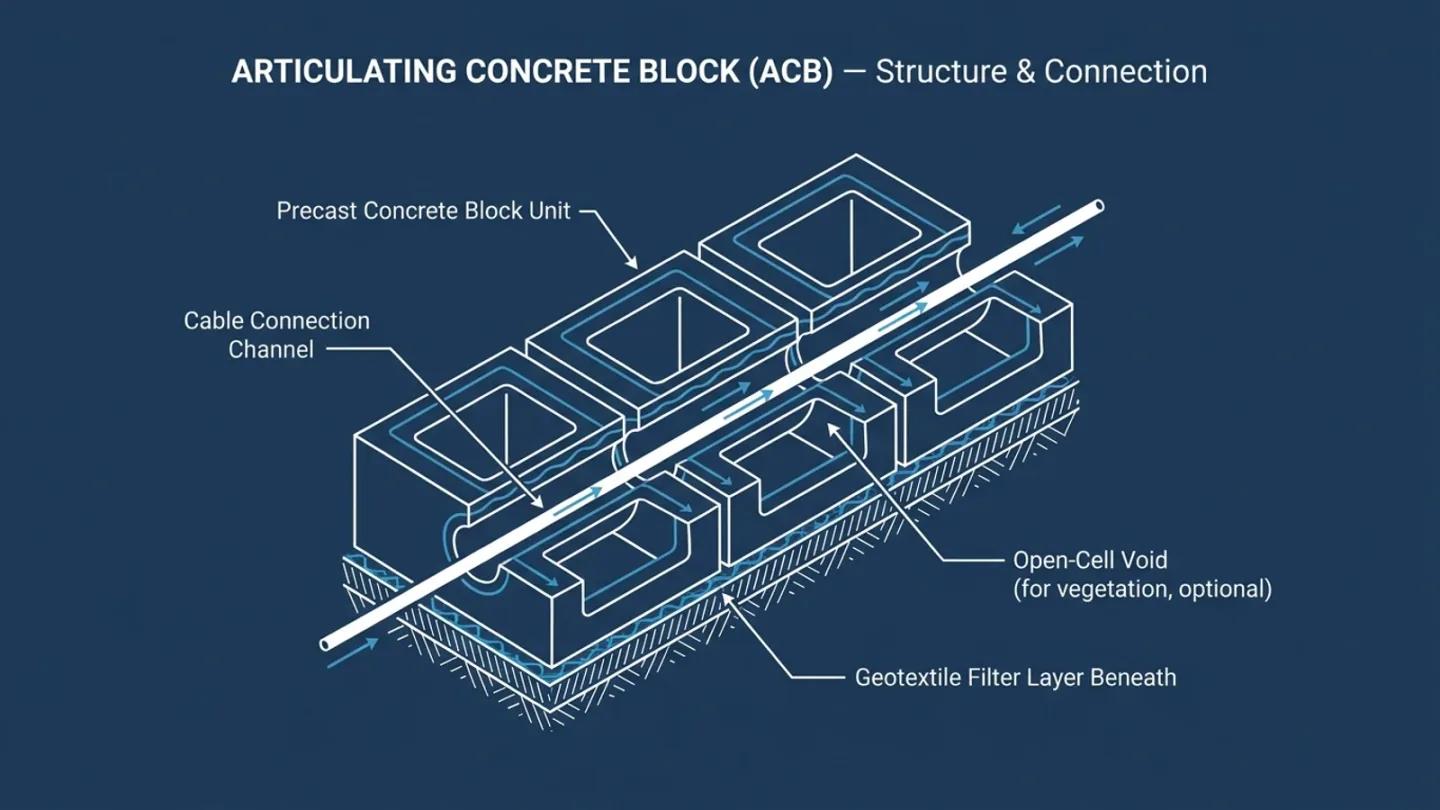
Articulating Concrete Block (ACB): Types, Cost, Specifications, and When to Choose It Over Grouted Mattress
Articulating concrete block (ACB) is a precast alternative to grouted mattress, connected by cables or geotextile through cast openings. This guide covers block types, costs, specification, and when each system is the better fit.
HydroBase - China Manufacturer
Ready to Specify Grouted Mattress?
GRI GT16 compliant products, factory test reports included. Engineering support at no cost. 48-hour response.