
Drainage Channel Lining: Road and Infrastructure Guide
Quick Summary
Drainage channels alongside roads, railways, and industrial sites carry high-velocity storm runoff that erodes unlined channels within seasons. This guide covers lining selection, hydraulic design, and installation for roadside drainage channels.
Quick Answer: Roadside drainage channels with design flow velocity above 2.0 m/s require hard lining — grass and biodegradable matting are inadequate. For velocities up to 4.0 m/s in channels up to 3 m wide, grouted mattress 100 mm is the most cost-effective permanent lining. Wider channels or higher velocities require 150 mm grouted mattress or precast concrete. For channels with design velocity below 1.5 m/s, vegetated or riprap systems are adequate. This guide provides the hydraulic design method and system selection table.
Drainage channels alongside highways, railways, airports, and industrial sites face a hydraulic challenge that is often underestimated in design: the impermeable pavement surface concentrates runoff with very short lag times, generating high peak discharges in channels that are often steep and narrow. Unlined channels alongside major highways erode within the first storm season, require repeated maintenance, and can undermine the road edge if the erosion extends laterally.
This guide covers the design and lining selection for roadside drainage channels — from the standard shallow roadside ditch to the large interceptor channel at the base of a highway cut slope. For highway embankment slope protection see Highway Slope Protection Guide. For irrigation canal design see Canal Lining.
Hydraulic Design: Calculating Channel Velocity
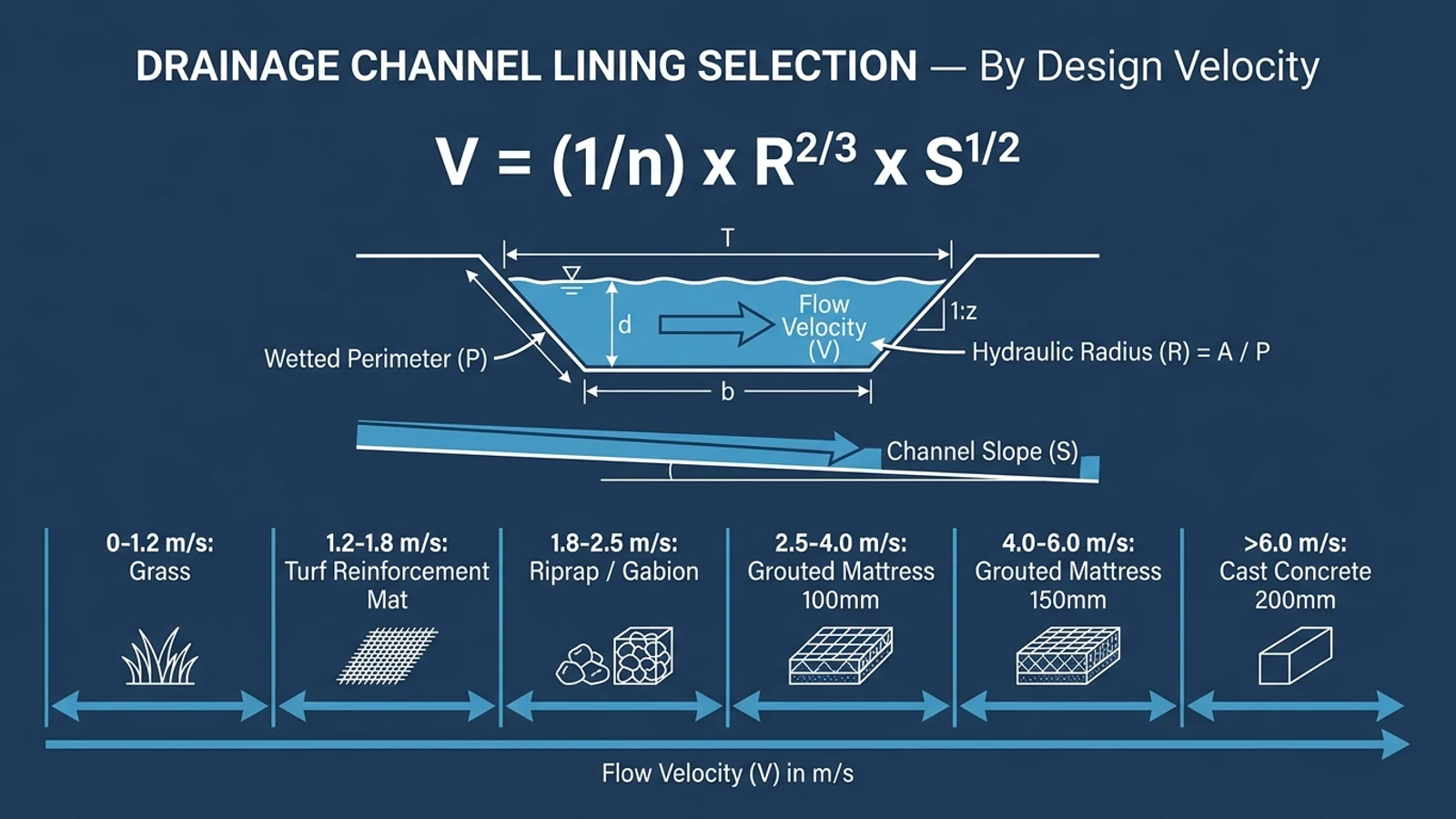
The design flow velocity in a drainage channel is calculated from Manning's equation:
V = (1/n) × R^(2/3) × S^(1/2)
Where V is mean velocity (m/s), n is Manning's roughness coefficient, R is hydraulic radius (area ÷ wetted perimeter, in metres), and S is channel gradient (m/m).
For a standard roadside ditch (trapezoidal section, 0.5 m base width, 1:1 side slopes, 0.4 m design depth, 1% grade):
- Design flow area = (0.5 + 0.4) × 0.4 = 0.36 m²
- Wetted perimeter = 0.5 + 2 × (0.4 / sin 45°) = 1.63 m
- R = 0.36 / 1.63 = 0.22 m
- V (grass, n = 0.035) = (1/0.035) × 0.22^0.67 × 0.01^0.5 = 1.37 m/s — within grass capacity
- V (grouted mattress, n = 0.018) = (1/0.018) × 0.22^0.67 × 0.01^0.5 = 2.67 m/s — demonstrates that even at 1% grade, GGFM is required if the Manning's n of the lining increases the velocity above grass limits
Note: Manning's roughness directly affects velocity for a given flow and grade. Lining the channel does not just resist erosion — it lowers n, which increases velocity, which in turn increases the required lining capacity. This coupling must be accounted for in the design iteration.
Lining Selection by Design Velocity
| Design Velocity (m/s) | Suitable Lining Systems | Manning's n (lined) |
|---|---|---|
| 0–1.2 | Mown grass, seeded slopes | 0.030–0.040 |
| 1.2–1.8 | Turf reinforcement mat (TRM), dense grass | 0.025–0.035 |
| 1.8–2.5 | Riprap (D50 = 100–150 mm), gabion mattress | 0.030–0.045 |
| 2.5–4.0 | Grouted Mattress 100 mm, precast concrete | 0.016–0.020 |
| 4.0–6.0 | Grouted Mattress 150 mm, cast concrete 150 mm | 0.016–0.020 |
| >6.0 | Cast concrete 200 mm + energy dissipation structure | 0.013–0.016 |
Grouted Mattress Advantages for Drainage Channels
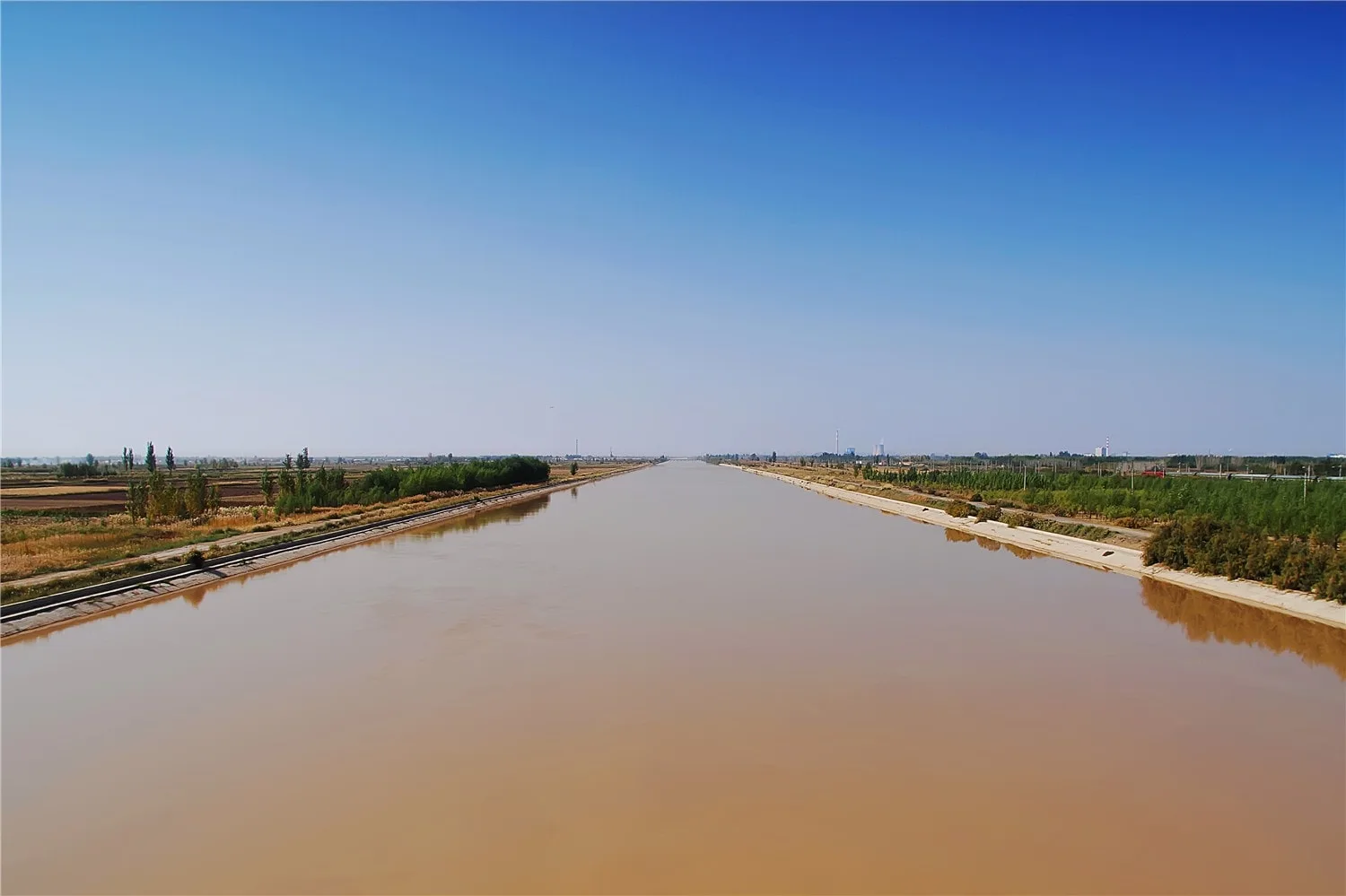
Grouted mattress is particularly well-suited for roadside drainage channels for three reasons specific to this application:
1. Irregular Channel Profile Tolerance
Roadside channels are rarely perfectly regular — they follow the road alignment through curves, transitions, and grade changes. Grouted mattress fabric conforms to channel bends and transitions without requiring pre-formed sections or complex formwork. Concrete requires either cast-in-place work (expensive on narrow irregular channels) or precast sections (which must be factory-ordered for each geometric variation).
2. Fast Installation with Minimum Closures
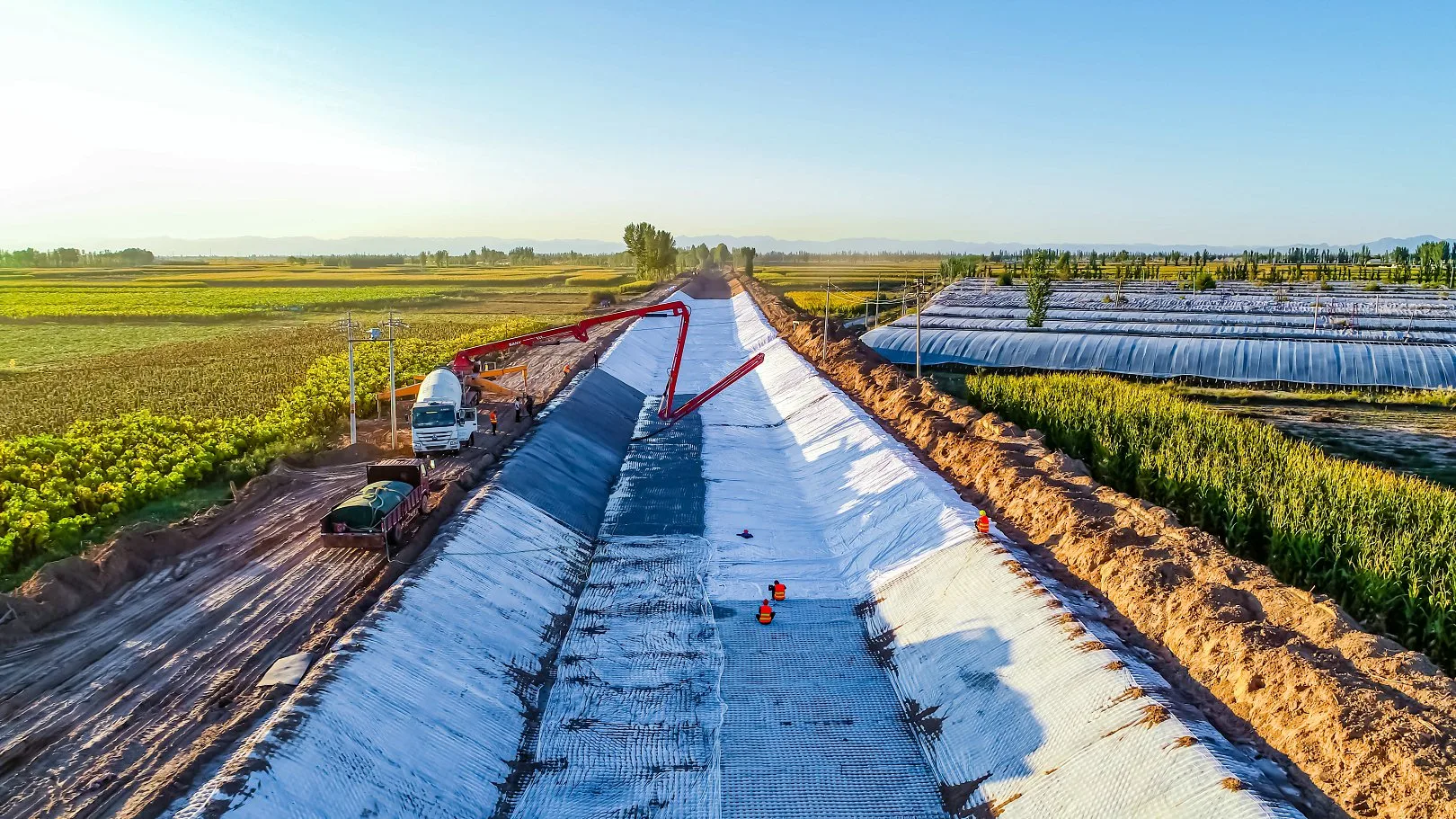
A 100-metre drainage channel can be lined with grouted mattress in one working day — one crew, one pump truck, minimal plant. The 7-day curing period is the only closure required. Precast concrete installation requires crane access alongside the channel, delivery logistics for heavy precast units, and longer closures of the adjacent road lane. For active highway projects, minimum disruption time has significant economic value.
3. Low Manning's n = Higher Hydraulic Capacity
Grouted mattress (n = 0.016–0.020) provides lower Manning's n than riprap (n = 0.030–0.045) or gabions (n = 0.025–0.035), meaning a lined channel carries more flow for the same cross-section. In constrained highway corridors where the channel cannot be widened, upgrading from riprap to grouted mattress can increase hydraulic capacity by 40–60% at the same cross-section dimensions.
Junction and Transition Details
The highest-velocity points in any drainage channel are at transitions — where the channel narrows, where the grade steepens, and at culvert inlets. These transitions require careful detailing to prevent erosion at the junction between lining types:
- Culvert inlet aprons: extend the grouted mattress 1.5–2.0 m upstream of each culvert inlet, matching the culvert floor level. This prevents scour at the inlet that undermines the culvert headwall.
- Grade change points: where channel grade steepens by more than 50%, install an energy dissipation step or plunge pool with a hardened splash pad — grouted mattress or concrete. The step head should be a full-width concrete curtain wall keyed into the channel banks to prevent flow bypassing the step.
- Channel to natural watercourse junction: the last 5–10 m before the channel discharges to a natural watercourse or detention pond should be lined with grouted mattress to prevent outlet scour, even if the main channel length is vegetated.
Design standards: FHWA HEC-15 (Design of Roadside Channels with Flexible Linings) is the primary US design reference for roadside drainage channel lining selection and velocity limits. CIRIA Report C786 provides equivalent guidance for UK and international highway drainage design.
Related: slope protection design for canals and reservoirs and our canal lining methods comparison.
Frequently Asked Questions
Does a roadside drainage channel need a geotextile filter beneath the grouted mattress?
In most roadside drainage channel applications, the GGFM fabric itself serves as the filter between the subgrade and the lining — provided the subgrade D85 particle size satisfies the filter retention criterion against the mattress fabric AOS, tested per relevant ASTM geotextile filtration standards. This should be checked using the project soil gradation data. Where the subgrade is a very fine, gap-graded material susceptible to piping (silt, loess, poorly graded fine sand), a 150 g/m² non-woven geotextile filter beneath the GGFM is specified.
Can grouted mattress be installed in a live drainage channel during rain?
Light rain (<5 mm/hour) is acceptable. Heavy rain should suspend installation — both because the fresh grout can be diluted by runoff on the channel surface, and because safety on the sloped channel walls is compromised. For channels that cannot be isolated from catchment runoff, install a temporary earth berm upstream of the work section to divert flow around the installation area. Remove the berm after curing is complete.
What is the minimum channel width for grouted mattress installation?
Standard GGFM rolls are 2.0 m wide — panels can be trimmed for narrower channels, but the minimum practical width for efficient installation is approximately 0.8 m (allowing the pump nozzle and two workers to fit in the channel). For channels narrower than 0.8 m, precast concrete channel sections are typically more practical than in-situ grouted mattress.
HydroBase supplies grouted mattress for roadside and infrastructure drainage channel lining across highway, railway, airport, and industrial site projects. Request a drainage channel lining assessment — send your channel cross-section, grade, and design discharge and our engineers will specify the correct system within 48 hours.
HydroBase Technical Team
HydroBase manufactures grouted mattresses (GRI GT16 compliant) in China and delivers to 30+ countries. Our engineering team provides specification support, grout mix design, and installation guidance.
About HydroBaseMore Articles
View all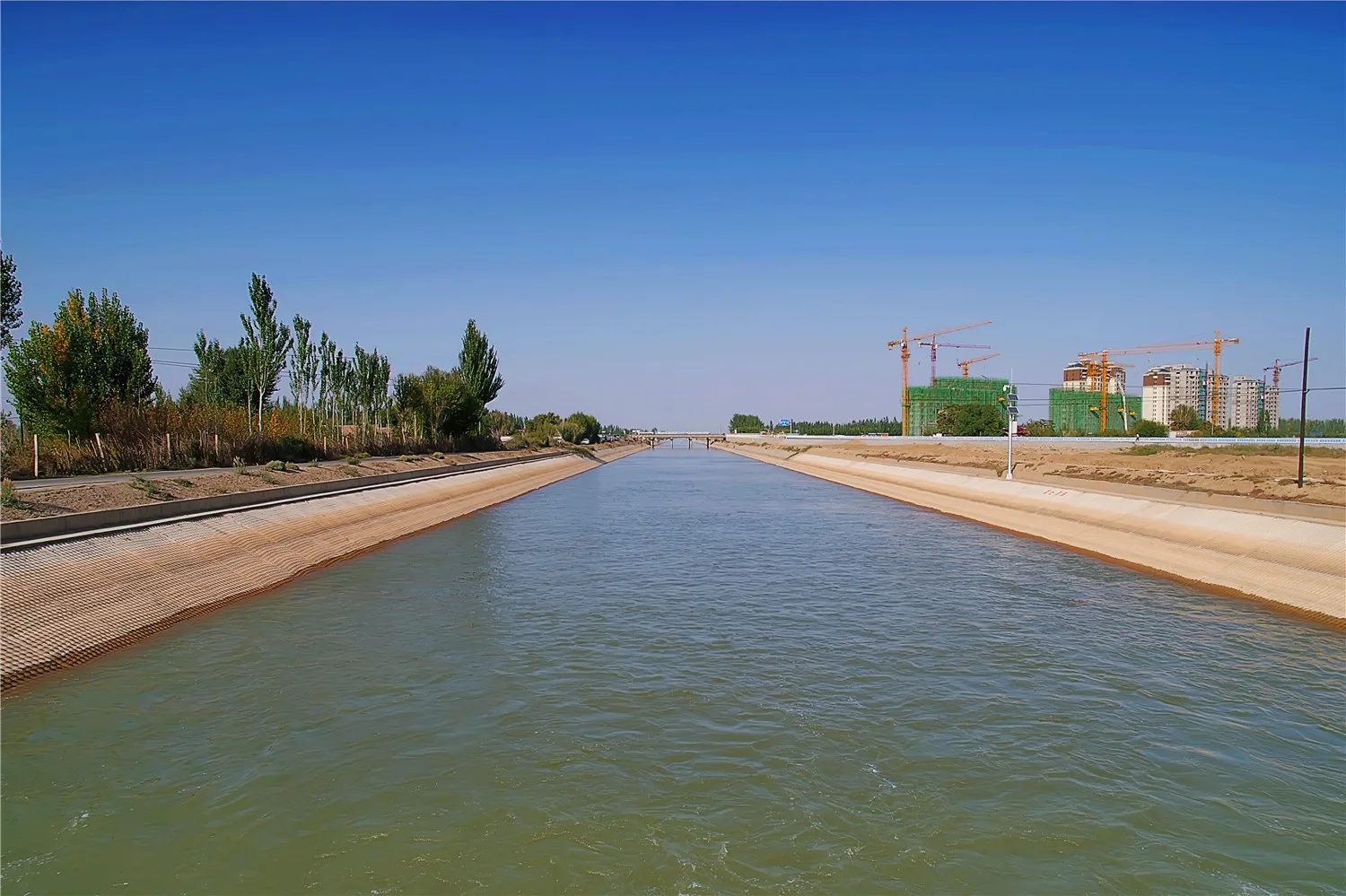
Grouted Mattress Case Studies: 5 Projects, Real Data
Five real grouted mattress installations across canal lining, river bank protection, coastal revetment, reservoir lining, and bridge pier scour — with actual project areas, design parameters, installation programmes, and post-installation performance data.
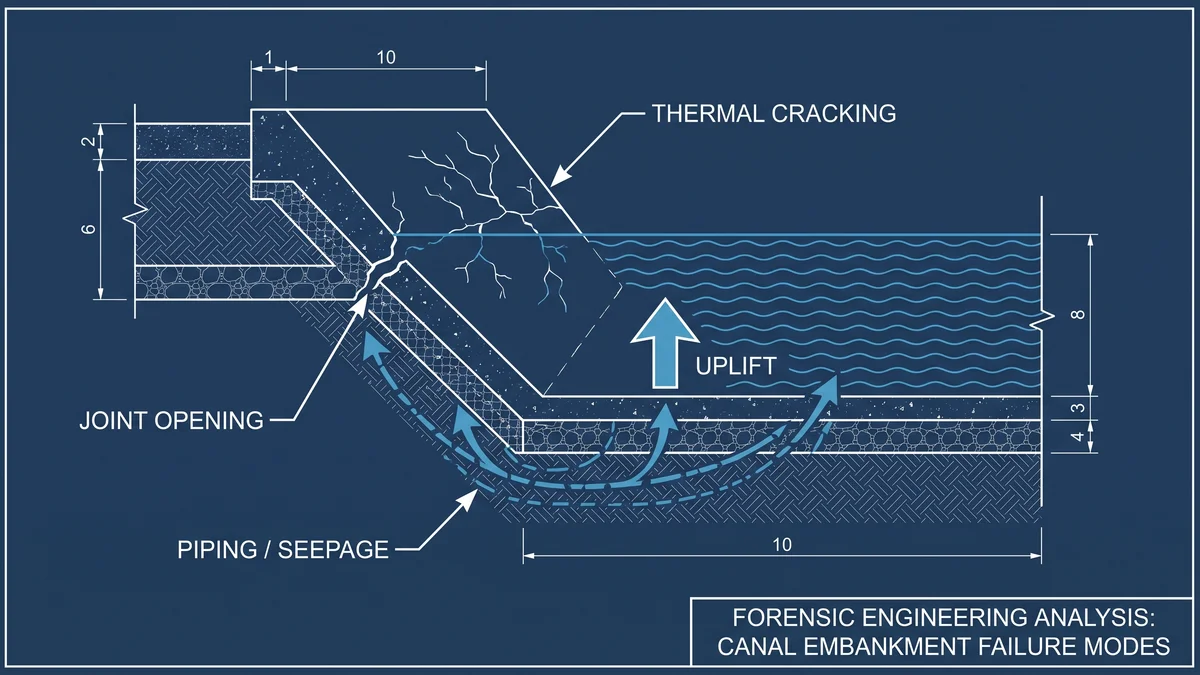
Canal Lining Failure: 7 Causes and How to Prevent Them
Canal lining failures cost irrigation authorities billions annually in emergency repairs and lost water. This forensic guide identifies the 7 most common failure causes — from joint failure to uplift — and explains how to prevent each through better specification and installation.
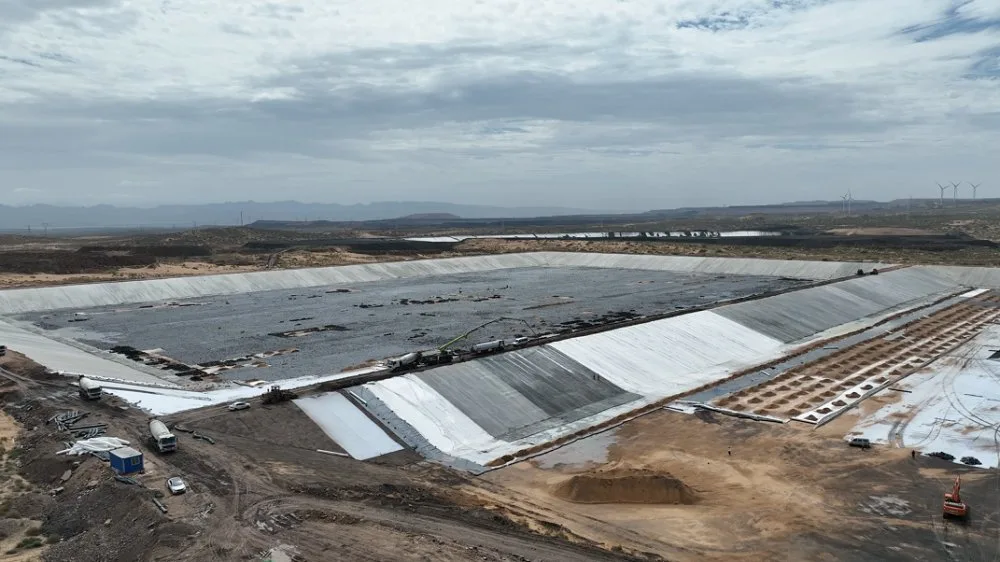
Aquaculture Pond Lining: Safety and Cost Compared
Unlined aquaculture ponds lose 20–40% of water to seepage and suffer high turbidity from bank erosion. This guide compares geomembrane, concrete, and grouted mattress lining for fish ponds and shrimp farms — covering water quality, cost, and fish safety.
HydroBase - China Manufacturer
Ready to Specify Grouted Mattress?
GRI GT16 compliant products, factory test reports included. Engineering support at no cost. 48-hour response.