
When Turf Reinforcement Mat Isn't Enough: TRM vs Vegetated Grouted Mattress
Quick Summary
Turf reinforcement mat is the right choice for low-velocity vegetated slopes — until design velocity or wave action exceeds its limits. This guide explains where TRM stops working and why vegetated grouted mattress takes over.
Quick Answer: Turf reinforcement mat (TRM) is a synthetic or natural-fibre matrix laid over topsoil to reinforce vegetation roots against surface erosion. It performs well up to roughly 1.5–2.0 m/s design velocity once vegetation is established, and costs a fraction of a concrete-based system. Above that velocity — or wherever structural protection is needed before vegetation has time to establish — TRM is undersized, and a structural vegetated system such as vegetated grouted mattress (GGFM) is required. The two are not interchangeable; they serve different points on the same erosion-control spectrum.
Turf reinforcement mat and vegetated grouted mattress both end up looking similar once established — a green, vegetated slope. That similarity causes real specification errors: engineers and landscape contractors sometimes select TRM for a slope that structurally requires a concrete-based system, because the finished appearance is what got compared, not the underlying design velocity and structural capacity.
This guide sets out clearly where TRM is the correct, most cost-effective choice, and where it will fail — sometimes not immediately, but within the first one or two storm seasons before vegetation has fully established. For the broader system comparison, see Erosion Control Blanket vs TRM vs Articulated Concrete Mat.
What Is Turf Reinforcement Mat?
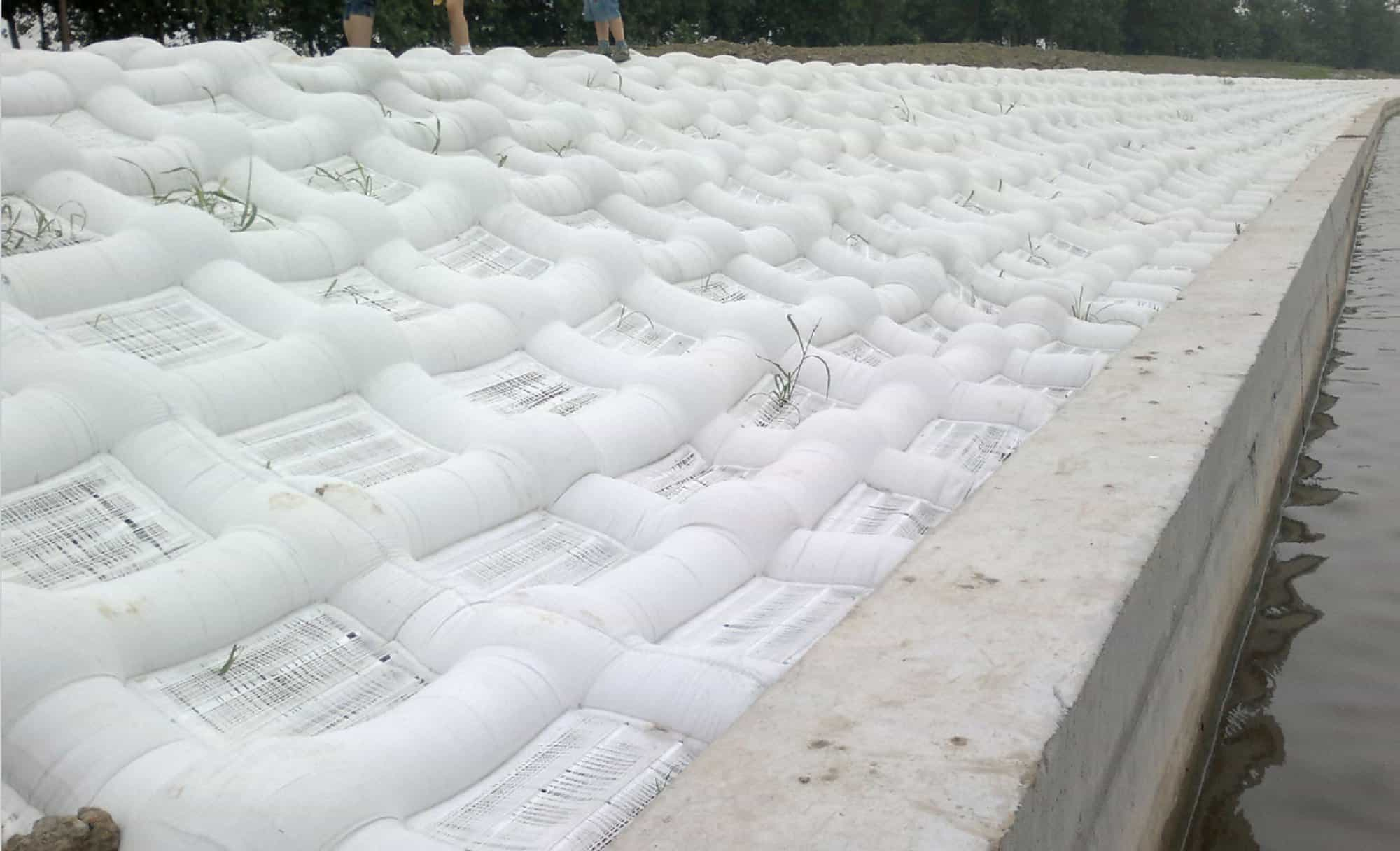
TRM is a three-dimensional matrix — typically UV-stabilised polypropylene or nylon monofilament, sometimes blended with natural coir or straw fibre — installed over prepared topsoil and seed, then pinned or staked to the slope. As grass roots grow through the matrix, the mat and root system combine to resist surface shear stress that would otherwise strip topsoil and seed before establishment — the same principle covered in Purdue Extension's erosion control guidance.
TRM comes in two broad classes:
- Standard TRM — lighter matrix, suited to velocities up to approximately 1.2–1.5 m/s post-vegetation, used on highway embankments, low-gradient channel banks, and general landscape slopes
- High Performance TRM (HPTRM) — heavier, higher-tensile matrix (sometimes combined with a geogrid layer), rated to approximately 1.8–2.0 m/s post-vegetation, used on steeper slopes and higher-flow drainage channels
Critically, both classes rely on vegetation establishment for their design performance. Manufacturer velocity ratings are typically split into an unvegetated (installation-period) limit — often below 1.0 m/s — and a vegetated (long-term) limit. A slope is at its most vulnerable in the weeks between installation and vegetation establishment, which is why TRM specifications always include an installation-period velocity check separate from the long-term rating.
What Is Vegetated Grouted Mattress?
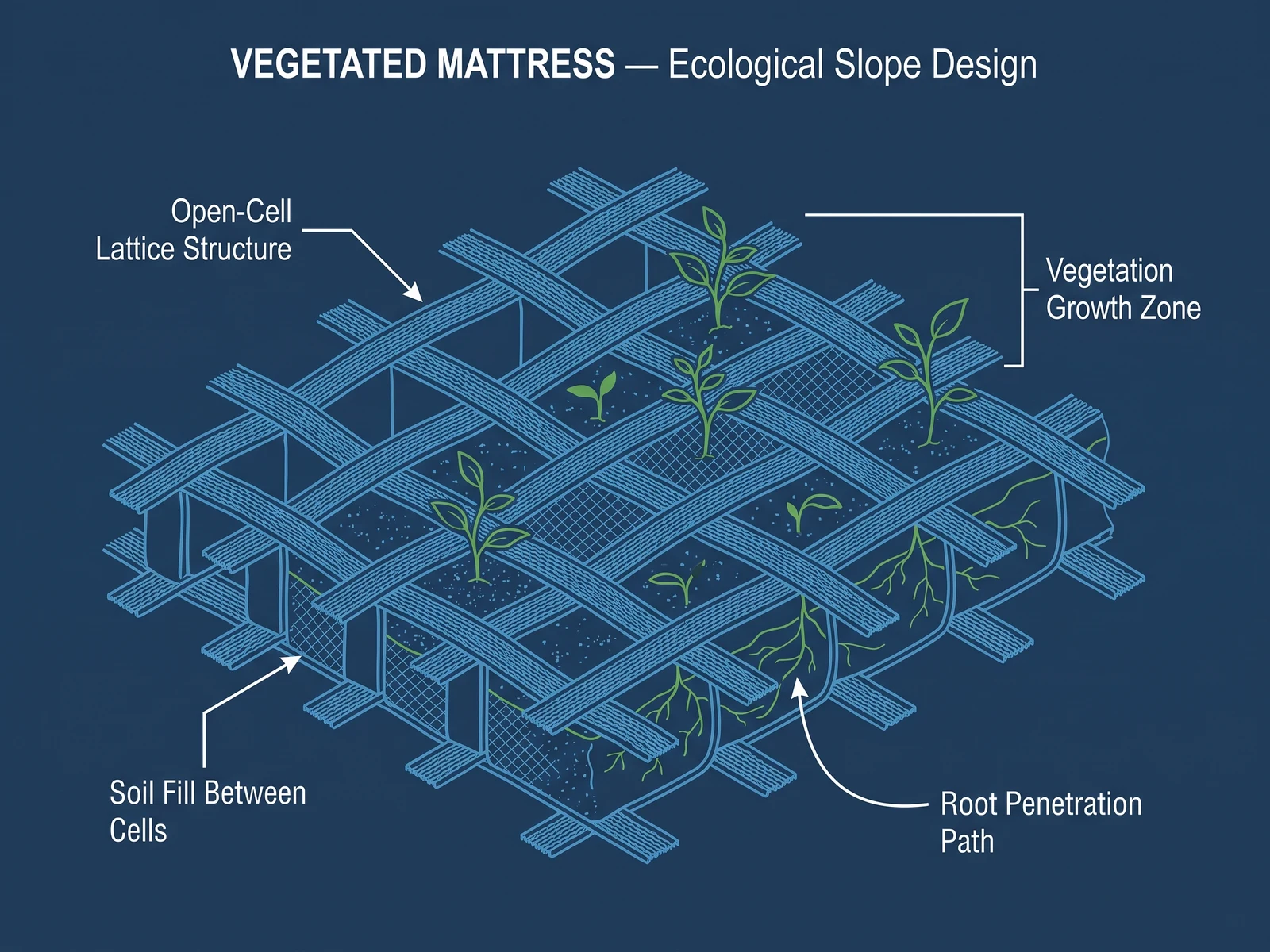
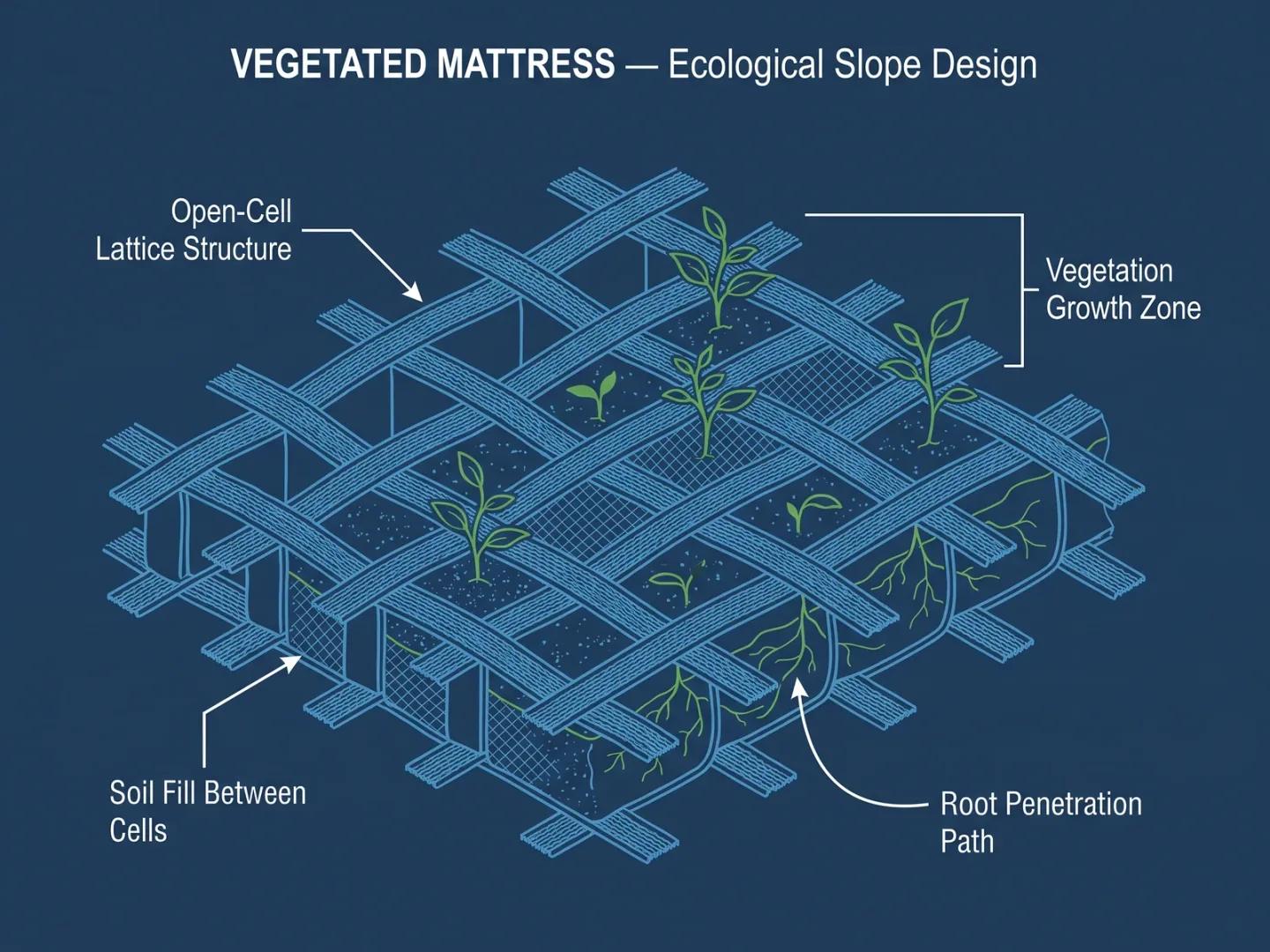
Vegetated GGFM uses the same double-layer woven geotextile and cement grout system as standard grouted mattress, but with a modified cell pattern that leaves open, soil-filled pockets between grouted ribs. Vegetation establishes in the open cells while the surrounding grout matrix provides full structural erosion resistance from the day of installation — independent of whether vegetation has established yet.
This is the fundamental difference: TRM's erosion resistance depends on vegetation; vegetated GGFM's erosion resistance does not. The concrete grid is doing the structural work from day one, and vegetation is layered on top for ecological integration and visual appearance, not for structural performance. The geotextile component of both systems is governed by the same testing framework maintained by the International Geosynthetics Society.
Design Velocity: Where the Crossover Happens
| System | Unvegetated Limit | Vegetated (Long-Term) Limit | Structural From Day One? |
|---|---|---|---|
| Standard TRM | 0.6–1.0 m/s | 1.2–1.5 m/s | No |
| High Performance TRM (HPTRM) | 0.9–1.2 m/s | 1.8–2.0 m/s | No |
| Vegetated Grouted Mattress | Up to 4.0 m/s | Up to 4.0 m/s (unchanged) | Yes |
The practical implication: any slope with sustained design velocity above roughly 2.0 m/s is outside TRM's range regardless of vegetation type or establishment period. Any slope where the construction programme cannot guarantee a full growing season before the first flood risk — even at moderate velocity — is also a poor candidate for TRM, since the unvegetated velocity limit is the one that actually applies during that window.
Cost Comparison
| System | Installed Cost (USD/m²) | Establishment Period Required | Design Life |
|---|---|---|---|
| Standard TRM | $3–$7 | 1–2 growing seasons | 10–15 years |
| HPTRM | $6–$12 | 1–2 growing seasons | 15–20 years |
| Vegetated Grouted Mattress | $26–$42 | None (structural from install) | 50+ years |
TRM is, and should remain, dramatically cheaper for the velocity range it is designed for. Specifying vegetated GGFM on a slope that only ever sees 0.8 m/s flow is over-engineering — the cost premium buys structural capacity the site does not need. The failure mode this article addresses runs the other direction: specifying TRM on a slope that periodically exceeds its rated velocity, usually because the design velocity was estimated from average conditions rather than the storm-event peak that actually does the damage.
How to Decide
- Design velocity consistently below 1.2 m/s, low-consequence site, construction timing allows a full growing season before flood risk: Standard TRM is the correct, most economical choice.
- Design velocity 1.2–2.0 m/s, or a growing season is not guaranteed before first flood exposure: HPTRM, evaluated carefully against the unvegetated velocity limit for the installation window.
- Design velocity above 2.0 m/s, any wave action or flow reversal, or a high-consequence site (dam face, flood embankment, bridge approach) where failure during establishment is unacceptable: vegetated grouted mattress. Structural protection cannot be deferred to "after the grass grows in."
- Ecological requirement is present but velocity is genuinely low: TRM remains preferable on cost grounds — do not default to GGFM purely because it is the more robust system on paper.
Frequently Asked Questions
Can TRM and vegetated grouted mattress be used together on the same slope?
Yes, on slopes with variable exposure — for example, a channel bank where the toe experiences sustained higher velocity and the upper bank experiences only occasional overtopping flow. Vegetated GGFM on the toe transitioning to TRM on the upper bank is a common and cost-effective hybrid design, provided the transition detail prevents undermining at the interface.
Does vegetated grouted mattress need irrigation during establishment, like TRM does?
Typically less. Because the concrete grid is already providing full erosion protection, there is no structural urgency around achieving fast vegetation cover, so establishment can proceed on natural rainfall in most climates. TRM projects, by contrast, often specify a temporary irrigation plan precisely because vegetation speed is structurally critical during the establishment window.
Is TRM suitable for underwater or permanently submerged applications?
No. TRM depends on vegetation growth, which requires the slope to be above the waterline for at least part of the establishment period. For permanently or frequently submerged slopes, use standard or filter point grouted mattress rather than either TRM or vegetated GGFM. See the EPA's riparian/wetland management guidance for the ecological considerations that inform this choice on riparian slopes.
Send us your design velocity, slope geometry, and vegetation requirement and the HydroBase engineering team will confirm whether TRM, HPTRM, or vegetated grouted mattress is the correct specification for your site — within 48 hours.
HydroBase Technical Team
HydroBase manufactures grouted mattresses (GRI GT16 compliant) in China and delivers to 30+ countries. Our engineering team provides specification support, grout mix design, and installation guidance.
About HydroBaseMore Articles
View all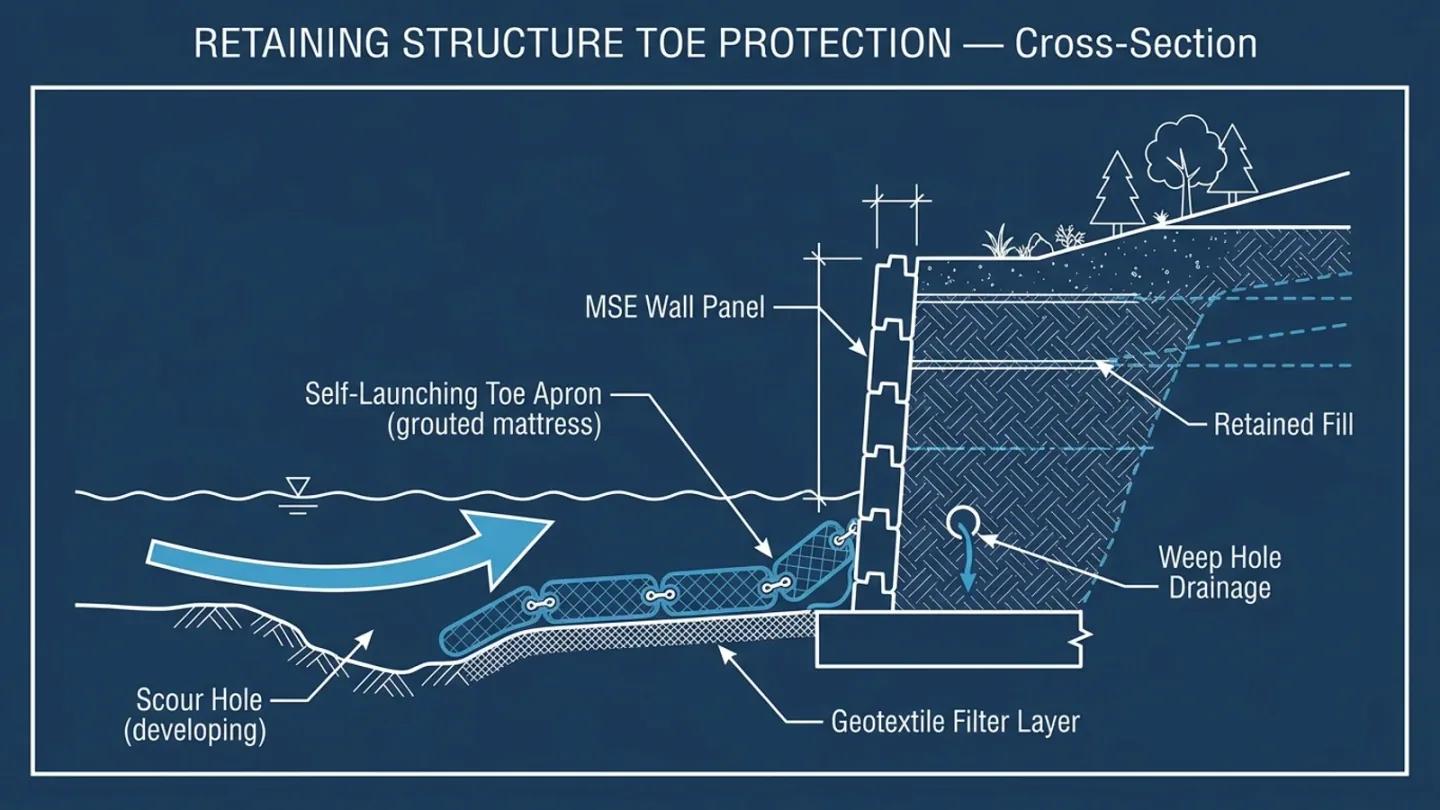
Erosion Control for Engineered Retaining Structures: MSE Walls, Canal Retaining, and Dam Toe Protection
Retaining structures fail more often from toe erosion and drainage problems than from the wall itself. This guide covers erosion control design at MSE walls, canal retaining structures, and dam toes.
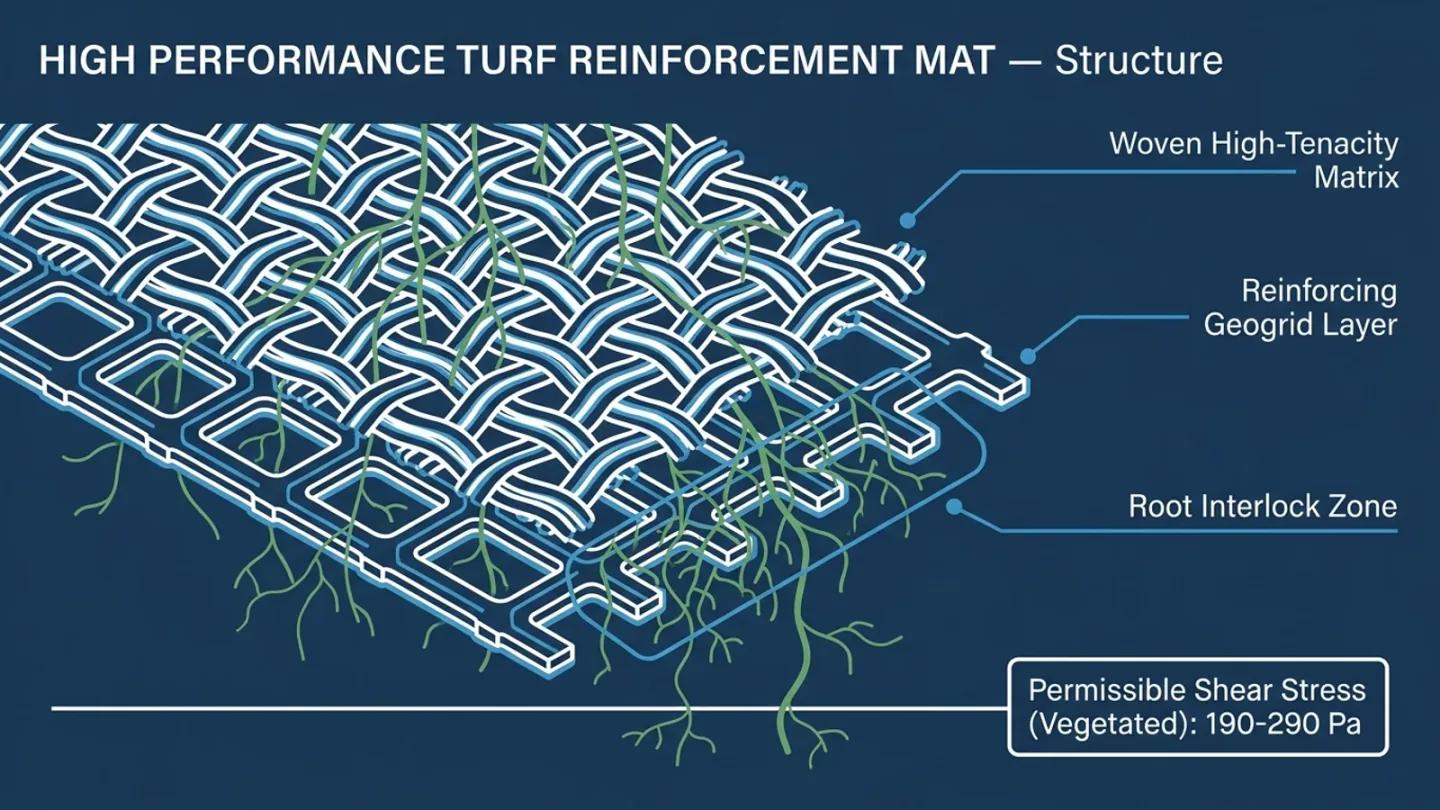
High Performance Turf Reinforcement Mat (HPTRM): Design and Specification Guide
High performance turf reinforcement mat extends vegetated erosion control into higher-velocity channels than standard TRM can handle. This guide covers the shear stress design method, matrix types, and specification requirements.
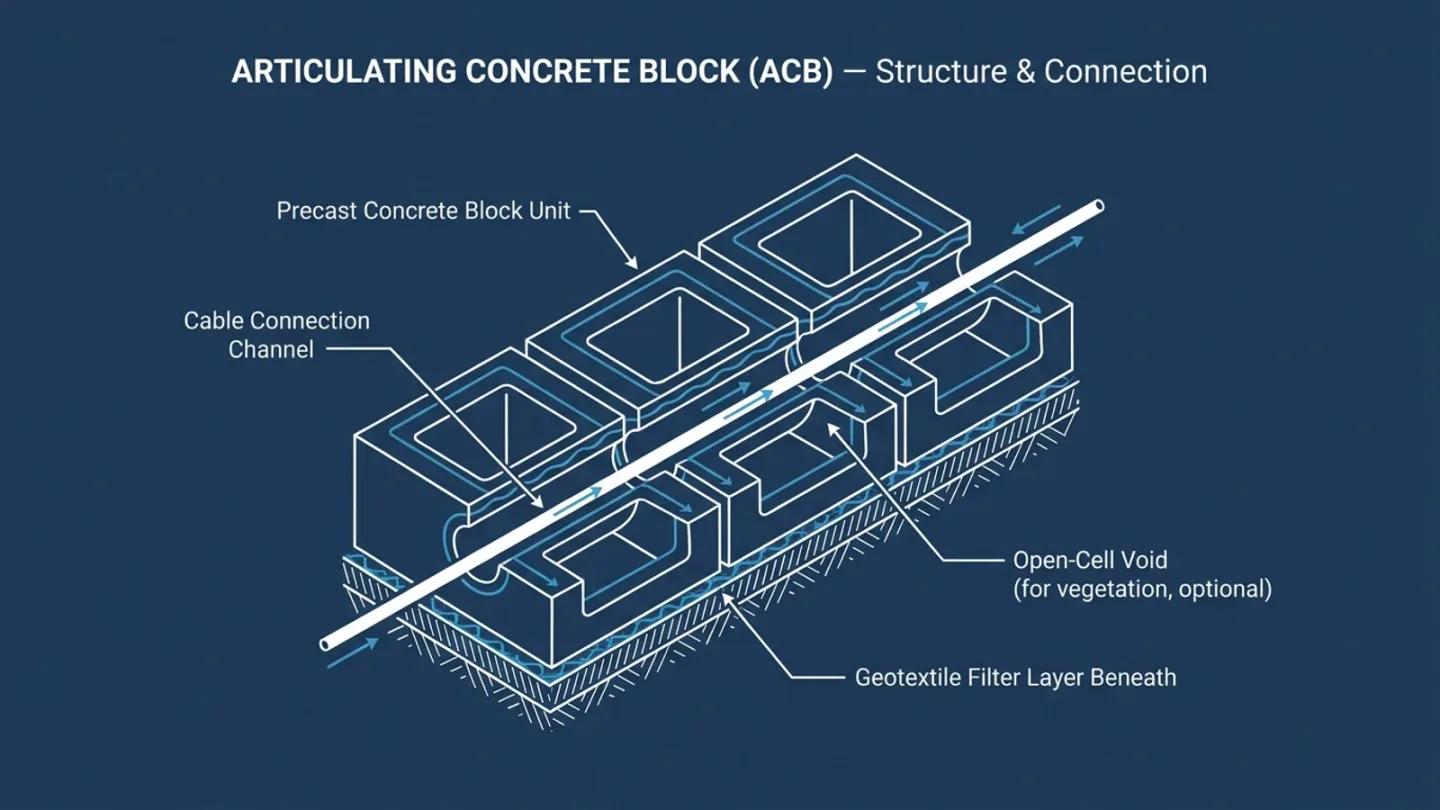
Articulating Concrete Block (ACB): Types, Cost, Specifications, and When to Choose It Over Grouted Mattress
Articulating concrete block (ACB) is a precast alternative to grouted mattress, connected by cables or geotextile through cast openings. This guide covers block types, costs, specification, and when each system is the better fit.
HydroBase - China Manufacturer
Ready to Specify Grouted Mattress?
GRI GT16 compliant products, factory test reports included. Engineering support at no cost. 48-hour response.