
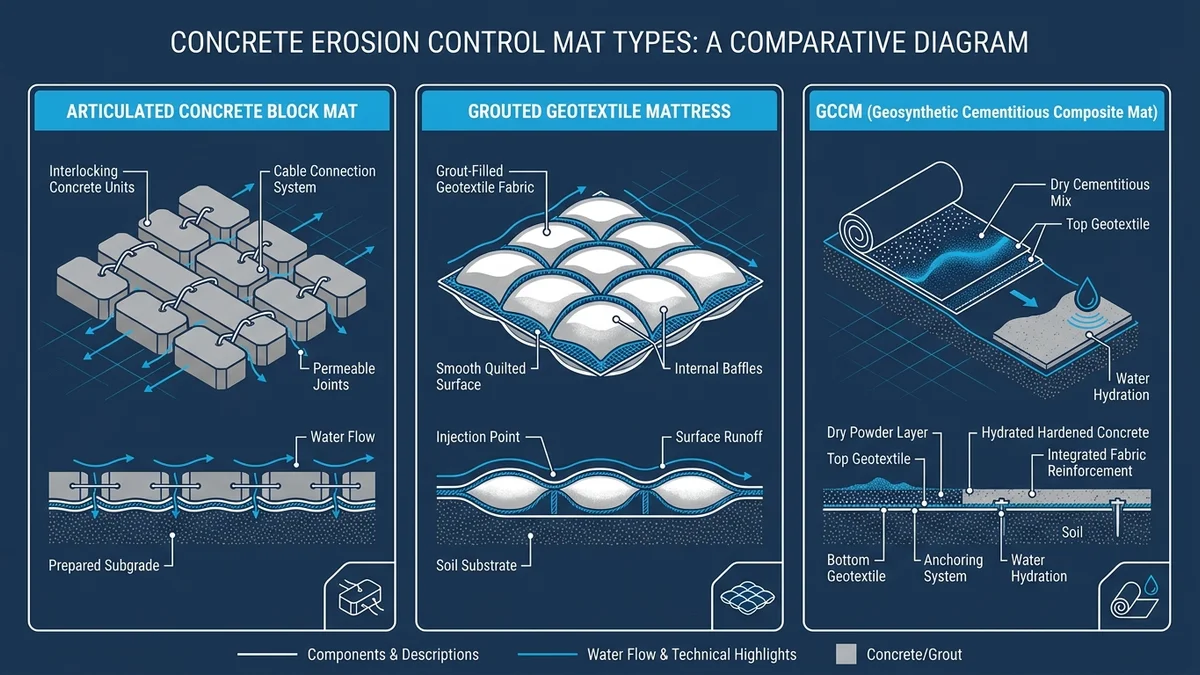
Concrete Erosion Control Mats: Types & Choice
Quick Summary
Concrete erosion control mats protect channels, slopes, and riverbanks from scour and erosion. This guide compares articulated concrete mats, grouted mattress, and GCCM systems — with selection criteria by application.
Quick Answer: Concrete erosion control mats are flexible concrete systems — either pre-grouted panels or fabric-filled mattresses — that protect slopes, channels, and riverbanks from erosion. The three main types are articulated concrete block mats, grouted geotextile mattresses (GGFM/ACM), and geosynthetic cementitious composite mats (GCCM). Selection depends on flow velocity, installation environment, and whether the site can be dewatered.
When rip-rap, grass, or geosynthetic turf reinforcement fails to hold against high-velocity flow or wave action, engineers specify a concrete erosion control mat. These systems deliver the hydraulic resistance of concrete with the installation flexibility of a rolled geotextile — a combination that makes them the dominant solution for large-scale hydraulic protection in Asia, the Middle East, and increasingly in Europe and North America.
This guide explains the three main concrete mat systems, compares their technical performance, and provides a straightforward decision framework for selecting the right system for your project.
What Are Concrete Erosion Control Mats?
A concrete erosion control mat is any flexible concrete system that can be deployed on a slope or channel surface and provides resistance to hydraulic shear stress, wave action, or surface runoff erosion. Unlike rigid concrete slabs, concrete mats articulate at panel joints — they tolerate settlement, conform to irregular surfaces, and do not crack under differential movement.
The term covers several distinct products:
- Articulated concrete block mat (ACB mat) — precast concrete blocks interlocked or tied into a mat with cables or geotextile backing
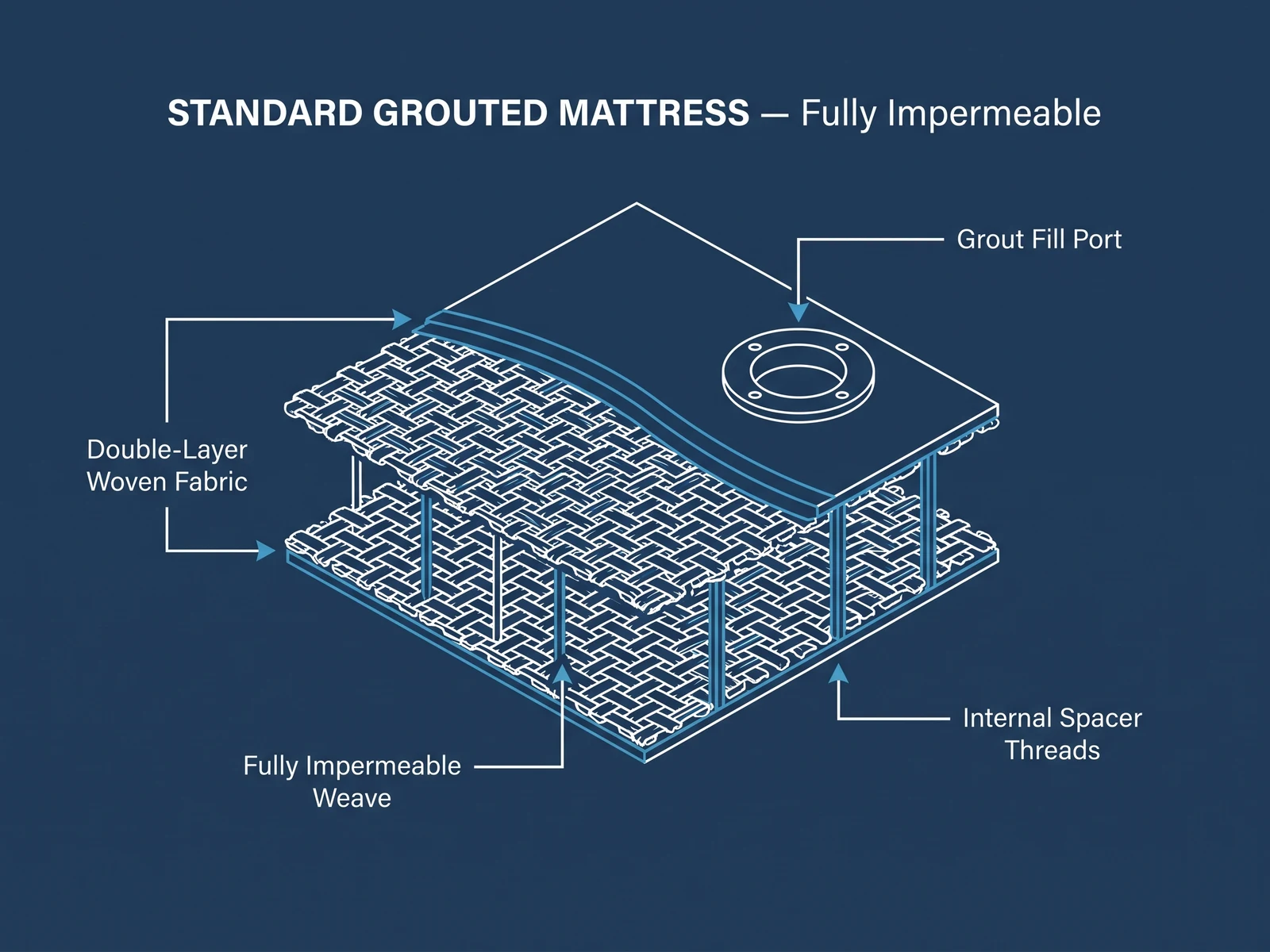
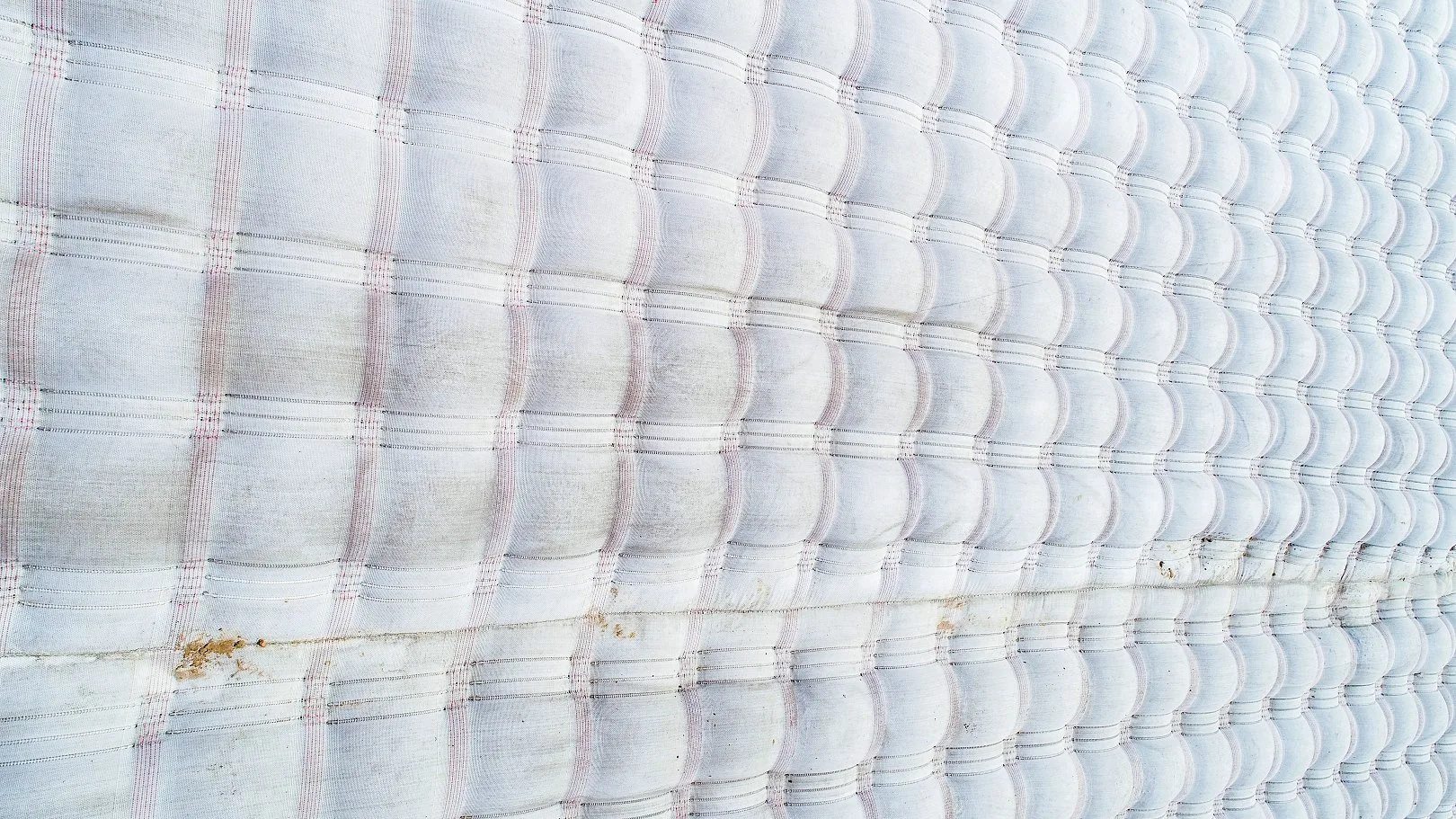
- Grouted geotextile mattress (GGFM/ACM) — double-layer woven fabric filled with cement grout on site
- Geosynthetic cementitious composite mat (GCCM) — thin pre-hydrated concrete fabric, activated with water on site
What Are the Three Main Types of Concrete Erosion Control Mat?
| Property | Articulated Concrete Block Mat | Grouted Mattress (GGFM/ACM) | GCCM |
|---|---|---|---|
| Max flow velocity | 3.0–4.5 m/s | Up to 6.0 m/s | Up to ~2.0 m/s |
| Thickness | 75–300 mm blocks | 50–200 mm filled | 5–13 mm |
| Underwater install | Crane placement, difficult | Yes — up to 10 m depth | Limited |
| Quality standard | ASTM D6684 / PIANC | GRI GT16 | Proprietary / no universal standard |
| Installation equipment | Crane, barge (large panels) | Standard concrete pump truck | Water hose only |
| Dewatering required | Usually yes | No | No |
| Design life | 30–50 years | 50+ years (GRI GT16) | 20–30 years |
| Filter / drainage variant | Open-cell blocks | Filter point GGFM | Not available |
Why Is Grouted Mattress the Highest-Performance Concrete Erosion Mat?
For projects requiring high flow-velocity resistance, underwater installation, or a large-area solution without crane plant, the articulated concrete mattress (GGFM) is the correct specification. It delivers the highest hydraulic performance of any concrete mat system, installs on live rivers and tidal sites without dewatering, and is governed by an internationally recognised quality standard — GRI GT16.
HydroBase manufactures three variants of grouted mattress to cover every hydraulic erosion control application:
- Standard GGFM — fully impermeable; for canals, river banks, slope protection, and reservoir facing
- Filter Point GGFM — drainage ports at cell intersections; for tidal zones, coastal revetment, and artesian conditions where hydrostatic uplift must be relieved
- Vegetated GGFM — open-cell fabric allows vegetation establishment; for ecological slopes and amenity riverbanks
Which Concrete Mat Should You Use for Each Erosion Type?
Which Mat Works Best for Canal and Channel Bed Erosion?
High-velocity flow in unlined irrigation canals and drainage channels removes fine-grained material from the channel bed and banks, widening the channel and reducing conveyance efficiency. A concrete erosion control mat — typically 75–150 mm GGFM — eliminates bed scour and side-slope erosion while maintaining the designed cross-section. See Canal Lining.
Which Mat Is Best for River Bank Protection?
River banks erode during flood events when high-velocity flow attacks the bank toe. The grouted mattress installs on the bank face with the river flowing — no coffer dam required. It conforms to the bank profile, fills existing scour voids, and locks together as a continuous flexible revetment rated to 6.0 m/s. This makes it the most cost-effective concrete mat for live-river bank protection. See River Bank Protection.
Which Mat Is Recommended for Coastal and Tidal Erosion?
Wave action and tidal scour erode seawall foundations, embankment toes, and beach dune faces. Impermeable mats fail in tidal zones due to hydrostatic uplift when the tide recedes. The filter point grouted mattress eliminates this failure mode — drainage ports at cell intersections equalise pressure across the tidal cycle. See Coastal Revetment.
Which Mat Is Used for Bridge Pier Scour Protection?
Scour around bridge piers removes bed material and undermines foundations — the leading cause of bridge failure worldwide. An articulated concrete mattress collar, installed around the pier at bed level, prevents localised scour by resisting the accelerated flow that develops around the pier obstruction. Installs underwater without traffic disruption. See Bridge Pier Scour Protection.
How to Choose the Right Concrete Erosion Control Mat
| Your Site Condition | Recommended System |
|---|---|
| Flow velocity > 3.0 m/s | Grouted mattress (GGFM/ACM) — only concrete mat rated above 3.0 m/s at practical thicknesses |
| Tidal or artesian site | Filter point GGFM — drainage ports prevent hydrostatic uplift failure |
| Underwater installation required | Grouted mattress (GGFM) — only system rated for submerged grouting at depth |
| Ecological requirement (vegetation) | Vegetated GGFM or open-cell ACB mat — allows root establishment |
| Small drainage channel, low velocity | GCCM (Concrete Canvas or equivalent) — thin, rapid-install for minor channels |
| Large precast units preferred | Articulated concrete block mat — crane-placed panels for large exposed coastal works |
Related: revetment mattress vs riprap comparison and our slope protection methods comparison guide.
Standards: ASTM D7572 covers standard practice for the classification of soil erosion control products. The GRI GT16 standard applies specifically to grouted geotextile mattress systems.
Frequently Asked Questions
What is a concrete mat used for in civil engineering?
A concrete mat (or concrete erosion control mat) is used to protect slopes, channel beds, riverbanks, and coastal structures from erosion caused by water flow, wave action, or rainfall. The flexible format allows it to conform to irregular surfaces and tolerate settlement without cracking — unlike rigid concrete slabs. Common applications include canal lining, river bank revetment, coastal protection, and bridge pier scour collars.
Is a grouted mattress the same as an articulated concrete mat?
Yes — the terms refer to the same system. "Articulated concrete mat" (ACM) is the preferred term in North America and Australia. "Grouted mattress" or "grouted geotextile mattress" (GGFM) is the standard term in the UK, Asia, and Africa. Both describe a double-layer woven geotextile filled with cement grout on site. The governing quality standard — GRI GT16 — uses the GGFM terminology.
What is a flex mat in erosion control?
A flex mat (or flexible concrete mat) is a broad term for any concrete erosion control mat that articulates at panel joints rather than forming a rigid slab. This includes grouted geotextile mattresses, articulated concrete block mats, and GCCM systems. The key advantage of all flex mat systems over poured concrete is their ability to conform to irregular surfaces and tolerate post-construction settlement without cracking.
How long does a concrete erosion control mat last?
Grouted mattress systems (GGFM/ACM) manufactured to GRI GT16 have a 50+ year design life with no maintenance. The polypropylene geotextile fabric is inert to UV, chemicals, and seawater. Articulated concrete block mats typically specify 30–50 years. GCCM systems carry 20–30 year design lives depending on manufacturer specification. In all cases, design life is subject to correct installation and product quality — GRI GT16 test compliance is the most reliable procurement safeguard.
HydroBase manufactures grouted mattress (GGFM/ACM) concrete erosion control mats to GRI GT16 at our 150,000 m² factory in Inner Mongolia. 48-hour dispatch. Third-party test reports with every shipment. Request a quote or download technical specifications.
HydroBase Technical Team
HydroBase manufactures grouted mattresses (GRI GT16 compliant) in China and delivers to 30+ countries. Our engineering team provides specification support, grout mix design, and installation guidance.
About HydroBaseMore Articles
View all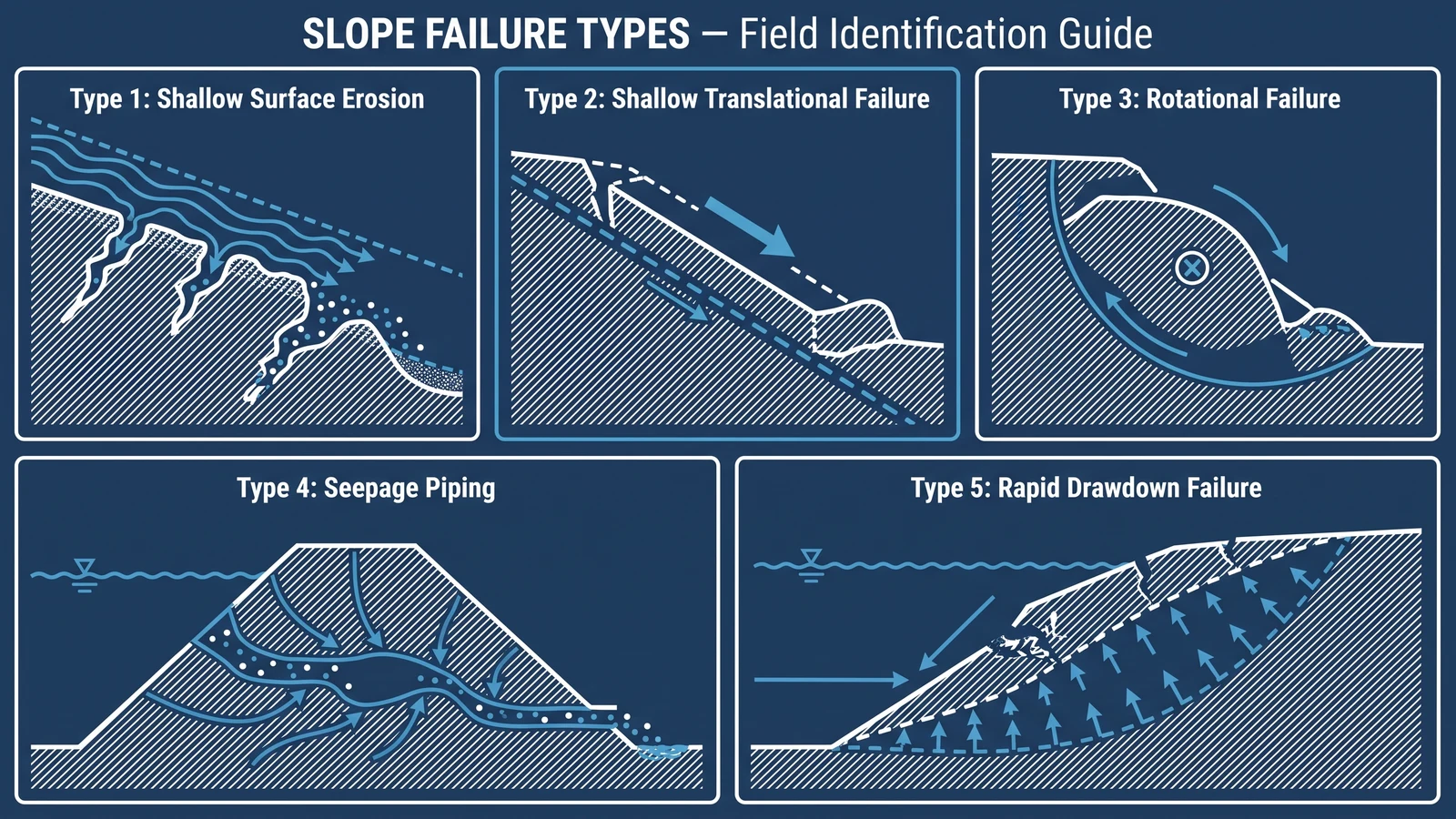
Slope Failure Causes and Prevention: Field Guide
Slope failures on canal embankments, reservoir faces, and road cuttings follow recognisable patterns. This field guide covers the five main slope failure types — shallow surface erosion, shallow translational, rotational, piping, and rapid drawdown — with prevention measures for each.
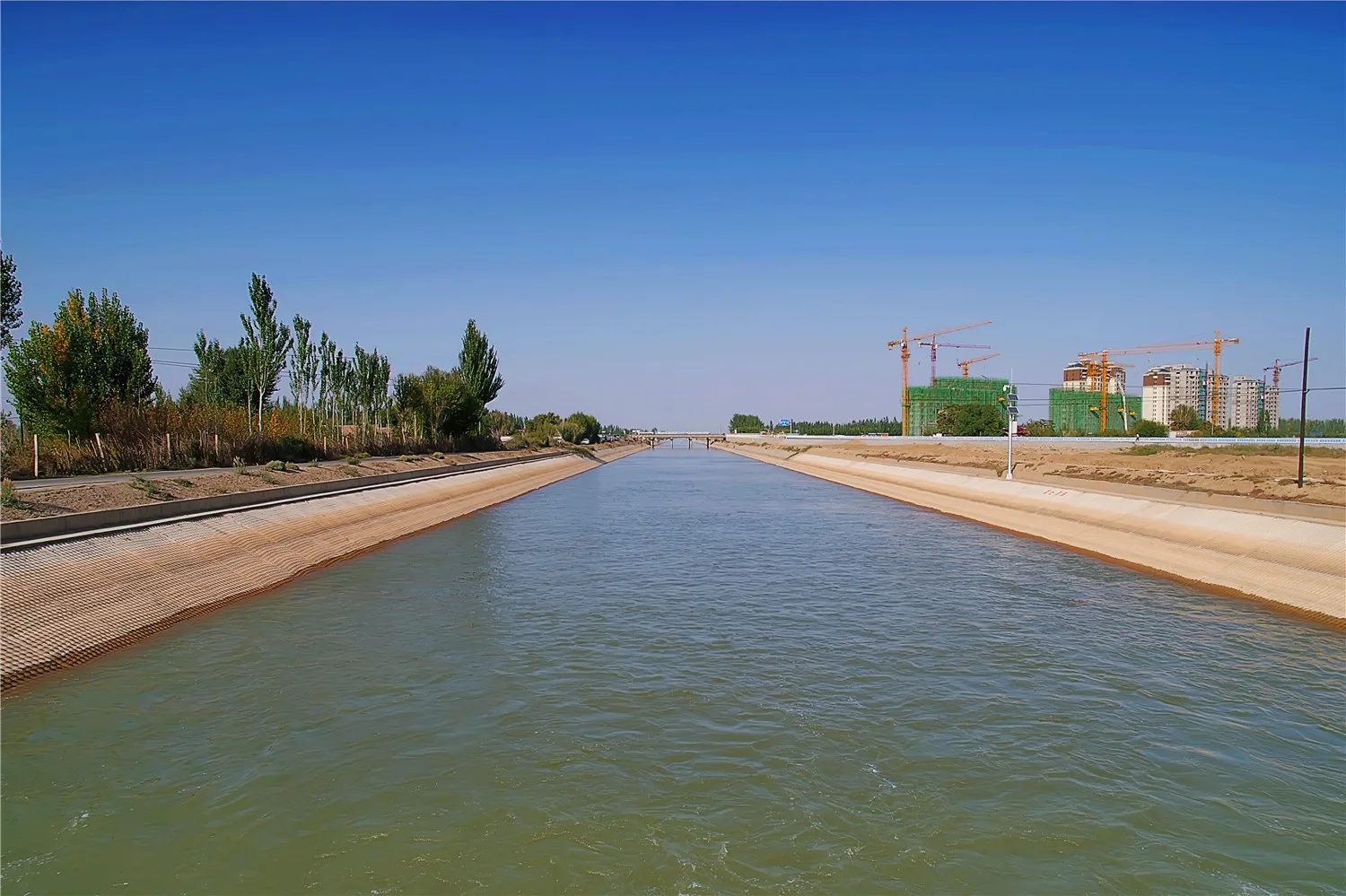
Grouted Mattress Case Studies: 5 Projects, Real Data
Five real grouted mattress installations across canal lining, river bank protection, coastal revetment, reservoir lining, and bridge pier scour — with actual project areas, design parameters, installation programmes, and post-installation performance data.
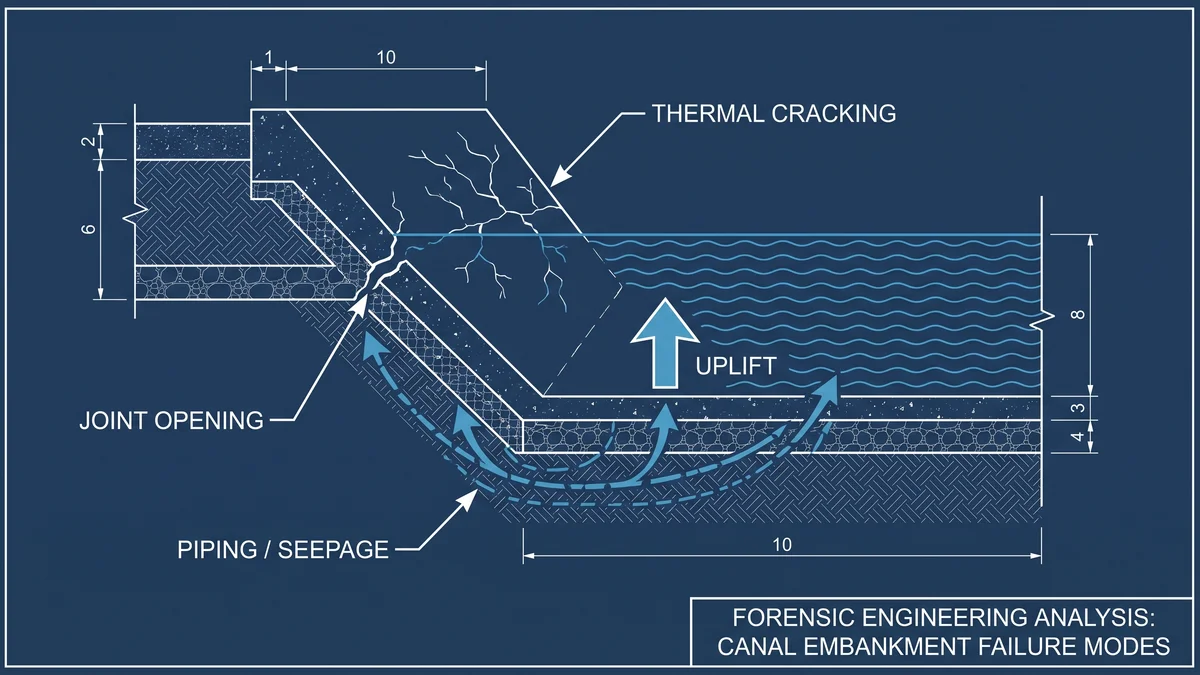
Canal Lining Failure: 7 Causes and How to Prevent Them
Canal lining failures cost irrigation authorities billions annually in emergency repairs and lost water. This forensic guide identifies the 7 most common failure causes — from joint failure to uplift — and explains how to prevent each through better specification and installation.
HydroBase - China Manufacturer
Ready to Specify Grouted Mattress?
GRI GT16 compliant products, factory test reports included. Engineering support at no cost. 48-hour response.